![Courtesan Riding a Carp (parody of the Daoist Immortal Kinko [Chinese: Qin Gao]) by Suzuki Harunobu — Japanese Color woodblock print; hashira-e, c. 1768/69](https://www.artic.edu/iiif/2/bf16d632-3d70-9de0-48a4-cc40c6f03358/full/843,/0/default.jpg)
Courtesan Riding a Carp (parody of the Daoist Immortal Kinko [Chinese: Qin Gao])
- Date:
- c. 1768/69
- Medium:
- Color woodblock print; hashira-e
- Source:
- Art Institute of Chicago
Description
Courtesan Riding a Carp, parody of the Daoist Immortal Kinko (Chinese: Qin Gao), a Suzuki Harunobu print of 1763 in the Art Institute of Chicago, takes a celebrated Chinese subject and remakes it as Edo mitate. According to legend, the Daoist sage Qin Gao, known in Japan as Kinko, rode out of a river on the back of a giant carp after a sojourn beneath the water with the dragon king. Harunobu replaces the bearded sage with an elegant courtesan, the slender woman perched gracefully astride the great fish as it breaches a stylized wave. The transformation is both witty and reverent, depending on viewers' familiarity with the original iconography while celebrating the beauty as a contemporary equivalent of the immortal. Such mitate-e were central to the visual culture of mid-eighteenth-century Edo, where refined townspeople delighted in spotting the literary or pictorial templates underlying everyday scenes. Produced at the threshold of the full nishiki-e revolution, the print uses careful registration to set the courtesan's patterned robe against the carp's blue-green body and the white spray of the wave. The figure's narrow shoulders, small oval face, and slightly tilted head exemplify Harunobu's Edo bijin-ga ideal, while the carp's vigorous form supplies a dramatic counterweight that the artist rarely permits in his interior scenes. Edo viewers would have recognized the parody as both a witty inversion of Chinese sage imagery and a celebration of the floating world's claim to its own pantheon of immortals. The Art Institute of Chicago's catalogue entry documents this impression among Harunobu's important early-1760s parodies that demonstrate his contribution to the mitate tradition that would define his mature output.
More Prints by Suzuki Harunobu

Two Women Washing Their Hair
c. 1767/68
Color woodblock print; chuban

Parody of Kawachi-goe from "Tales of Ise"
1765
Color woodblock print; right sheet of chuban diptych (left sheet: 1925.2025)

Young Man Holding Umbrella Beside a Fence
c. 1767/68
Color woodblock print; chuban

Going to the Theater
c. 1770/71
Color woodblock print; chuban
More Fish Prints


Frequently Asked Questions
Courtesan Riding a Carp (parody of the Daoist Immortal Kinko [Chinese: Qin Gao]) was created by Suzuki Harunobu (鈴木春信) in c. 1768/69.
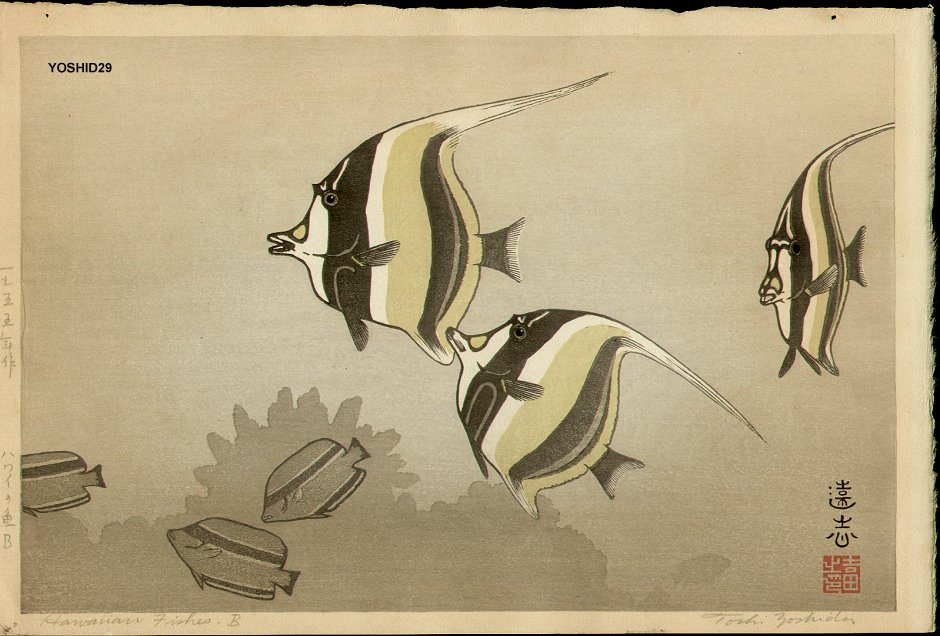
Courtesan Riding a Carp (parody of the Daoist Immortal Kinko [Chinese: Qin Gao]) depicts fish.