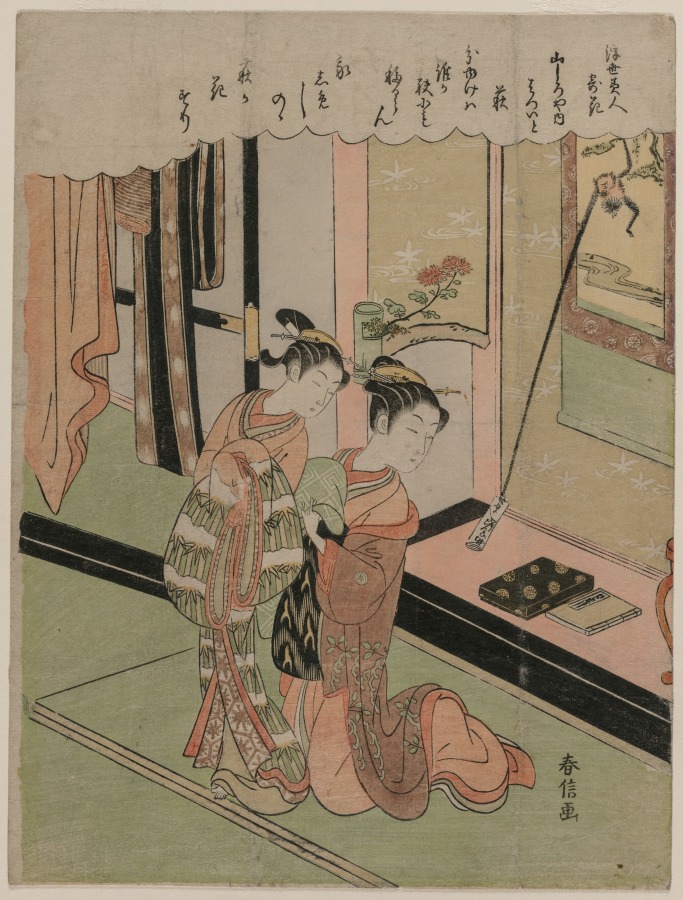
Hatsuito of the Yamashiroya Likened to Bush Clover, from Beauties of the Floating World Compared to Flowers
- Date:
- 1769–70
- Medium:
- color woodblock print
- Source:
- Cleveland Museum of Art
Description
Hatsuito of the Yamashiroya Likened to Bush Clover comes from Suzuki Harunobu's Beauties of the Floating World Compared to Flowers, a series in which each celebrated courtesan of the Yoshiwara is paired with a seasonal blossom. The print, dated 1769 and held in the Cleveland Museum of Art (accession 1916.1157), pairs Hatsuito, a courtesan of the Yamashiroya house, with hagi (bush clover), an autumn flower beloved in waka poetry. Harunobu draws Hatsuito with the slender, attenuated grace that became the canonical bijin-ga ideal of the 1760s, her body small-headed and willowy beneath layered robes whose patterns are rendered through carefully registered color blocks. As one of the founding masters of nishiki-e, the full-color 'brocade prints' that revolutionized Edo printmaking from 1765, Suzuki Harunobu used the new technique to enrich character portraits like this one with delicate gradations of pink, green, and ochre, transforming what would once have been an austere monochrome design into a luxuriant image of fashion and reputation. The series exemplifies the close commercial relationship between ukiyo-e publishers and the licensed pleasure quarters: prints functioned as visual catalogues of the Yoshiwara's stars, raising the cultural profile of named courtesans like Hatsuito while also feeding the literary game of comparing women to flowers. As a single sheet, the work shows how Harunobu fused Edo bijin-ga, classical poetic association, and the technical sophistication of nishiki-e into an elegant whole.
More Prints by Suzuki Harunobu

Two Women Washing Their Hair
c. 1767/68
Color woodblock print; chuban

Parody of Kawachi-goe from "Tales of Ise"
1765
Color woodblock print; right sheet of chuban diptych (left sheet: 1925.2025)

Young Man Holding Umbrella Beside a Fence
c. 1767/68
Color woodblock print; chuban

Going to the Theater
c. 1770/71
Color woodblock print; chuban
More Birds & Flowers Prints
Frequently Asked Questions
Hatsuito of the Yamashiroya Likened to Bush Clover, from Beauties of the Floating World Compared to Flowers was created by Suzuki Harunobu (鈴木春信) in 1769–70.
Hatsuito of the Yamashiroya Likened to Bush Clover, from Beauties of the Floating World Compared to Flowers depicts birds & flowers.