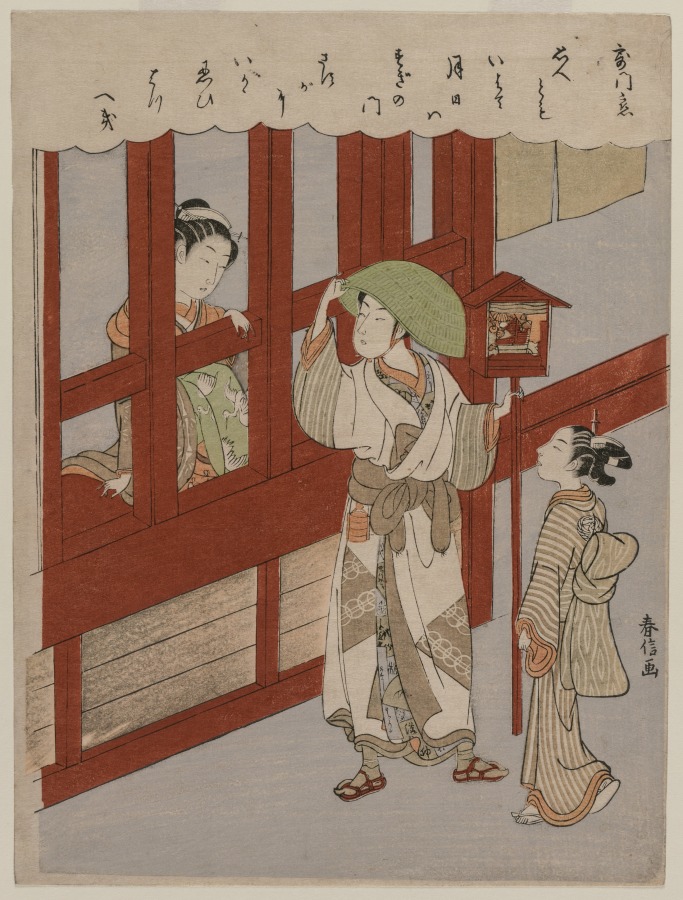
Love at the Brothel Gate
- Date:
- late 1760s
- Medium:
- color woodblock print
- Source:
- Cleveland Museum of Art
Description
Love at the Brothel Gate, dated 1760 and preserved in the Cleveland Museum of Art, is a relatively early Suzuki Harunobu design that anticipates the themes he would refine throughout the decade. The scene unfolds near the threshold of one of Edo's licensed pleasure houses, where a young couple meets, parts, or speaks with the discretion that such public-private boundaries required. Brothel gates in Edo were not merely commercial portals but charged social spaces, places of arrival, leave-taking, and small encounters that supplied the urban culture of the floating world with much of its emotional texture. Harunobu's chuban-format composition focuses on the figures themselves, with the gate or lintel providing a quiet architectural frame. The drawing is characteristic of his earlier manner, before the full polychrome resources of nishiki-e came on line: line carries much of the descriptive load, color is held in a restrained register, and the figures' slender bodies and gentle inclinations of head already announce his mature interest in the small intimacies of urban life. Within the broader development of Edo ukiyo-e, the print marks one of Harunobu's early ventures into a subject matter, the pleasure quarter as a setting for tender private feeling, that he and his contemporaries would continue to refine throughout the 1760s.
More Prints by Suzuki Harunobu

Two Women Washing Their Hair
c. 1767/68
Color woodblock print; chuban

Parody of Kawachi-goe from "Tales of Ise"
1765
Color woodblock print; right sheet of chuban diptych (left sheet: 1925.2025)

Young Man Holding Umbrella Beside a Fence
c. 1767/68
Color woodblock print; chuban

Going to the Theater
c. 1770/71
Color woodblock print; chuban
Frequently Asked Questions
Love at the Brothel Gate was created by Suzuki Harunobu (鈴木春信) in late 1760s.