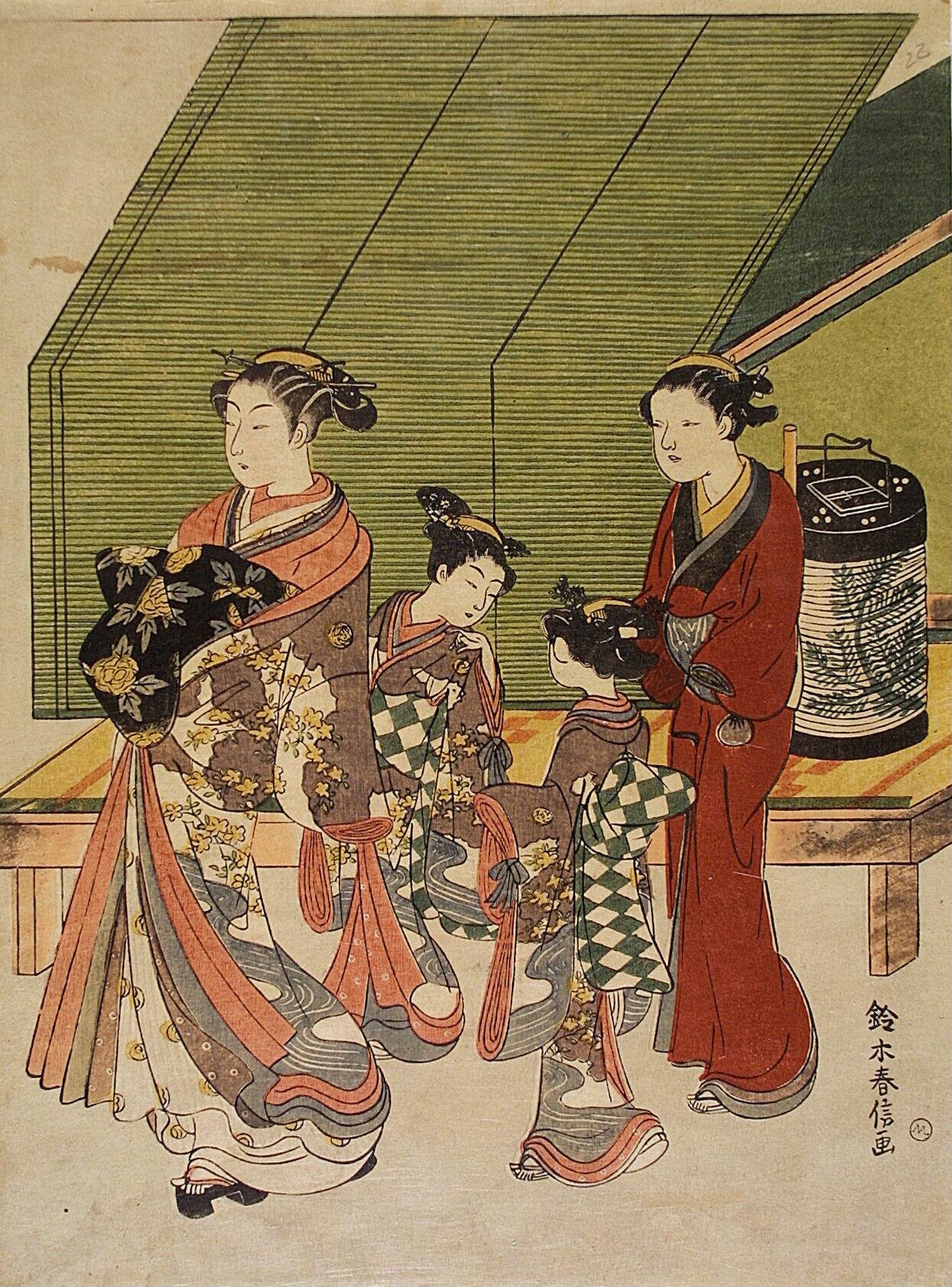
Parading Courtesan with Attendants
- Date:
- late 1760s
- Medium:
- Source:
- Victoria and Albert Museum
Description
Parading Courtesan with Attendants, dated about 1760 and held by the Victoria and Albert Museum, depicts the elaborate dochu procession through which a high-ranking Yoshiwara courtesan displayed herself to the public. Suzuki Harunobu shows the central figure, her hair piled high with elaborate combs and pins, walking on tall geta whose forward tilt requires the slow, deliberate eight-figure step for which such processions were famous. Two kamuro, the young attendants in matching robes who accompanied a tayu, walk on either side, while a third figure follows behind. The composition is condensed into a tight vertical arrangement that emphasizes the verticality of the courtesan's coiffure and the sweep of her trailing garments. The print predates the 1765 nishiki-e revolution that Suzuki Harunobu would soon help inaugurate, and its color range is therefore more limited than the full polychromatic palette of his later masterpieces, relying on the soft pinks, greens, and grays of the late benizuri-e period. As a defining contributor to Edo bijin-ga, Harunobu used Yoshiwara processions less as ethnographic record than as occasions for staging ideal feminine elegance, and this early sheet shows how thoroughly his sense of slender figures, restrained gesture, and rhythmic compositional intervals was already formed before the chromatic possibilities of nishiki-e were available to him.
More Prints by Suzuki Harunobu

Two Women Washing Their Hair
c. 1767/68
Color woodblock print; chuban

Parody of Kawachi-goe from "Tales of Ise"
1765
Color woodblock print; right sheet of chuban diptych (left sheet: 1925.2025)

Young Man Holding Umbrella Beside a Fence
c. 1767/68
Color woodblock print; chuban

Going to the Theater
c. 1770/71
Color woodblock print; chuban
Frequently Asked Questions
Parading Courtesan with Attendants was created by Suzuki Harunobu (鈴木春信) in late 1760s.