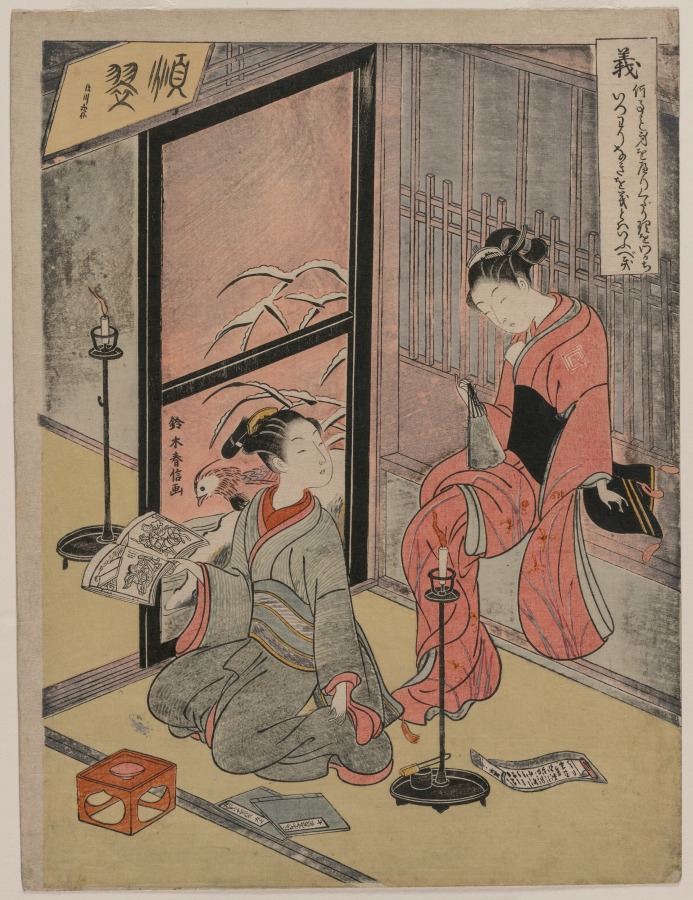
Righteousness, from The Five Virtues
- Date:
- 1767
- Medium:
- color woodblock print
- Source:
- Cleveland Museum of Art
Description
Righteousness, from The Five Virtues, dated 1767 in the Cleveland Museum of Art, is one sheet from Suzuki Harunobu's series translating the Confucian cardinal virtues — benevolence, righteousness, propriety, wisdom, and faithfulness — into vignettes of contemporary Edo life. Rather than illustrate the abstract concept directly, Harunobu personifies righteousness through a small, observed moment between fashionable young women, leaving the moral content to be inferred from gesture, gaze, and setting. Issued near the height of the nishiki-e boom that he helped initiate in 1765, the print uses subtle gradations of pink, blue, and ochre, register that depends on precisely cut blocks and disciplined printing. Harunobu's slender, doll-like figures, soft contours, and quiet domestic spaces are exactly the formula that made his Edo bijin-ga so influential; here that style is bent toward a didactic program more often associated with painting or book illustration. The series reflects the broader Edo taste for finding classical and ethical references inside scenes of urban modernity, allowing buyers to enjoy the prints both as decoration and as gentle moral commentary. The Cleveland Museum of Art's impression preserves the careful color separations and the unblemished paper that allow viewers to read Suzuki Harunobu's design at its intended pitch of refinement.
More Prints by Suzuki Harunobu

Two Women Washing Their Hair
c. 1767/68
Color woodblock print; chuban

Parody of Kawachi-goe from "Tales of Ise"
1765
Color woodblock print; right sheet of chuban diptych (left sheet: 1925.2025)

Young Man Holding Umbrella Beside a Fence
c. 1767/68
Color woodblock print; chuban

Going to the Theater
c. 1770/71
Color woodblock print; chuban
Frequently Asked Questions
Righteousness, from The Five Virtues was created by Suzuki Harunobu (鈴木春信) in 1767.