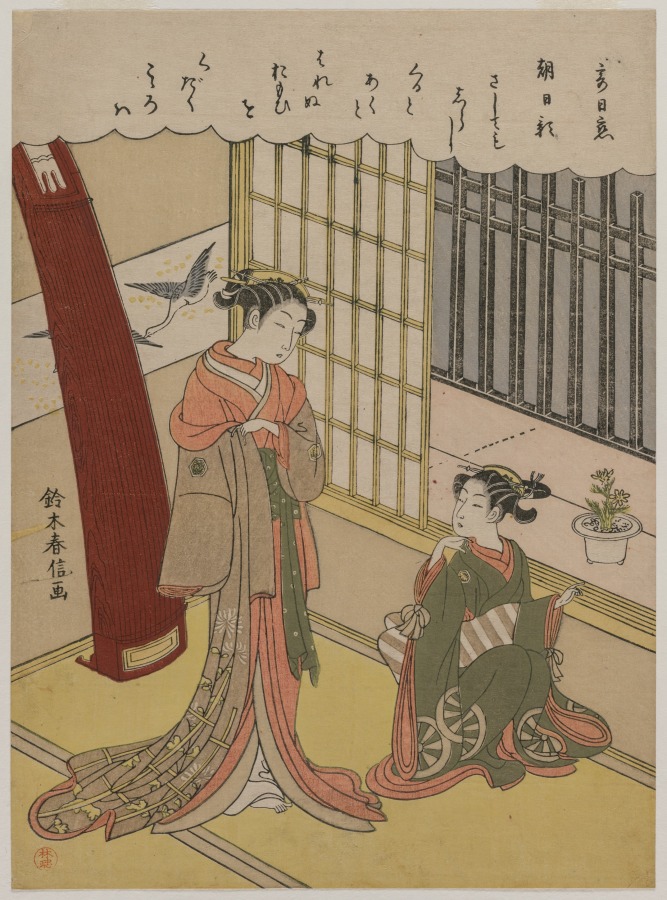
Woman and Maid Servant
- Date:
- late 1760s
- Medium:
- color woodblock print
- Source:
- Cleveland Museum of Art
Description
Woman and Maid Servant is a print by Suzuki Harunobu, dated around 1760 and held in the collection of the Cleveland Museum of Art. The composition pairs a refined young woman with her attendant in a quiet moment of daily life, the kind of intimate, low-key subject that Harunobu transformed into one of the defining themes of Edo bijin-ga, the genre devoted to images of beautiful women in the floating world of Edo (modern Tokyo). The slender, willowy figures with their small features and elongated limbs are characteristic of the idealized type Harunobu invented in the 1760s and that quickly became the dominant model for ukiyo-e portraiture of women. The dated context places this work near the threshold of the technical revolution that Harunobu would help lead. By the middle of that decade he was producing the first full-color nishiki-e, or brocade prints, in which multiple carefully registered woodblocks built up complex layered palettes of pinks, greens, yellows, and grays on heavy hosho paper. Even where the printing here is comparatively restrained, the design anticipates that direction: the mistress and maid are arranged so that their robes set up a quiet rhythm of pattern against plain ground, encouraging a viewer to read the social relationship of the pair as much through cloth and posture as through facial expression. The Cleveland Museum of Art's accession of this sheet places it among the strong American holdings of early Harunobu, and the page on clevelandart.org under the accession number 1921.336 documents the impression and its place in the development of Suzuki Harunobu's mature manner of Edo bijin-ga.
More Prints by Suzuki Harunobu

Two Women Washing Their Hair
c. 1767/68
Color woodblock print; chuban

Parody of Kawachi-goe from "Tales of Ise"
1765
Color woodblock print; right sheet of chuban diptych (left sheet: 1925.2025)

Young Man Holding Umbrella Beside a Fence
c. 1767/68
Color woodblock print; chuban

Going to the Theater
c. 1770/71
Color woodblock print; chuban
Frequently Asked Questions
Woman and Maid Servant was created by Suzuki Harunobu (鈴木春信) in late 1760s.