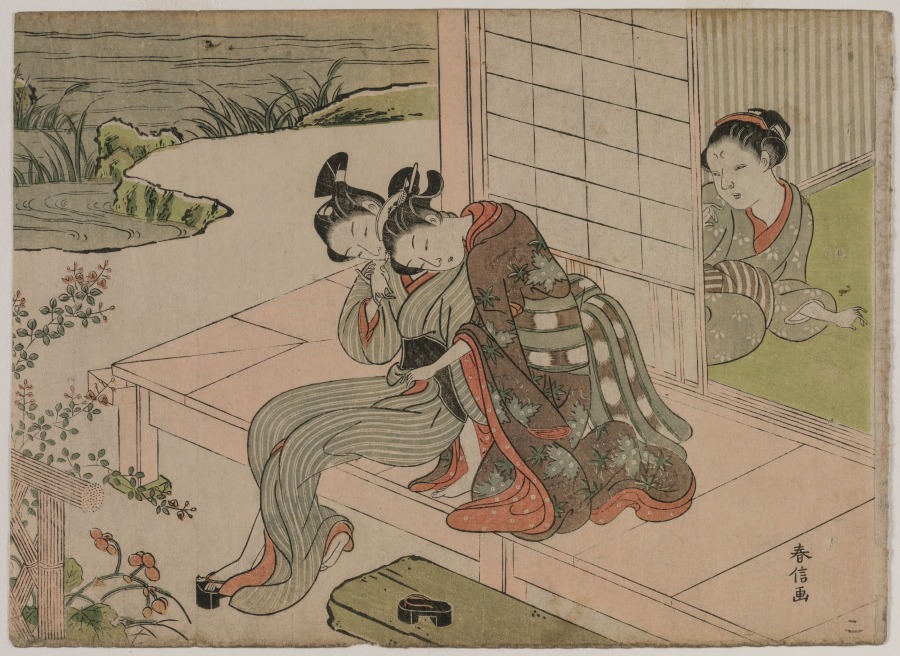
Woman Watching Young Couple Embrace on a Veranda
- Date:
- late 1760s
- Medium:
- color woodblock print
- Source:
- Cleveland Museum of Art
Description
Woman Watching Young Couple Embrace on a Veranda, dated to about 1767 and held by the Cleveland Museum of Art, exemplifies Suzuki Harunobu's interest in layered emotional scenes within domestic interiors. The print presents three figures across two registers of attention: in the foreground a young couple leans together on a wooden veranda, while behind them a third young woman, possibly a maidservant, watches with quiet curiosity. The architecture is rendered in spare, geometric lines, with the railing of the veranda separating the lovers from the garden beyond. Harunobu uses the third figure as a surrogate for the viewer, drawing attention to the act of looking itself and complicating the otherwise straightforward romantic vignette. By 1767 the artist was at the height of his powers, working entirely within the new nishiki-e technique whose development he had helped accelerate two years earlier, and the print displays his fully realized polychromatic palette of soft pinks, greens, and ochres. As the defining figure of Edo bijin-ga in the late 1760s, Suzuki Harunobu specialized in precisely this kind of psychologically charged interior, in which the relationships between figures are encoded through subtle differences of pose and gaze rather than through any overt narrative caption. The result is a print that rewards slow attention, asking viewers to consider not only the central embrace but the more ambiguous, knowing presence of the watcher beyond.
More Prints by Suzuki Harunobu

Two Women Washing Their Hair
c. 1767/68
Color woodblock print; chuban

Parody of Kawachi-goe from "Tales of Ise"
1765
Color woodblock print; right sheet of chuban diptych (left sheet: 1925.2025)

Young Man Holding Umbrella Beside a Fence
c. 1767/68
Color woodblock print; chuban

Going to the Theater
c. 1770/71
Color woodblock print; chuban
Frequently Asked Questions
Woman Watching Young Couple Embrace on a Veranda was created by Suzuki Harunobu (鈴木春信) in late 1760s.