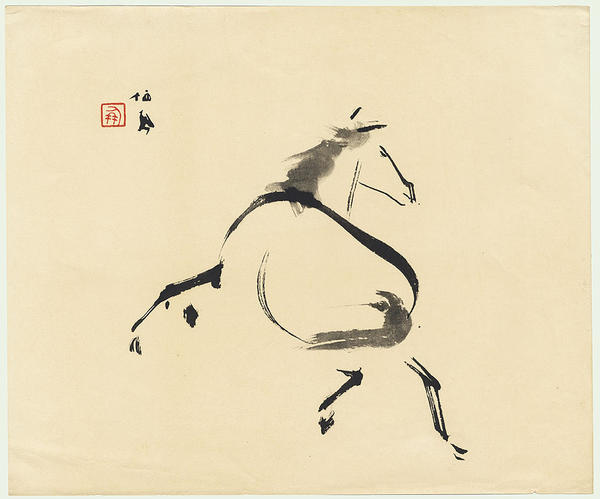
Galloping Horse
駆ける馬
- Medium:
- Color woodblock print
Description
Galloping Horse, no year recorded, is a vertical print of approximately 46 by 39 cm catalogued by the Japanese Art Open Database (image at https://ukiyo-e.org/image/jaodb/Takeuchi_Seiho-No_Series-Galloping_Horse-00042817-110109-F06), showing a single horse in full gallop rendered in brushy strokes that resemble sumi ink painting. The print is among Takeuchi Seihō's most virtuosic brush demonstrations: the horse's body is built up almost entirely from dilute ink wash, with sharp strokes defining the mane, tail, and hooves, and very little in the way of color accent. The composition belongs to the same family as the Horse plate of the Seihō Jūnishi zodiac album but is an independent design, larger and more atmospheric, probably produced as a stand-alone print by Unsōdō or a related Kyoto publisher in the late 1910s or 1920s. The horse was a subject Seihō refined across decades of practice, beginning with his Maruyama-Shijō training under Kōno Bairei in the 1880s, deepened by direct observation of European cavalry horses during his 1900-1901 tour of Paris, Berlin, and other European centers, and consolidated into one of his signature motifs through the 1910s and 1920s. The galloping horse in particular became one of his recognized signatures, the brush-line speed of the design making it a vehicle for demonstrating the synthesis of Western naturalist anatomical observation with the calligraphic economy of Kyoto Shijō brush practice. The Japanese Art Open Database describes the work as 'an attractive design' with the figure rendering 'in brushy strokes resembling a sumi ink painting' and notes that the print is in good condition. As a design it stands among the clearest documents of Seihō's post-European nihonga manner.
More Prints by Takeuchi Seihō


Frequently Asked Questions
Galloping Horse (駆ける馬) was created by Takeuchi Seihō (竹内栖鳳).