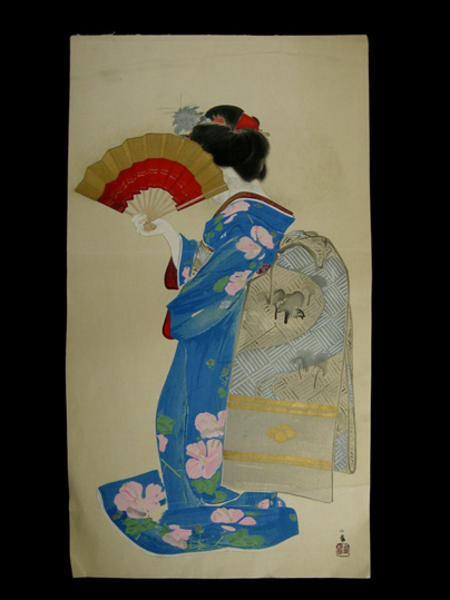
Maiko
舞妓
- Medium:
- Color woodblock print
Description
Maiko (舞妓), no year recorded, depicts an apprentice geisha of the Kyoto pleasure quarters in a vertical impression of approximately 41 by 23 cm catalogued by the Japanese Art Open Database (image at https://ukiyo-e.org/image/jaodb/Takeuchi_Seiho-No_Series-Maiko-00039136-060407-F06). The print is one of Takeuchi Seihō's relatively rare bijin designs, the genre of beautiful-women painting that his most famous pupil Uemura Shōen would build into a major nihonga subgenre over the following decades. The subject of the apprentice geisha — distinguished from a full geiko by her long hanging obi (darari-no-obi), her elaborate hairstyle adorned with seasonal hana-kanzashi ornaments, and her white-painted face — was a defining motif of early-twentieth-century Kyoto painting, and Seihō produced several painted treatments of maiko alongside this print design. The composition is vertical and full-figure, with the maiko's heavy embroidered kimono and the long swing of her obi defined in fluid line and color; Seihō's red signature-seal anchors the composition. The maiko was a quintessentially Kyoto subject, observed at the height of her formal training in the geisha districts of Gion, Pontochō, and Miyagawachō, each of which retained its own hair-ornament conventions, kimono styles, and dance schools — distinctions that a Kyoto painter of Seihō's standing would have noted with precision. The treatment shows Seihō applying his Maruyama-Shijō brush training — calibrated line, observed posture, restrained color — to a contemporary urban subject rather than the bird, animal, or landscape motifs more often associated with his name, and it carries forward the broader nihonga project of using the inherited Kyoto idiom to address recognizably modern Kyoto life. The Japanese Art Open Database notes the print is in good condition with some fold marks.
More Prints by Takeuchi Seihō


Frequently Asked Questions
Maiko (舞妓) was created by Takeuchi Seihō (竹内栖鳳).