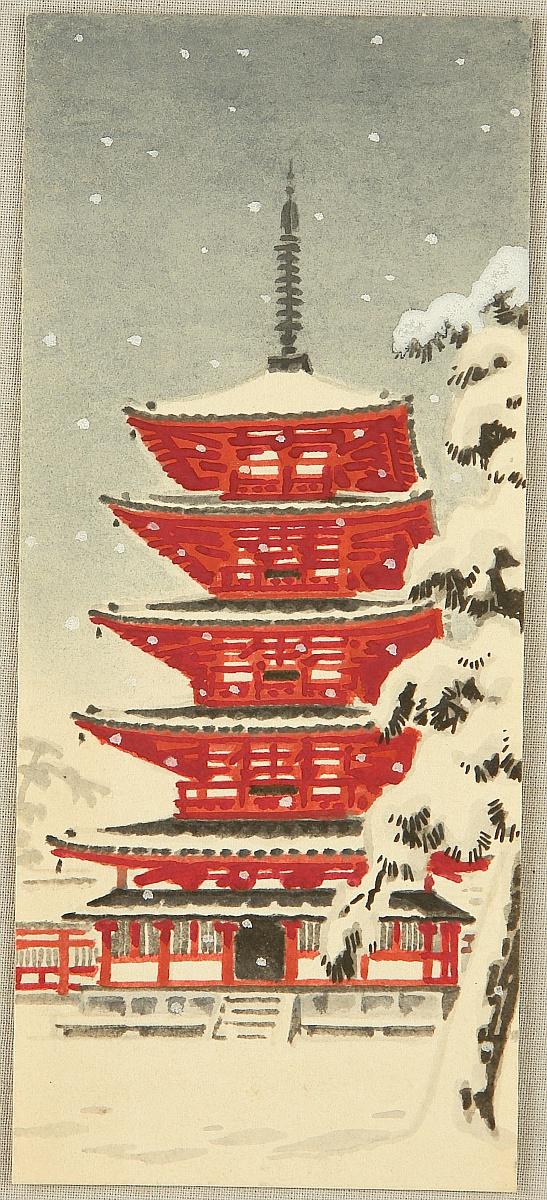
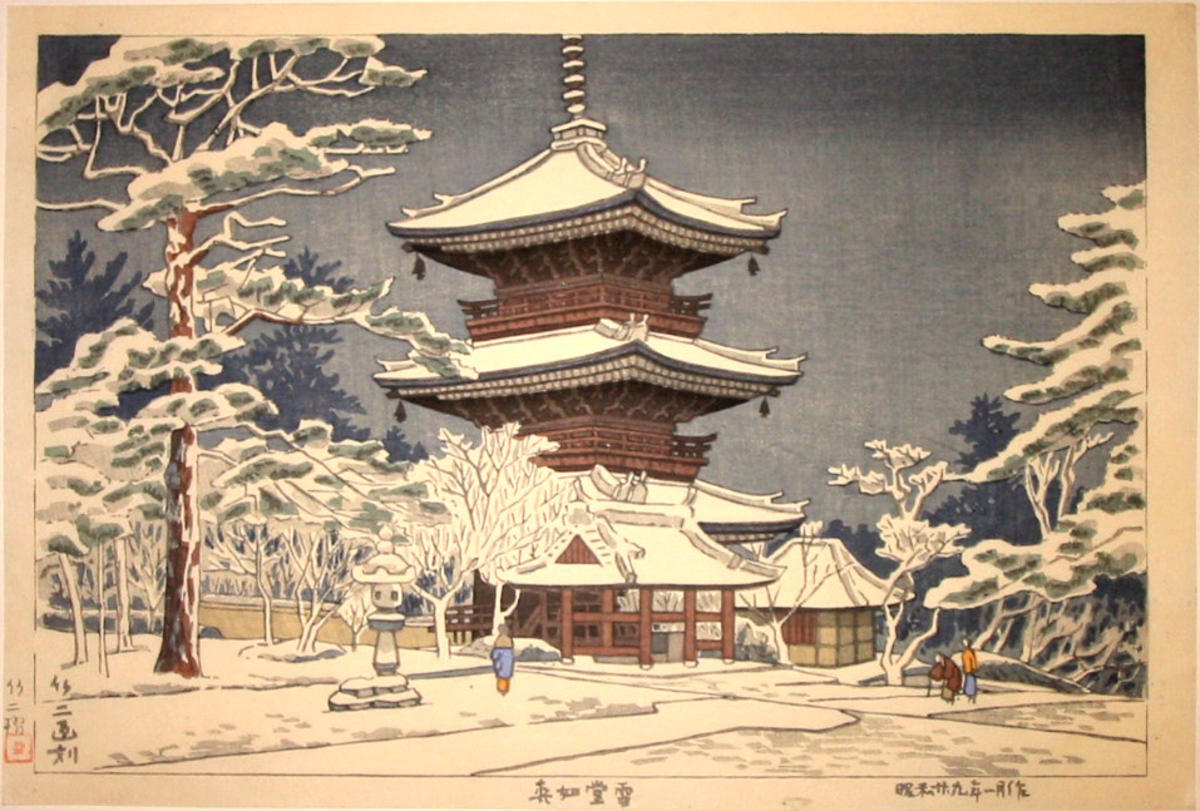
Pagoda Spire
塔
- Medium:
- Color woodblock print
Description
Pagoda Spire, undated but produced within Takeuchi Seihō's mature Kyoto career, captures the artist's lifelong attention to architectural detail and atmospheric register within Japan's classical religious landscape. Seihō (1864–1942), the leading Kyoto nihonga master of late Meiji and Taishō and a foundational teacher in the Maruyama-Shijō lineage descending through Kōno Bairei, brought to architectural subjects the same observational rigor and atmospheric sensitivity he applied to his celebrated animal and landscape paintings. The pagoda spire — typically the upper finial and sōrin of a multi-storied temple pagoda — provided a vertical motif that allowed Seihō to study how Japanese architectural form silhouettes against changing sky, how the relief of the bronze finial catches and releases light, and how the upper stage of a temple roof reads against forest or mist. Seihō's compositional choice to isolate the spire — rather than depict the entire pagoda — places the work within the late-nineteenth-century Kyoto reformation of nihonga, in which artists like Seihō pursued increasingly selective, suggestive framing of traditional subjects influenced by their exposure to European observational painting. His 1900–1901 European tour, which included study of Western landscape and architectural painting, sharpened this sensibility. The Japanese Art Open Database preserves this impression in its open-access catalogue (https://ukiyo-e.org/image/jaodb/Takeuchi_Seiho-No_Series-Pagoda_Spire-00042815-110109-F06), positioning it within Seihō's broader practice of selective architectural and landscape study that shaped the way an entire generation of Kyoto nihonga painters approached their subjects.
More Prints by Takeuchi Seihō


More Pagodas Prints

Frequently Asked Questions
Pagoda Spire (塔) was created by Takeuchi Seihō (竹内栖鳳).
Pagoda Spire depicts pagodas.