
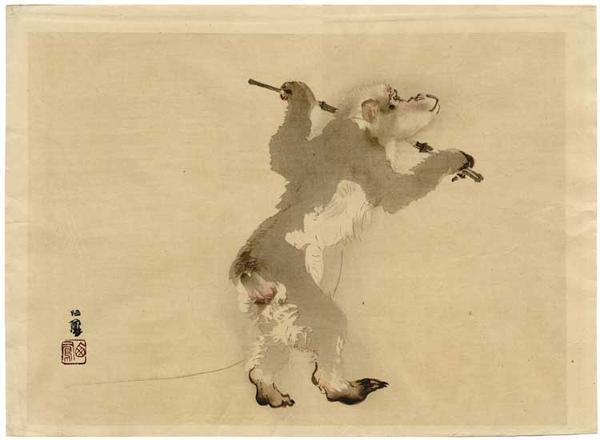
Rooster and Hen, from the series "Album of Twelve Zodiacal Animals by the Artist Seiho (Seiho gahaku hitsu junishi cho)"
栖鳳画伯筆十二支帖 (酉)
- Date:
- c. 1910/12 (printed c. 1930s/40s)
- Medium:
- Color woodblock print
- Source:
- Art Institute of Chicago
Description
Rooster and Hen, from the album Seihō Gahaku Hitsu Jūnishi-jō (Album of Twelve Zodiacal Animals by the Artist Seihō), is held by the Art Institute of Chicago (accession 1954.205; catalogue at https://www.artic.edu/artworks/80371) and represents the tori (cock) year of the East Asian zodiac. The composition is a horizontal sheet, approximately 25.8 by 38.4 cm — Takeuchi Seihō and his Kyoto carvers used a mix of vertical and horizontal formats across the twelve animals — and shows the rooster and hen in close grouping, the cock's tail feathers and comb defined in confident sumi line and accented with red, the hen tucked beneath in a softer wash of grey and ochre. The pictorial source is a typical Shijō-school bird-and-flower study of the kind Seihō produced throughout his career, descended through his teacher Kōno Bairei from the eighteenth-century Maruyama-Shijō tradition of careful observation combined with calligraphic economy. Like the other plates in the album, the print preserves the brush movement of the original ink painting; the woodblock medium serves not to translate the design into print-graphic vocabulary but to reproduce, as faithfully as possible, the look of a brush original on paper. The Art Institute's impression dates to the c. 1930s-40s edition of the album, which corresponds to a later Unsōdō reissue of the Yamada Naosaburō / Geisōdō original. Roosters were a recurring Bairei-school subject, treated as exercises in handling iridescent plumage and the sculptural geometry of comb and wattle; Seihō's version belongs to that pedagogical tradition while turning the pair into a domestic vignette through their close grouping, a quietly observational touch in line with the broader synthesis of Maruyama-Shijō method and post-European realism that defined his mature Kyoto nihonga practice.
More Prints by Takeuchi Seihō


Frequently Asked Questions
Rooster and Hen, from the series "Album of Twelve Zodiacal Animals by the Artist Seiho (Seiho gahaku hitsu junishi cho)" (栖鳳画伯筆十二支帖 (酉)) was created by Takeuchi Seihō (竹内栖鳳) in c. 1910/12 (printed c. 1930s/40s).