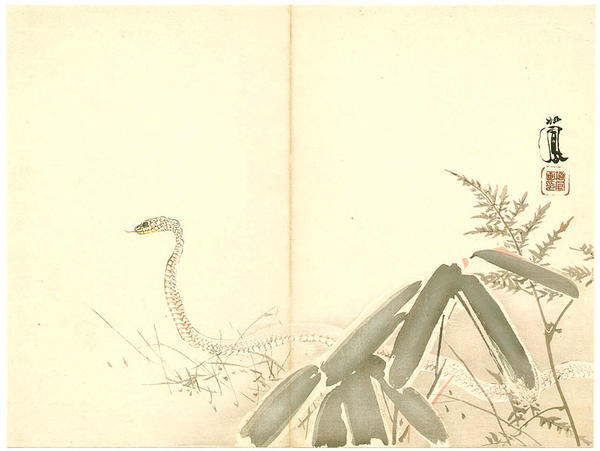
Snake
蛇
- Date:
- early 20th century
- Medium:
- Color woodblock print
Description
Snake, no year recorded but probably an early-twentieth-century impression catalogued by the Japanese Art Open Database (image at https://ukiyo-e.org/image/jaodb/Takeuchi_Seiho-No_Series-Snake-00039676-060901-F06), depicts a serpent crawling through bushes in search of prey. The print is in dai-ōban (large ōban) format, approximately 35 by 47 cm, and is signed and sealed in red by Takeuchi Seihō. The snake (hebi) was a recurring subject in Seihō's practice — appearing both as part of the zodiac album (where it represents the mi or snake year) and as an independent design like this one — and his handling of the reptile's slender, sinuous body in sumi line is a virtuoso demonstration of the Maruyama-Shijō brush as Seihō received it from Kōno Bairei. The composition foregrounds the snake against a lightly washed ground of grasses and foliage, with the eye drawn to the curve of the body and the focal alertness of the head. Snakes in Japanese visual culture carry both protective and threatening associations — guardian of the household kitchen, but also messenger of the kami at certain shrines — and their inclusion in the zodiac and in independent designs allowed Kyoto painters to display brush control through a continuous, fluid line that few other subjects required to the same degree. Seihō's snake also bears the imprint of his post-1900 synthesis: the foliage ground is built up through tonal washes rather than through patterned line, an atmospheric treatment of background that he had absorbed from European naturalist practice during his 1900-1901 study tour. The Japanese Art Open Database notes this impression is in very good condition with excellent color and impression quality, characteristic of the careful Kyoto workshop practice that supported Seihō's printed output.
More Prints by Takeuchi Seihō


Frequently Asked Questions
Snake (蛇) was created by Takeuchi Seihō (竹内栖鳳) in early 20th century.