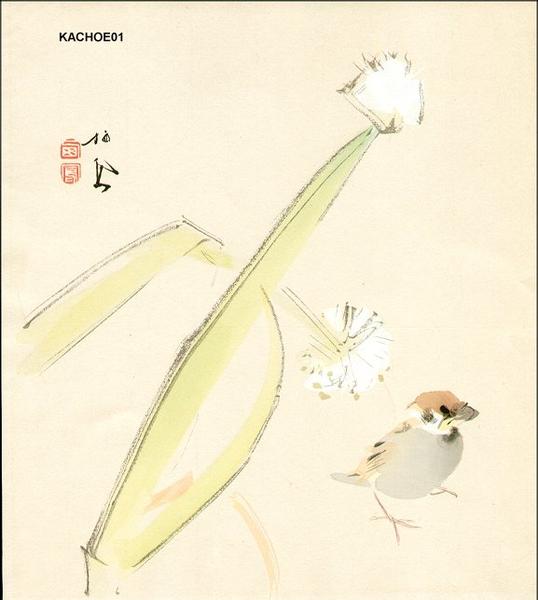
Sparrow
雀
- Medium:
- Color woodblock print (shikishi-e)
Description
Sparrow, no year recorded, is a shikishi-e — a squarish print, traditionally about 25-27 cm on a side — catalogued by the Japanese Art Open Database (image at https://ukiyo-e.org/image/jaodb/Takeuchi_Seiho-No_Series-Sparrow-00038419-050917-F06), signed and sealed by Takeuchi Seihō. The sparrow (suzume) had been a Maruyama-Shijō staple since Maruyama Ōkyo and Matsumura Goshun in the eighteenth century and is one of the most frequently encountered subjects in Seihō's printed output; this small-format design likely belonged to a published series of artist's sketches issued in album or portfolio form by a Kyoto publisher in the early twentieth century. The bird is rendered in confident sumi line and a few touches of color, with Seihō's red name-seal at the corner. Shikishi-e formats were used for tipped-in album plates, for hanging miniatures, and for occasional gift prints; their small scale required tight composition and economical brush handling, both of which Seihō handled with characteristic ease, the discipline traceable to the Bairei studio where he had absorbed the Maruyama-Shijō imperative of disciplined life-drawing as a young painter from 1881. The sparrow as a subject carries deep classical associations in Japanese poetry and folktale — most famously in Shitakiri Suzume, the 'Tongue-cut Sparrow' — and was treated in Kyoto-school painting as a vehicle for demonstrating brush-line virtuosity in a deliberately limited format. The Japanese Art Open Database notes the impression is in good condition. The print would have been collectable in its own right or pasted into a multi-artist shikishi-album of small works in the Kyoto manner, where Seihō's contribution would have stood as one of the most prestigious entries given his standing as Imperial Household Artist from 1913 and the most influential nihonga teacher in western Japan.
More Prints by Takeuchi Seihō


More Birds & Flowers Prints
Frequently Asked Questions
Sparrow (雀) was created by Takeuchi Seihō (竹内栖鳳).
Sparrow depicts birds & flowers.