
Matsumoto Koshiro III as Kusunoki Bokon and Sawamura Kijuro as Omori Hikoshichi in the Scene from a Drama (Sandaime Matsumoto Koshiro no Kusunoki Bokon to Sawamura Kijuro no Omori Hikoshichi)
- Date:
- 1773
- Medium:
- Color woodblock print; hosoban, benizuri-e
- Source:
- Art Institute of Chicago
Description
Matsumoto Koshiro III as Kusunoki Bokon and Sawamura Kijuro as Omori Hikoshichi is a color woodblock print designed by Torii Kiyonaga around 1762, when the young artist was still working closely within the Torii school's long-established specialty of kabuki actor prints. Matsumoto Koshiro III and Sawamura Kijuro were popular performers of mid-eighteenth-century Edo, and Kusunoki Bokon (a vengeful spirit linked to the loyalist hero Kusunoki Masashige) and Omori Hikoshichi belong to the cycle of dramas dramatizing fourteenth-century warrior history. The scene typically called for charged confrontation, often staged on a moonlit road, where the warrior Hikoshichi carries a woman on his back only to discover her supernatural identity. Kiyonaga's hosoban print presents the two actors in characteristic mie poses, their costumes patterned with family crests that identify them to the audience. The Art Institute of Chicago, which holds this impression, identifies the sheet as a benizuri-e or early limited-color print, dating from the years immediately before full polychrome printing transformed Edo's prints in 1765. The palette relies on a few overprinted colors—pinks, greens, yellows—against the patterned ground of costume and the black of formal printed inscriptions at top and side. For modern viewers, the print preserves the moment just before Kiyonaga's career would pivot toward bijin-ga, and it documents how thoroughly the young Torii heir mastered the conventions of yakusha-e at the school's traditional theatrical heart.
More Prints by Torii Kiyonaga

Watching the Water Festival from Azuma Bridge, from the series "Eight Precincts of the Kinryuzan Temple in Asakusa (Asakusa Kinruzan hakkei)"
c. 1782
Color woodblock print; chuban

Courtesans of Yoshiwara and their attendants viewing the peonies on Nakanocho
c. 1787
Color woodblock print; center and right sheets of oban triptych

A visit to a shrine, from the series "Twelve Scenes of Popular Customs (Fuzoku juni tsui)"
c. 1786
Color woodblock print; koban

A Party Viewing the Moon Across the Sumida River
c. 1787
Color woodblock print; oban triptych
More Sumo Prints


Frequently Asked Questions
Matsumoto Koshiro III as Kusunoki Bokon and Sawamura Kijuro as Omori Hikoshichi in the Scene from a Drama (Sandaime Matsumoto Koshiro no Kusunoki Bokon to Sawamura Kijuro no Omori Hikoshichi) was created by Torii Kiyonaga (鳥居清長) in 1773.
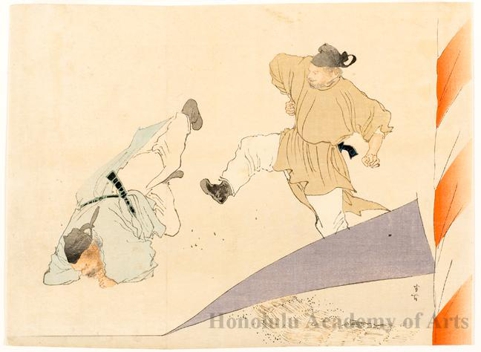
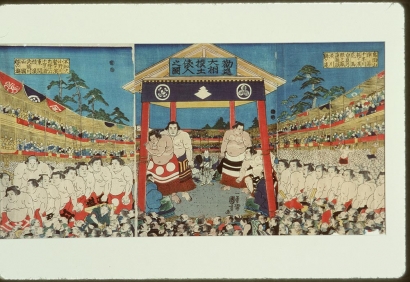
Matsumoto Koshiro III as Kusunoki Bokon and Sawamura Kijuro as Omori Hikoshichi in the Scene from a Drama (Sandaime Matsumoto Koshiro no Kusunoki Bokon to Sawamura Kijuro no Omori Hikoshichi) depicts sumo.