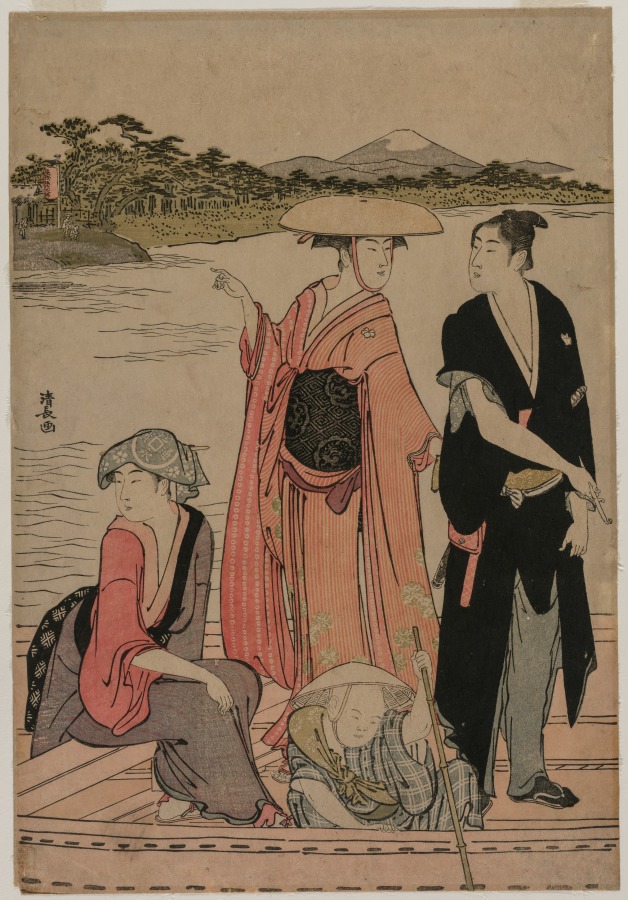
Passengers in a Ferry Boat on the Sumida River
- Date:
- 1784
- Medium:
- color woodblock print
- Source:
- Cleveland Museum of Art
Description
Passengers in a Ferry Boat on the Sumida River, dated 1784 and held by the Cleveland Museum of Art, is a Torii Kiyonaga design that places fashionable Edo townspeople aboard one of the small ferries that crossed between the city and the eastern bank of the Sumida. Such ferries—those at Takeya, Hashiba, and other established crossings—served residents and pleasure-seekers traveling between the central districts and the temples, tea-houses, and pleasure quarters of Honjo and Mukojima. Kiyonaga, who succeeded as fourth head of the Torii school in the early 1780s, treats the boat as a stage on which his elongated, broad-shouldered figures stand and sit in carefully spaced groupings. Women in summer robes, an attendant with a parasol, and male passengers are arranged across the design with the calm geometry that distinguishes his Edo bijin-ga from the more agitated style of earlier ukiyo-e. The river is reduced to broad bands of color, allowing costume patterns and contour lines to dominate; this restraint anticipates the later landscape integration of Utamaro and Hokusai. The composition shows Kiyonaga in his prime, when the Torii school's role had expanded from kabuki theater billboards into a wider visual chronicling of Edo's everyday and leisure life. As a 1784 Cleveland Museum of Art holding, the print is an important reference for the development of multi-figure river-life scenes in late-eighteenth-century Japanese woodblock printing and for Kiyonaga's particular synthesis of figure, costume, and place.
More Prints by Torii Kiyonaga

Watching the Water Festival from Azuma Bridge, from the series "Eight Precincts of the Kinryuzan Temple in Asakusa (Asakusa Kinruzan hakkei)"
c. 1782
Color woodblock print; chuban

Courtesans of Yoshiwara and their attendants viewing the peonies on Nakanocho
c. 1787
Color woodblock print; center and right sheets of oban triptych

A visit to a shrine, from the series "Twelve Scenes of Popular Customs (Fuzoku juni tsui)"
c. 1786
Color woodblock print; koban

A Party Viewing the Moon Across the Sumida River
c. 1787
Color woodblock print; oban triptych
Frequently Asked Questions
Passengers in a Ferry Boat on the Sumida River was created by Torii Kiyonaga (鳥居清長) in 1784.