
The Actors Matsumoto Koshiro IV as Ukita Sakingo and Sawamura Sojuro III as the ghost of the courtesan Takao, in the play "Ominaeshi Sugata no Hatsuaki," performed at the Nakamura Theater, 1788
- Date:
- 1788
- Medium:
- Color woodblock print; oban
- Source:
- Art Institute of Chicago
Description
The Actors Matsumoto Koshiro IV as Ukita Sakingo and Sawamura Sojuro III as the ghost of the courtesan Takao, in the play Ominaeshi Sugata no Hatsuaki, performed at the Nakamura Theater, 1788, is a kabuki print held by the Art Institute of Chicago that places Torii Kiyonaga squarely within his family obligation to advertise the Edo theatres. The play dramatises the legendary courtesan Takao, whose ghost returns to haunt a samurai entanglement, here personified by Ukita Sakingo. Sawamura Sojuro III, costumed as the spectral Takao, faces Matsumoto Koshiro IV's Sakingo in a confrontation that the design renders with restraint rather than melodrama. As a Torii school designer, Kiyonaga inherited the school's monopoly on signboards and programme illustrations for the kabuki theatres, and prints like this one served as souvenir extensions of that publicity. By 1788 his bijin-ga manner had already reshaped Edo printmaking, and the actor portrait reflects that revolution: the figures are tall and statuesque, their kimono unfolded in long vertical sweeps, and the staging is treated almost as if it were a Yoshiwara interior. The Art Institute's record links the print to a specific Nakamura-za production, anchoring it in the documented theatrical calendar of late 1780s Edo. For collectors, the sheet is interesting as evidence that Kiyonaga's Torii inheritance and his Edo bijin-ga ambitions reinforced rather than contradicted one another, and that even his ghost stories obey the calm, ordered surface that defines his style.
More Prints by Torii Kiyonaga

Watching the Water Festival from Azuma Bridge, from the series "Eight Precincts of the Kinryuzan Temple in Asakusa (Asakusa Kinruzan hakkei)"
c. 1782
Color woodblock print; chuban

Courtesans of Yoshiwara and their attendants viewing the peonies on Nakanocho
c. 1787
Color woodblock print; center and right sheets of oban triptych

A visit to a shrine, from the series "Twelve Scenes of Popular Customs (Fuzoku juni tsui)"
c. 1786
Color woodblock print; koban

A Party Viewing the Moon Across the Sumida River
c. 1787
Color woodblock print; oban triptych
More Sumo Prints


Frequently Asked Questions
The Actors Matsumoto Koshiro IV as Ukita Sakingo and Sawamura Sojuro III as the ghost of the courtesan Takao, in the play "Ominaeshi Sugata no Hatsuaki," performed at the Nakamura Theater, 1788 was created by Torii Kiyonaga (鳥居清長) in 1788.
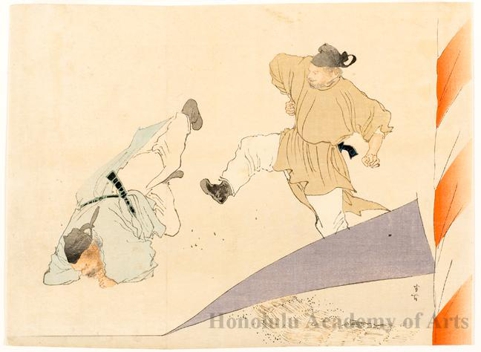
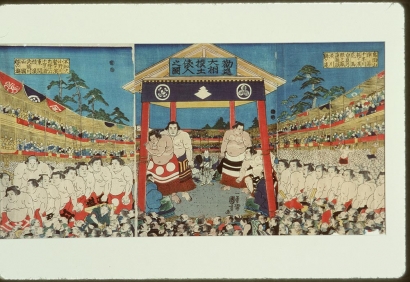
The Actors Matsumoto Koshiro IV as Ukita Sakingo and Sawamura Sojuro III as the ghost of the courtesan Takao, in the play "Ominaeshi Sugata no Hatsuaki," performed at the Nakamura Theater, 1788 depicts sumo.