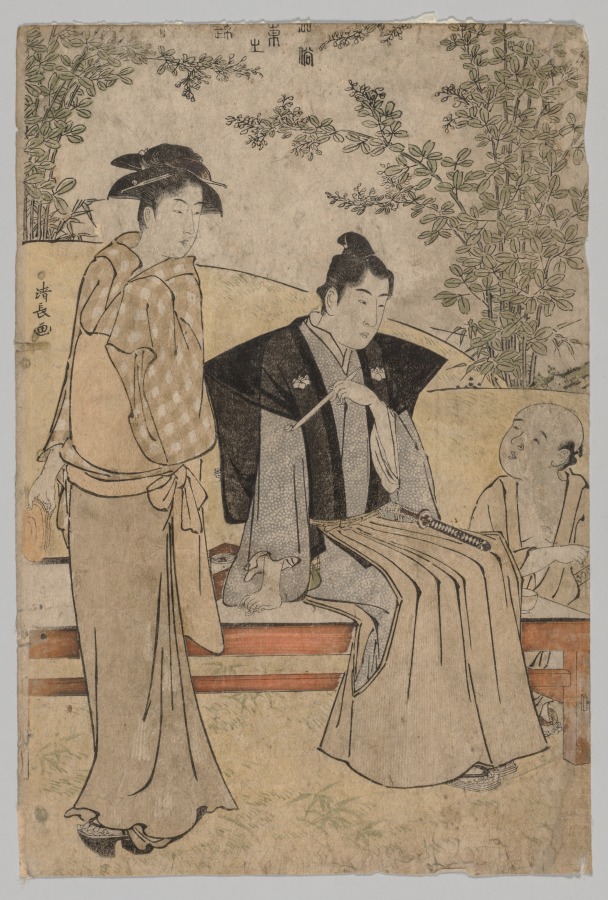
Two Lovers (from the series Brocades of the East in Fashion)
- Date:
- 1752–1815
- Medium:
- color woodblock print
- Source:
- Cleveland Museum of Art
Description
Two Lovers, from the series Brocades of the East in Fashion, in the Cleveland Museum of Art collection, is a Torii Kiyonaga design—the museum's recorded 1752 date predates the artist's birth and almost certainly refers to a literary or series association rather than the year of printing; the style and the Cleveland record place the impression firmly in Kiyonaga's mature 1780s output. The series Brocades of the East in Fashion (Azuma fuzoku nishiki) belongs to the typological mode of Edo bijin-ga in which named or notional eastern (Edo) types are catalogued as if they were textile samples, the brocade of the title doubling as a metaphor for the city's fashionable surface. Two Lovers presents a quiet encounter between a man and a woman, set within an interior or against a screen, posed with the calm dignity Kiyonaga brought to even his most intimate subjects. The Torii school's strong outline anchors the long vertical lines of the figures, while colour is reserved for the kimono patterns that effectively act as the brocade promised by the series title. As one of the leading bijin-ga designers of the 1780s, Kiyonaga used such two-figure compositions to test the spatial intervals between bodies that distinguish his work from the more crowded compositions of his predecessors. The Cleveland Museum of Art holds the print among its Japanese woodblock holdings. For collectors, the sheet is a good example of how Kiyonaga handled the lover or couple theme without descending into shunga and how Edo bijin-ga used the language of fashion to dignify what could otherwise have read as gossip.
More Prints by Torii Kiyonaga

Watching the Water Festival from Azuma Bridge, from the series "Eight Precincts of the Kinryuzan Temple in Asakusa (Asakusa Kinruzan hakkei)"
c. 1782
Color woodblock print; chuban

Courtesans of Yoshiwara and their attendants viewing the peonies on Nakanocho
c. 1787
Color woodblock print; center and right sheets of oban triptych

A visit to a shrine, from the series "Twelve Scenes of Popular Customs (Fuzoku juni tsui)"
c. 1786
Color woodblock print; koban

A Party Viewing the Moon Across the Sumida River
c. 1787
Color woodblock print; oban triptych
Frequently Asked Questions
Two Lovers (from the series Brocades of the East in Fashion) was created by Torii Kiyonaga (鳥居清長) in 1752–1815.