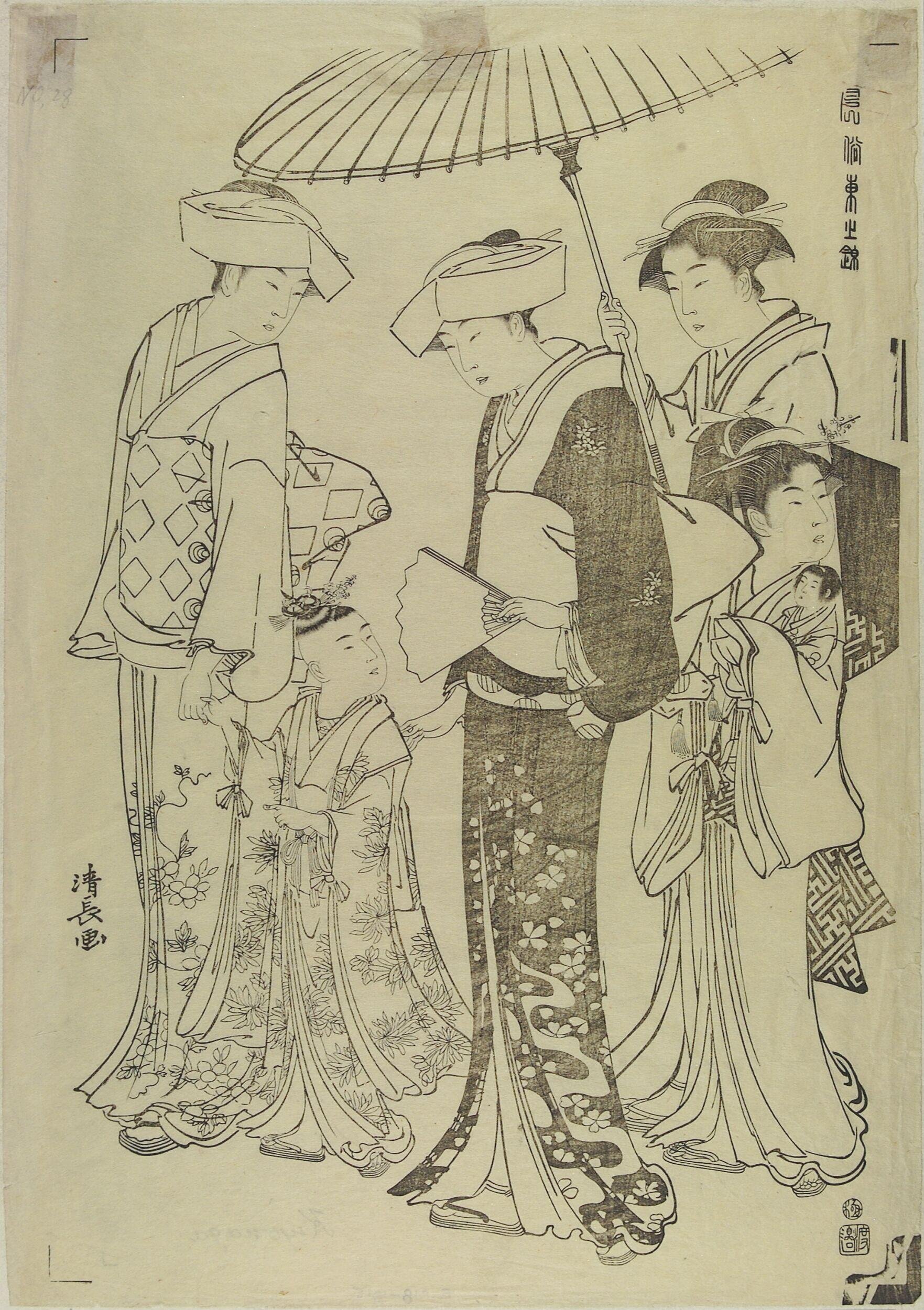
Young girl and four attendants
- Date:
- ca. 1784
- Medium:
- Source:
- Victoria and Albert Museum
Description
Young girl and four attendants, dated 1784 in the Victoria and Albert Museum collection, is a Torii Kiyonaga design that gives his characteristic tall, statuesque figures an unusual quintet structure. The central young girl, identifiable by her hairstyle and bearing as a high-ranking apprentice—possibly a senior kamuro or a daughter of a wealthy townsman—stands surrounded by four attendants who together convey her importance through sheer numerical accompaniment. Kiyonaga arranges the group across the sheet in his familiar measured rhythm, varying the heights of the attendants so that the protagonist remains visually anchored at the centre, and exploits the contrast between her brighter robes and the more subdued textiles of those around her. The composition belongs to a class of Kiyonaga prints in which retinue is itself the subject, advertising both fashion and the social standing it announces. The Torii school's reliance on confident outline rather than dense colour or shading allows the multiple figures to coexist on the sheet without visual congestion; the Edo bijin-ga emphasis on elongated proportions ensures that even a group of five reads as architecture rather than crowd. The Victoria and Albert Museum records the print as part of its East Asian collection and uses it as an example of late eighteenth-century Edo bijin-ga at its compositional peak. For collectors, Young girl and four attendants is a useful demonstration of how Kiyonaga handled larger groups, a skill that would influence later artists such as Utamaro and Eishi when they undertook similar multi-figure showpieces of the pleasure quarter.
More Prints by Torii Kiyonaga

Watching the Water Festival from Azuma Bridge, from the series "Eight Precincts of the Kinryuzan Temple in Asakusa (Asakusa Kinruzan hakkei)"
c. 1782
Color woodblock print; chuban

Courtesans of Yoshiwara and their attendants viewing the peonies on Nakanocho
c. 1787
Color woodblock print; center and right sheets of oban triptych

A visit to a shrine, from the series "Twelve Scenes of Popular Customs (Fuzoku juni tsui)"
c. 1786
Color woodblock print; koban

A Party Viewing the Moon Across the Sumida River
c. 1787
Color woodblock print; oban triptych
More Children Prints
Frequently Asked Questions
Young girl and four attendants was created by Torii Kiyonaga (鳥居清長) in ca. 1784.
Young girl and four attendants depicts children.