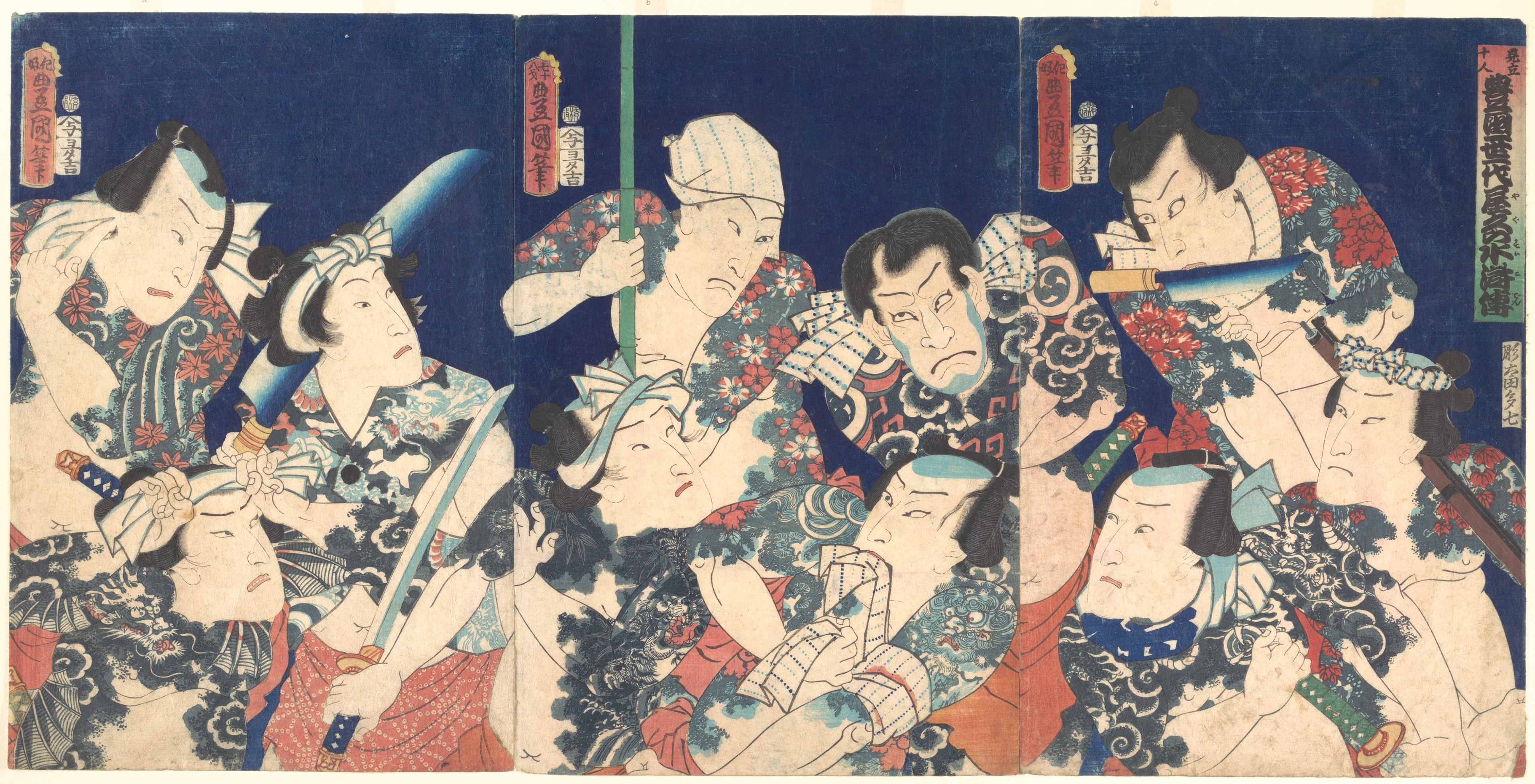
Utagawa's Lifetime Masterpiece, from the Japanese version of the Shuihu Zhuan
- Date:
- 1863 (5th month)
- Medium:
- Woodblock print; ink and color on paper
- Source:
- Metropolitan Museum of Art
Description
Utagawa's Lifetime Masterpiece, from the Japanese version of the Shuihu Zhuan, was issued in 1863 and is preserved at the Metropolitan Museum of Art. The print appears late in Utagawa Kunisada's career, when he was working as Toyokuni III, the lineage head of the Utagawa school that had transformed Edo ukiyo-e in the nineteenth century. The title's self-referential framing - a lifetime masterpiece - is typical of the marketing language used by Edo publishers to flag a high-value sheet to collectors, and the subject ties the print to the same Suikoden craze that drove so many of Kunisada's actor series. The Shuihu zhuan, known in Japan as Suikoden, had been domesticated into kabuki and ukiyo-e since the early nineteenth century, especially through Utagawa Kuniyoshi's groundbreaking 1827-30 warrior series. Kunisada, while temperamentally a yakusha-e artist rather than a musha-e specialist, repeatedly adapted Suikoden iconography to actor portraiture and to commemorative compositions like this one. The design typically arranges multiple figures from the novel and from the Edo stage in tableau, with crests, captions, and cartouches identifying the dual identities. The palette of the Met's impression preserves the late Edo polychrome printing of the early Bunkyu years, balancing dark indigo backgrounds against strong reds and the deep purples derived from imported dyes. The print is a useful late-career document of how the Utagawa-school visual brand continued to capitalize on Chinese literary themes and on the celebrity of kabuki actors right up to the eve of the Meiji Restoration.


