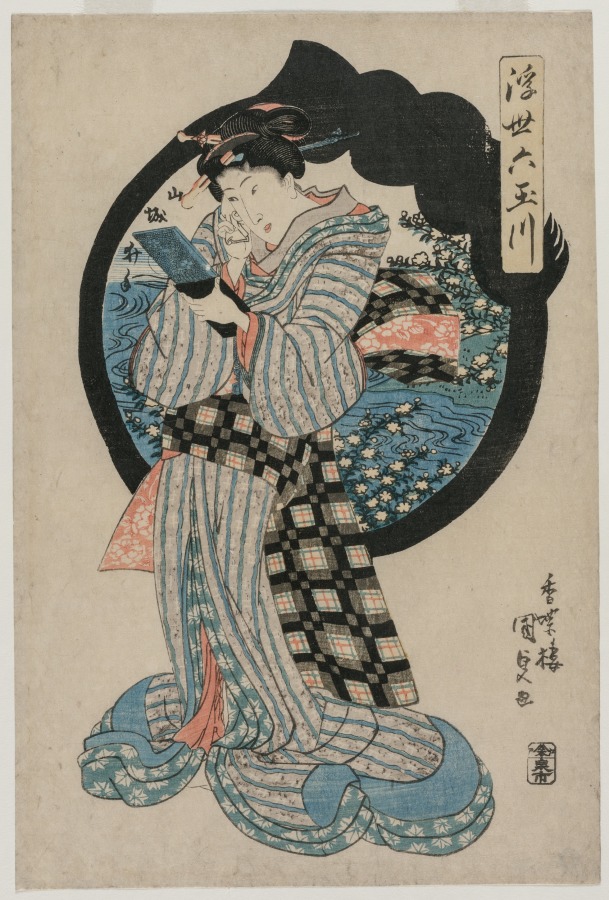
Woman with a Hand Mirror from the series The Six Tama Rivers of the Floating World
- Date:
- c. early 1830s
- Medium:
- color woodblock print
- Source:
- Cleveland Museum of Art
Description
Utagawa Kunisada's Woman with a Hand Mirror, from the series The Six Tama Rivers of the Floating World, dates to about 1830 and belongs to the Cleveland Museum of Art. The Tama River, one of the classical mu-tamagawa, the six rivers named Tama in Japanese poetry, provided a thousand-year-old vocabulary of seasonal and emotional reference that Edo ukiyo-e designers loved to update. Kunisada turns each of the six into a bijinga vignette of contemporary life in the licensed quarters, and in this sheet a fashionable woman regards herself in a small hand mirror, the entire composition a meditation on self-presentation. The mirror is a recurring late-Edo prop because it lets the designer show the woman from two angles, with her own scrutiny becoming part of the viewer's gaze. Kunisada draws her with the long oval face and tapered features that he favored in the late 1820s, dressing her in patterned silks rendered through the dense color blocks of his printers' workshops. By 1830 Kunisada was already the dominant bijinga designer in Edo as well as the leading yakusha-e artist, and the Tama Rivers series belongs to the moment when his fashion plates set the standard for the city's print buyers. The Cleveland Museum's catalogue preserves the series title and date, anchoring the print within the broader vocabulary of poetic-name series that defined Edo ukiyo-e in the period.


