Actor
- Date:
- Late Edo period, 19th century
- Medium:
- Right panel from an ukiyo-e woodblock-printed "ōban" triptych; ink and color on paper
- Source:
- Harvard Art Museums
Description
This print, simply catalogued as Actor and preserved in the Harvard Art Museums, comes from late in Utagawa Kuniyoshi's career and reflects his lifelong involvement with the kabuki stage. By the late Edo period the Utagawa school had become the dominant force in actor prints, and Kuniyoshi, like his fellow pupils of Toyokuni I, contributed substantially to the genre even while he is now best remembered for Edo ukiyo-e warrior prints. The unnamed performer is rendered in three-quarter view with the kind of bold facial drawing and intense gaze that Kuniyoshi favoured, while the patterned costume and stylised background follow the conventions of mid-nineteenth-century yakusha-e. The Harvard collection assigns the print to 1867, a year that places it within the tumultuous final period of the Tokugawa shogunate, although Kuniyoshi himself died in 1861, suggesting that the date reflects either a posthumous edition, a re-issue, or a print produced by a follower under his name; museum records frequently preserve such cataloguing conventions to indicate the historical context of survival rather than original publication. Either way, the sheet testifies to how thoroughly Kuniyoshi's visual idiom permeated Edo theatrical culture. The lessons that he absorbed from Toyokuni I and refined in his Suikoden and musha-e projects fed back into actor prints, lending them the muscular energy and theatrical force that distinguish his treatment of the genre from that of his rival Kunisada. As a document of Edo ukiyo-e's late flowering, the print rewards attention as a single-figure portrait that fuses warrior intensity with the spectacle of the kabuki stage.
More Prints by Utagawa Kuniyoshi
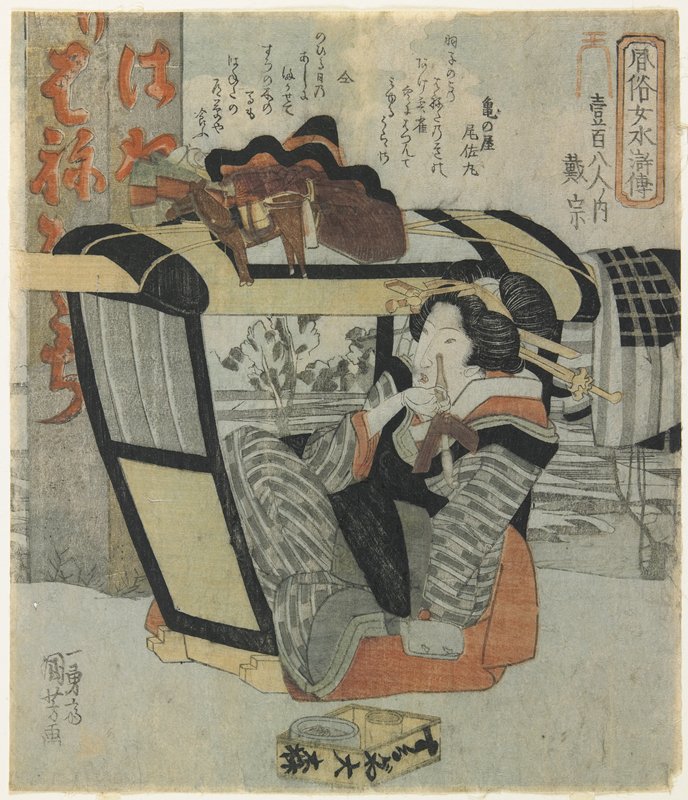
Woman as the Hero Taisō in Palanquin Holding a Pipe
c. 1830
Woodblock print (surimono), ink and color on paper

Yan Qing (Roshi Ensei), from the series "One Hundred and Eight Heroes of the Popular Water Margin (Tsuzoku Suikoden goketsu hyakuhachinin no hitori)"

Poem by Abe no Nakamaro, from an untitled series of One Hundred Poems by One Hundred Poets

Hu Sanniang (Ko Sanjo Ichijosei), from the series "One Hundred and Eight Heroes of the Popular Water Margin (Tsuzoku Suikoden goketsu hyakuhachinin no hitori)"
Frequently Asked Questions
Actor was created by Utagawa Kuniyoshi (歌川国芳) in Late Edo period, 19th century.