Actor Nakamura Utaemon 4th (One of Three Kabuki Actors)
- Date:
- Late Edo period, circa 1847-1852
- Medium:
- Center panel from an ukiyo-e woodblock-printed "ōban" triptych; ink and color on paper with printed signature reading "Ichiyūsai Kuniyoshi ga"
- Source:
- Harvard Art Museums
Description
Actor Nakamura Utaemon 4th, one of three kabuki actors in a Harvard Art Museums grouping, is an Edo ukiyo-e portrait by Utagawa Kuniyoshi (1797-1861) dated 1847. Nakamura Utaemon IV (1796-1852) was one of the most accomplished kabuki actors of the early to mid-nineteenth century, particularly celebrated in Osaka and Edo for his interpretations of male leads and onnagata roles, and he was a frequent subject of actor prints. Kuniyoshi's portrait participates in the long Utagawa-school tradition of yakusha-e that had been shaped by his teacher Utagawa Toyokuni I and by Kuniyoshi's contemporary Kunisada; he himself was an important contributor to the genre even as he became internationally known principally for his warrior prints. The 1847 date places the sheet in the years immediately after the Tenpō reforms, when actor prints were once again issued with a degree of identification that allowed audiences to attach the image firmly to a named performer. Kuniyoshi's actor prints often differ in feel from those of Kunisada: he favored a slightly more grounded physical presence and a sharper, more individualized facial structure, qualities well suited to a powerful actor such as Utaemon IV. The Harvard Art Museums record the work as part of a set of three kabuki actor portraits and document the actor's name, the date and Kuniyoshi's authorship. The description here adheres to that record, presenting the print as a representative Edo ukiyo-e actor portrait by Kuniyoshi, complementary in genre to his celebrated warrior prints.
More Prints by Utagawa Kuniyoshi
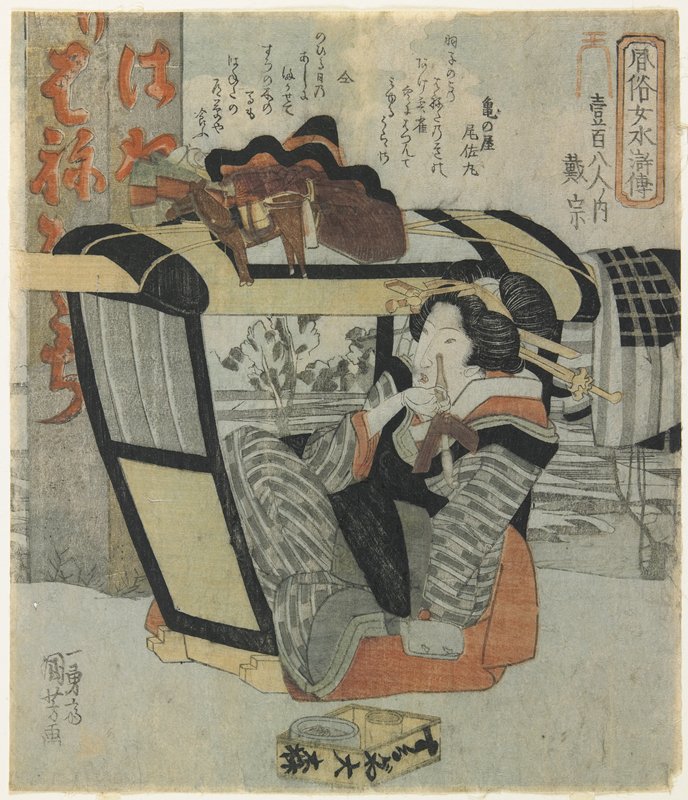
Woman as the Hero Taisō in Palanquin Holding a Pipe
c. 1830
Woodblock print (surimono), ink and color on paper

Yan Qing (Roshi Ensei), from the series "One Hundred and Eight Heroes of the Popular Water Margin (Tsuzoku Suikoden goketsu hyakuhachinin no hitori)"

Poem by Abe no Nakamaro, from an untitled series of One Hundred Poems by One Hundred Poets

Hu Sanniang (Ko Sanjo Ichijosei), from the series "One Hundred and Eight Heroes of the Popular Water Margin (Tsuzoku Suikoden goketsu hyakuhachinin no hitori)"
Frequently Asked Questions
Actor Nakamura Utaemon 4th (One of Three Kabuki Actors) was created by Utagawa Kuniyoshi (歌川国芳) in Late Edo period, circa 1847-1852.