Actors
- Date:
- Late Edo period, 19th century
- Medium:
- Left panel from an ukiyo-e woodblock-printed "ōban" triptych; ink and color on paper
- Source:
- Harvard Art Museums
Description
Actors, dated 1867 in the Harvard Art Museums catalog, is a posthumously dated or late-attributed kabuki print associated with Utagawa Kuniyoshi (1797–1861). Since Kuniyoshi himself died in 1861, the 1867 catalog date most likely reflects publication, reissue, or the institutional records for a print bearing his signature or design. Kabuki actor prints (yakusha-e) were a foundational genre for the Utagawa school, and Kuniyoshi—best known for his warrior prints—was a prolific contributor across his career, producing portraits of leading performers at Edo's major theaters. The Harvard impression preserves the bold, theatrically posed figural drawing characteristic of late-Edo ukiyo-e, with strong outlines defining the faces, costumes, and stylized expressions for which Kuniyoshi was admired. Whether the print represents a documented stage production or a recombinant design issued under Kuniyoshi's name, it illustrates how Edo ukiyo-e workshops sustained the actor-print tradition into the early Meiji era, often reusing designs or compositional formulae developed by the school's leading designers. Kuniyoshi's actor portraits typically demonstrate the same skill in physiognomy and dramatic composition that animated his warrior prints, with each figure individuated through hairstyle, kimono pattern, and characteristic gesture. The print is a useful object for understanding how the broader market for kabuki imagery continued in Tokyo just before and after the Meiji Restoration. As part of the Harvard collection, it contributes to study of Utagawa Kuniyoshi's actor-print output and the diffusion of his designs in the years following his death. Source: Harvard Art Museums.
More Prints by Utagawa Kuniyoshi
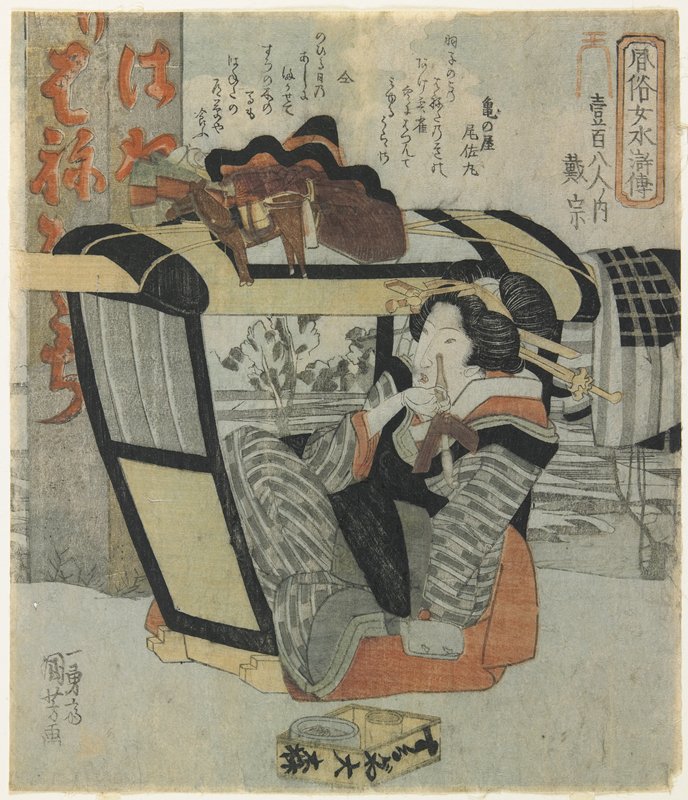
Woman as the Hero Taisō in Palanquin Holding a Pipe
c. 1830
Woodblock print (surimono), ink and color on paper

Yan Qing (Roshi Ensei), from the series "One Hundred and Eight Heroes of the Popular Water Margin (Tsuzoku Suikoden goketsu hyakuhachinin no hitori)"

Poem by Abe no Nakamaro, from an untitled series of One Hundred Poems by One Hundred Poets

Hu Sanniang (Ko Sanjo Ichijosei), from the series "One Hundred and Eight Heroes of the Popular Water Margin (Tsuzoku Suikoden goketsu hyakuhachinin no hitori)"
Frequently Asked Questions
Actors was created by Utagawa Kuniyoshi (歌川国芳) in Late Edo period, 19th century.