
Actors as Hotei Ichiemon and Gokuin Chiemon
- Date:
- c. 1847/52
- Medium:
- Color woodblock print; oban
- Source:
- Art Institute of Chicago
Description
Actors as Hotei Ichiemon and Gokuin Chiemon, dated 1842, is an actor print by Utagawa Kuniyoshi depicting two characters from the world of Edo otokodate, the dashing commoner heroes of urban legend who featured prominently in kabuki. The names Hotei Ichiemon and Gokuin Chiemon belong to the catalogue of Edo street-bravo figures whose tattoos, robes, and codes of honor made them favorite roles for actors of the period and favorite subjects for Edo ukiyo-e designers. Kuniyoshi was uniquely suited to such material: he had built a sensation in the late 1820s with One Hundred and Eight Heroes of the Suikoden, popularizing full-body tattoos in actual Edo culture as well as in print, and the otokodate figures of the kabuki stage drew on the same iconography. The composition typically pairs the two actors in identifiable poses, allowing fans of the kabuki theater to recognize specific performers in specific roles. The 1842 date places the print within the Tenpo Reforms period, during which formal restrictions on naming actors complicated yakusha-e publishing; Kuniyoshi's output of these years reflects various strategies for navigating the new rules. As color woodblock prints of late Edo ukiyo-e, prints like this one rely on nishiki-e techniques perfected over decades. This impression is preserved in the collection of the Art Institute of Chicago, where it documents Kuniyoshi's contribution to the actor-print tradition.
More Prints by Utagawa Kuniyoshi
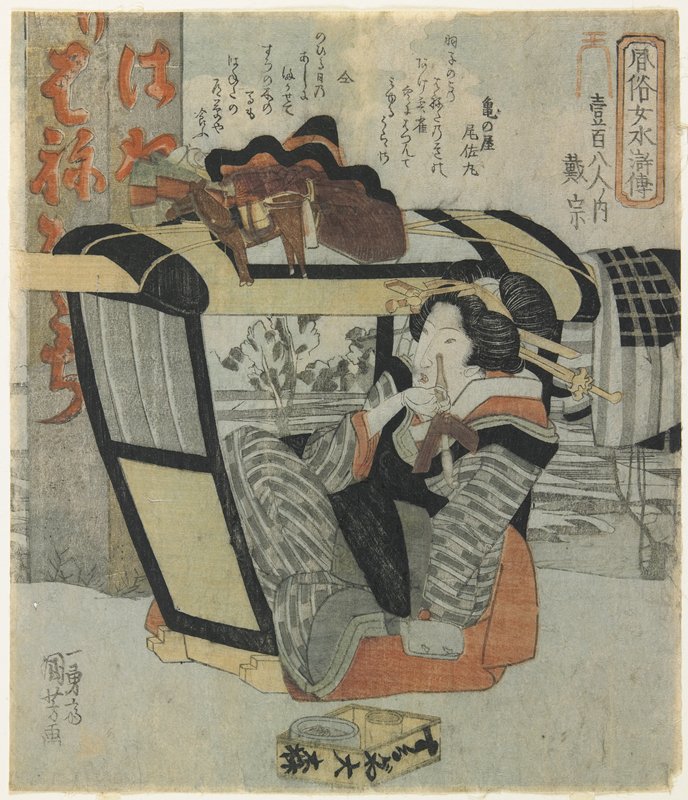
Woman as the Hero Taisō in Palanquin Holding a Pipe
c. 1830
Woodblock print (surimono), ink and color on paper

Yan Qing (Roshi Ensei), from the series "One Hundred and Eight Heroes of the Popular Water Margin (Tsuzoku Suikoden goketsu hyakuhachinin no hitori)"

Poem by Abe no Nakamaro, from an untitled series of One Hundred Poems by One Hundred Poets

Hu Sanniang (Ko Sanjo Ichijosei), from the series "One Hundred and Eight Heroes of the Popular Water Margin (Tsuzoku Suikoden goketsu hyakuhachinin no hitori)"
Frequently Asked Questions
Actors as Hotei Ichiemon and Gokuin Chiemon was created by Utagawa Kuniyoshi (歌川国芳) in c. 1847/52.