
Akizuki Yuminosuke's Daughter Miyuki, Later the blind Musician Asagao (Akizuki Yuminosuke musume Miyuki, nochi ni goze Asagao)
- Date:
- c. 1848
- Medium:
- Color woodblock print; oban
- Source:
- Art Institute of Chicago
Description
Akizuki Yuminosuke's Daughter Miyuki, Later the Blind Musician Asagao (1843) is a print by Utagawa Kuniyoshi depicting the heroine of the popular drama Shokoku Monogatari, also known as the Asagao Nikki (Diary of the Morning Glory). The narrative follows Miyuki, daughter of the samurai Akizuki Yuminosuke, who falls in love with the young Komazawa Jiroza. Separated from her beloved through family circumstance, Miyuki eventually loses her sight from grief and becomes a wandering blind musician (goze) under the name Asagao, the morning glory, traveling Japan in search of Komazawa. The story became one of the most popular romantic narratives of the late Edo theater and inspired a substantial visual tradition in ukiyo-e. Kuniyoshi's composition focuses on the transformed Miyuki/Asagao, allowing the kimono, the koto or other instrument, and her bearing to evoke both the courtly past and her present condition as a blind itinerant musician. Although Kuniyoshi is most famous for warrior prints, his treatment of dramatic and literary heroines reflects the breadth of late Edo ukiyo-e. The 1843 date places the print within the Tenpo Reforms period, during which character-only designations were a useful strategy for publishing theatrical material. As nishiki-e of the era, it employs the layered color woodblock palette and the patterned costume vocabulary of mid-century Utagawa-school design.
More Prints by Utagawa Kuniyoshi
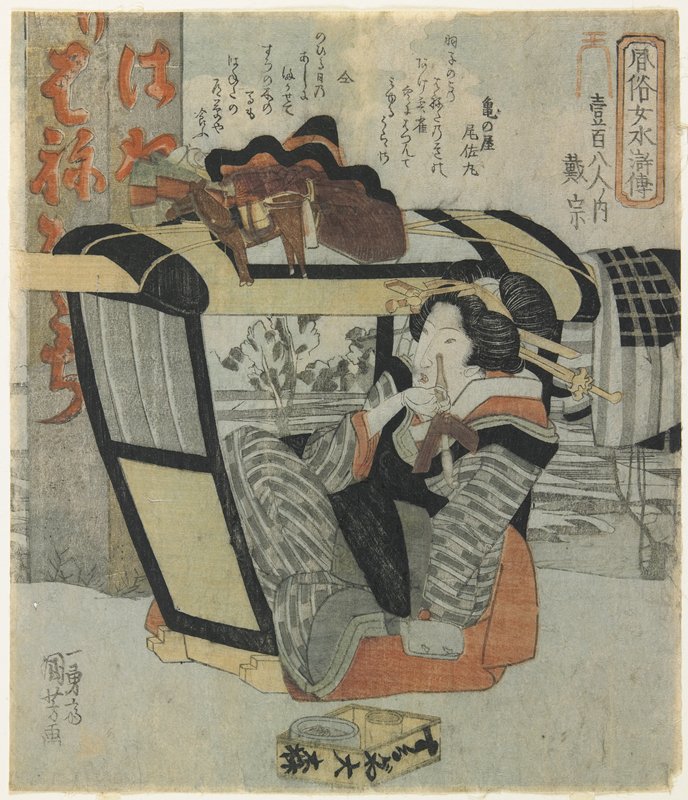
Woman as the Hero Taisō in Palanquin Holding a Pipe
c. 1830
Woodblock print (surimono), ink and color on paper

Yan Qing (Roshi Ensei), from the series "One Hundred and Eight Heroes of the Popular Water Margin (Tsuzoku Suikoden goketsu hyakuhachinin no hitori)"

Poem by Abe no Nakamaro, from an untitled series of One Hundred Poems by One Hundred Poets

Hu Sanniang (Ko Sanjo Ichijosei), from the series "One Hundred and Eight Heroes of the Popular Water Margin (Tsuzoku Suikoden goketsu hyakuhachinin no hitori)"
Frequently Asked Questions
Akizuki Yuminosuke's Daughter Miyuki, Later the blind Musician Asagao (Akizuki Yuminosuke musume Miyuki, nochi ni goze Asagao) was created by Utagawa Kuniyoshi (歌川国芳) in c. 1848.