
Cai Shun (Sai Jun), from the series "Twenty-four Paragons of Filial Piety in China (Morokoshi nijushiko)"
- Date:
- c. 1848/50
- Medium:
- Color woodblock print; chuban
- Source:
- Art Institute of Chicago
Description
Cai Shun (Sai Jun), from Utagawa Kuniyoshi's 1843 series Twenty-four Paragons of Filial Piety in China (Morokoshi nijushiko), depicts one of the celebrated Confucian exemplars of filial devotion. The traditional account of Cai Shun describes how, during a famine, the boy went into the wild to gather mulberries to feed his hungry mother. He gathered black and white berries into separate baskets, intending to give the ripe black ones to his mother and keep the unripe white ones for himself. When bandits stopped him and asked why, Cai Shun explained his sorting principle; the bandits were so moved by his filial care that they spared him and gave him provisions. The story illustrates the Confucian conviction that genuine filial devotion exerts moral influence even on hardened outlaws. Kuniyoshi's nishiki-e composition follows the standard iconography, depicting Cai Shun with his baskets and often the bandits in the surrounding scene. Although Kuniyoshi is best known for warrior prints, his engagement with Chinese moral and legendary subjects was substantial throughout his career, reflecting the broad cultural prestige of Confucian learning in late Edo Japan. As Edo ukiyo-e of the late Tenpo era, the print employs color woodblock printing with attention to costume pattern and narrative setting. This impression is preserved in the collection of the Art Institute of Chicago.
More Prints by Utagawa Kuniyoshi
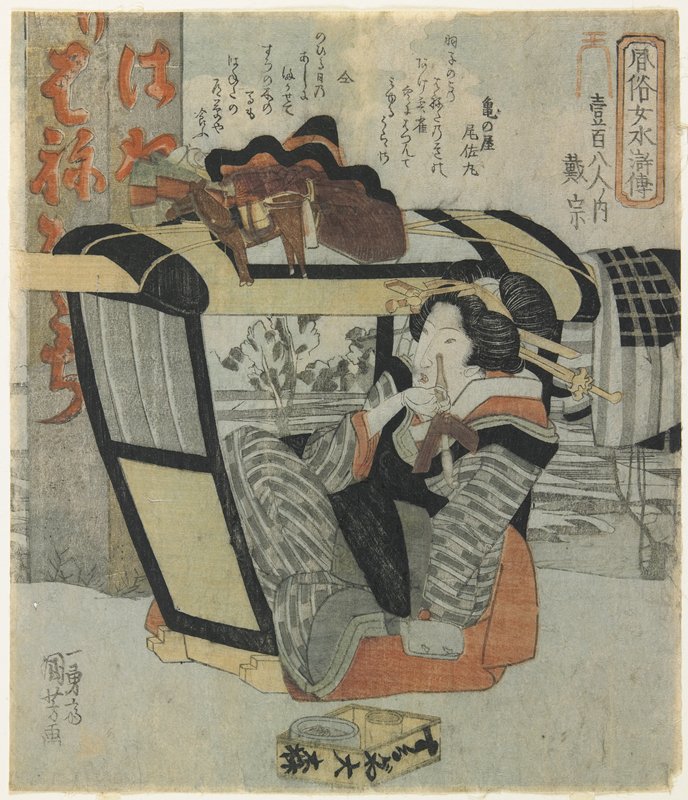
Woman as the Hero Taisō in Palanquin Holding a Pipe
c. 1830
Woodblock print (surimono), ink and color on paper

Yan Qing (Roshi Ensei), from the series "One Hundred and Eight Heroes of the Popular Water Margin (Tsuzoku Suikoden goketsu hyakuhachinin no hitori)"

Poem by Abe no Nakamaro, from an untitled series of One Hundred Poems by One Hundred Poets

Hu Sanniang (Ko Sanjo Ichijosei), from the series "One Hundred and Eight Heroes of the Popular Water Margin (Tsuzoku Suikoden goketsu hyakuhachinin no hitori)"
Frequently Asked Questions
Cai Shun (Sai Jun), from the series "Twenty-four Paragons of Filial Piety in China (Morokoshi nijushiko)" was created by Utagawa Kuniyoshi (歌川国芳) in c. 1848/50.