
Caricatures of Laughing Actors Scribbled on a Wall (Hakumensho kabe no mudagaki)
- Date:
- c. 1848/51
- Medium:
- Color woodblock print; left sheet of oban triptych (right: 1975.474, center: 1975.476)
- Source:
- Art Institute of Chicago
Description
Caricatures of Laughing Actors Scribbled on a Wall (Hakumensho kabe no mudagaki), dated 1843, is one of Utagawa Kuniyoshi's most ingenious responses to the Tenpo Reforms, the censorship regime of 1841-1843 that prohibited identifiable depictions of named kabuki actors in ukiyo-e prints. To circumvent the ban, Kuniyoshi disguised actor caricatures as graffiti scrawled on a wall by an anonymous hand, a witty visual fiction that allowed him to deliver instantly recognizable likenesses of leading kabuki stars while ostensibly publishing only a print of random street drawings. The conceit transformed compliance with censorship into a public joke, and the print became famous as a tour de force of artistic resourcefulness. Edo audiences, attuned to subtle facial conventions and stage habits, would have identified each laughing face immediately. As Edo ukiyo-e of the Tenpo Reforms period, the print employs nishiki-e color woodblock printing while restraining the palette to evoke the chalky surface of a graffitied wall. Kuniyoshi was no stranger to confrontation with authorities; his career included direct clashes with the shogunate over satirical content, and Hakumensho kabe no mudagaki belongs to a documented strain of his work that pushed against official restriction. The print remains a touchstone of Kuniyoshi's wit and his commitment to actor portraiture. This impression is preserved in the collection of the Art Institute of Chicago, where it documents a defining moment in the conflict between Edo print culture and government censorship.
More Prints by Utagawa Kuniyoshi
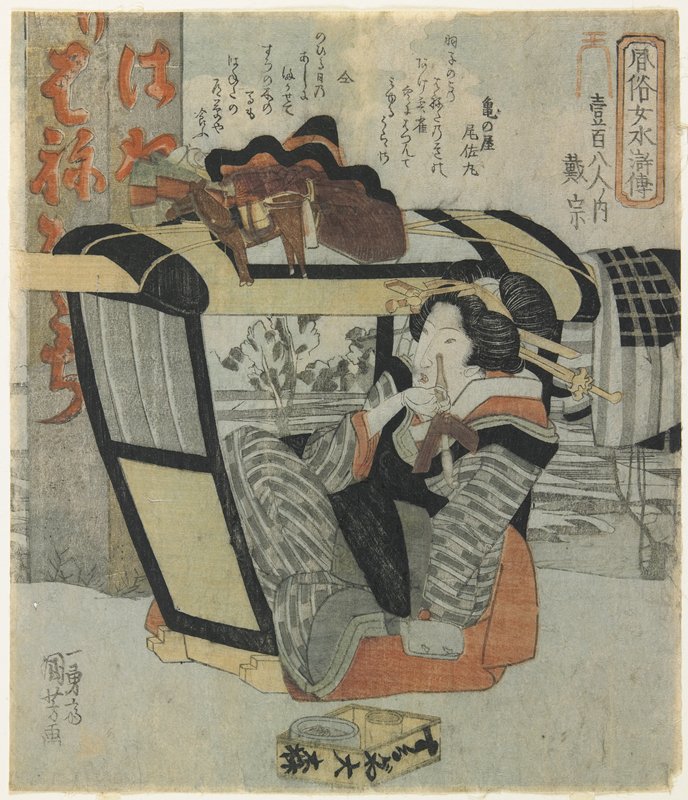
Woman as the Hero Taisō in Palanquin Holding a Pipe
c. 1830
Woodblock print (surimono), ink and color on paper

Yan Qing (Roshi Ensei), from the series "One Hundred and Eight Heroes of the Popular Water Margin (Tsuzoku Suikoden goketsu hyakuhachinin no hitori)"

Poem by Abe no Nakamaro, from an untitled series of One Hundred Poems by One Hundred Poets

Hu Sanniang (Ko Sanjo Ichijosei), from the series "One Hundred and Eight Heroes of the Popular Water Margin (Tsuzoku Suikoden goketsu hyakuhachinin no hitori)"
Frequently Asked Questions
Caricatures of Laughing Actors Scribbled on a Wall (Hakumensho kabe no mudagaki) was created by Utagawa Kuniyoshi (歌川国芳) in c. 1848/51.