
Ding Lan (Tei Ran), from the series "Twenty-four Paragons of Filial Piety in China (Morokoshi nijushiko)"
- Date:
- c. 1848/50
- Medium:
- Color woodblock print; chuban
- Source:
- Art Institute of Chicago
Description
Ding Lan (Tei Ran), a print from Utagawa Kuniyoshi's 1843 Edo ukiyo-e series Twenty-four Paragons of Filial Piety in China (Morokoshi nijushiko), tells the story of a son whose grief for his parents became so consuming that he carved wooden statues of them and continued to serve them daily as if they were still alive. When his wife mocked the figures by pricking one of them with a needle, the wooden statue is said to have bled and wept, and her impiety was revealed. Kuniyoshi, although best known for warrior prints, brings to this household drama the same theatrical instinct that animates his musha-e, balancing the central figure of Ding Lan against the carved images and the tense gesture of the wife. The composition makes the wooden statues unmistakably present, almost as supplementary figures, and the painted contour work gives them an unsettling vitality. Patterned textiles, careful interior details, and a controlled color palette mark the design as the product of a mature Utagawa-school workshop. The Morokoshi nijushiko series was issued during the Tenpo Reforms, when shogunal censorship discouraged depictions of contemporary actors and courtesans; Confucian Chinese exemplars provided a legitimate alternative subject for ambitious full-color prints. The Art Institute of Chicago holds this impression (artworks/149888) in its collection of nineteenth-century Japanese woodblock prints. The sheet shows how Kuniyoshi exploited the eerier corners of the filial-piety tradition to produce moral storytelling that doubles as visually arresting Edo popular imagery.
More Prints by Utagawa Kuniyoshi
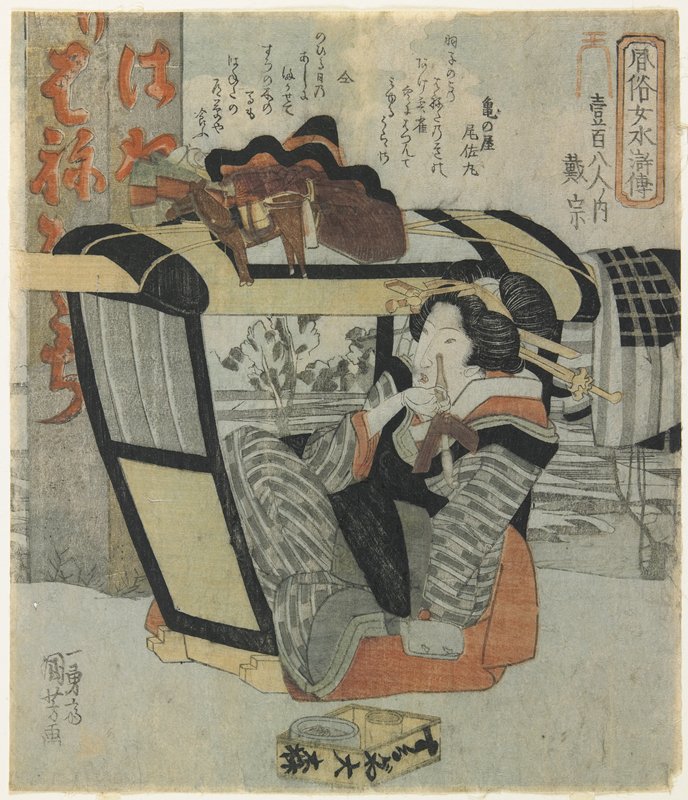
Woman as the Hero Taisō in Palanquin Holding a Pipe
c. 1830
Woodblock print (surimono), ink and color on paper

Yan Qing (Roshi Ensei), from the series "One Hundred and Eight Heroes of the Popular Water Margin (Tsuzoku Suikoden goketsu hyakuhachinin no hitori)"

Poem by Abe no Nakamaro, from an untitled series of One Hundred Poems by One Hundred Poets

Hu Sanniang (Ko Sanjo Ichijosei), from the series "One Hundred and Eight Heroes of the Popular Water Margin (Tsuzoku Suikoden goketsu hyakuhachinin no hitori)"
Frequently Asked Questions
Ding Lan (Tei Ran), from the series "Twenty-four Paragons of Filial Piety in China (Morokoshi nijushiko)" was created by Utagawa Kuniyoshi (歌川国芳) in c. 1848/50.