
Miya, Kuwana, Yokkaichi, and Ishiyakushi, from the series "Famous Places on the Fifty-three Stations of the Tokaido, Four Stations (Tokaido gojusan eki yonshuku meisho)"
- Source:
- Art Institute of Chicago
Description
Miya, Kuwana, Yokkaichi, and Ishiyakushi, four consecutive stations of the Tokaido road as it skirts the head of Ise Bay and crosses into the lands south of Nagoya, are consolidated onto a single oban sheet in Utagawa Kuniyoshi's series Famous Places on the Fifty-three Stations of the Tokaido, Four Stations. Published around 1825 and held by the Art Institute of Chicago, the design captures one of the most distinctive stretches of the great highway, where overland travel intersected with the ferry crossing of Ise Bay between Miya and Kuwana. Kuniyoshi orchestrates the composition as a landscape continuum, weaving small figures of travellers, boats, and pilgrims through a topography that recalls the actual geographic relationships of the four stations. The Miya-Kuwana ferry, the bustling river-mouth town of Kuwana, the open fields and small temples around Yokkaichi, and the famous Yakushi-do of Ishiyakushi are all suggested with concise notational detail. Although Kuniyoshi is most strongly identified with Edo ukiyo-e warrior prints, his treatment of the Tokaido here testifies to his complete fluency in the meisho-e idiom of the late Bunsei era. The bokashi gradations of sky and water, the careful balance of horizontal and vertical, and the rhythm of figures echo the larger landscape currents that Hokusai had set in motion and that Hiroshige would soon transform. The sheet also records the everyday experience of the Tokaido for Edo travellers, suggesting how literary, religious, and commercial activity all overlapped along the road as it approached the Ise pilgrimage routes.
More Prints by Utagawa Kuniyoshi
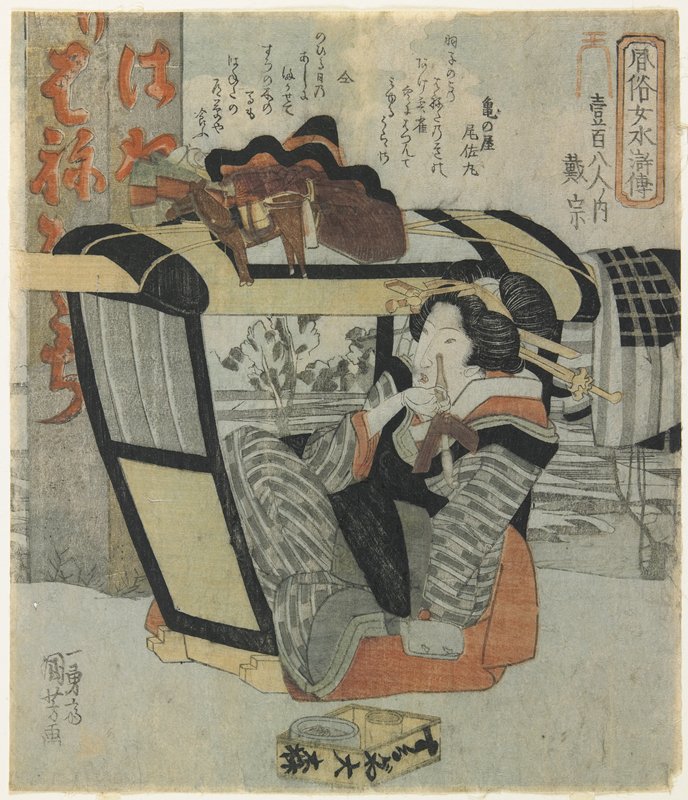
Woman as the Hero Taisō in Palanquin Holding a Pipe
c. 1830
Woodblock print (surimono), ink and color on paper

Yan Qing (Roshi Ensei), from the series "One Hundred and Eight Heroes of the Popular Water Margin (Tsuzoku Suikoden goketsu hyakuhachinin no hitori)"

Poem by Abe no Nakamaro, from an untitled series of One Hundred Poems by One Hundred Poets

Hu Sanniang (Ko Sanjo Ichijosei), from the series "One Hundred and Eight Heroes of the Popular Water Margin (Tsuzoku Suikoden goketsu hyakuhachinin no hitori)"
Frequently Asked Questions
Miya, Kuwana, Yokkaichi, and Ishiyakushi, from the series "Famous Places on the Fifty-three Stations of the Tokaido, Four Stations (Tokaido gojusan eki yonshuku meisho)" was created by Utagawa Kuniyoshi (歌川国芳).