
Suetsumuhana: Mukan-no-tayu Atsumori, from the series "Japanese and Chinese Comparisons for the Chapters of Genji (Wakan nazorae Genji)"
- Date:
- 1855
- Medium:
- Color woodblock print; oban
- Source:
- Art Institute of Chicago
Description
Suetsumuhana: Mukan-no-tayu Atsumori, from Utagawa Kuniyoshi's 1855 series Japanese and Chinese Comparisons for the Chapters of Genji (Wakan nazorae Genji), pairs the Suetsumuhana (Safflower) chapter of The Tale of Genji with the figure of Taira no Atsumori, the young flute-playing Heike warrior whose death at Ichi-no-tani became one of the most affecting moments in The Tale of the Heike. Suetsumuhana, a melancholy noblewoman whose oddly long red nose makes her the gentle laughingstock of the Genji world, may seem an incongruous match for Atsumori, but the series often works by indirect resonance, linking a chapter's mood, color, or emblem to a heroic figure. Kuniyoshi, an Utagawa-school master best known for warrior prints, foregrounds Atsumori's identity through armor, flute, and elegant pose, weaving the visual cue of red, recalling Suetsumuhana's emblematic safflower, into the costume and color scheme. The cartouche supplies the chapter title and a poem to anchor the literary frame, while the figure work shows the firm contour drawing and richly patterned textiles characteristic of Kuniyoshi's late style. The Art Institute of Chicago preserves this impression (artworks/236198) within its substantial Kuniyoshi holdings. The sheet exemplifies how mid-nineteenth-century Edo ukiyo-e publishers used Genji and Heike traditions in combination to produce sophisticated, multi-layered prints aimed at culturally literate collectors.
More Prints by Utagawa Kuniyoshi
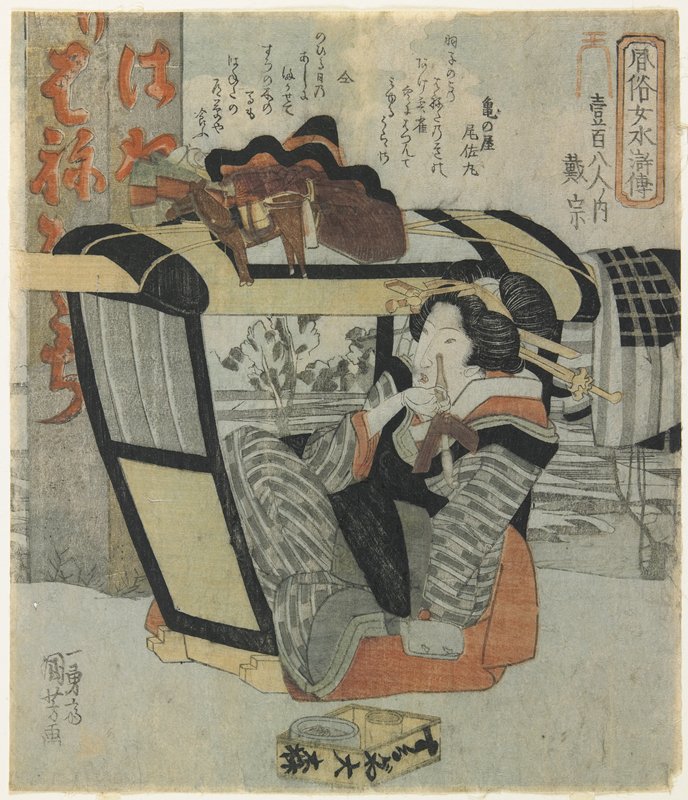
Woman as the Hero Taisō in Palanquin Holding a Pipe
c. 1830
Woodblock print (surimono), ink and color on paper

Yan Qing (Roshi Ensei), from the series "One Hundred and Eight Heroes of the Popular Water Margin (Tsuzoku Suikoden goketsu hyakuhachinin no hitori)"

Poem by Abe no Nakamaro, from an untitled series of One Hundred Poems by One Hundred Poets

Hu Sanniang (Ko Sanjo Ichijosei), from the series "One Hundred and Eight Heroes of the Popular Water Margin (Tsuzoku Suikoden goketsu hyakuhachinin no hitori)"
More Sumo Prints


Frequently Asked Questions
Suetsumuhana: Mukan-no-tayu Atsumori, from the series "Japanese and Chinese Comparisons for the Chapters of Genji (Wakan nazorae Genji)" was created by Utagawa Kuniyoshi (歌川国芳) in 1855.
Suetsumuhana: Mukan-no-tayu Atsumori, from the series "Japanese and Chinese Comparisons for the Chapters of Genji (Wakan nazorae Genji)" depicts sumo.