The Paper Snake
- Medium:
- Ink on paper
- Source:
- Harvard Art Museums
Description
"The Paper Snake" is an Edo ukiyo-e print by Utagawa Kuniyoshi (1797-1861) preserved in the collection of the Harvard Art Museums (object 207249). Kuniyoshi is best known as a master of warrior prints, but his sensibility was equally suited to the playful, the supernatural, and the comic, all genres in which serpents and other reptilian forms recur with notable frequency. Snakes appear throughout his oeuvre as auspicious symbols, as transformations of female spirits in legends such as that of Kiyohime, and as visual jokes within his celebrated novelty designs that compose figures from gathered objects, fish, or scraps of paper. In this image, the conceit of a snake made of paper points to the latter tradition: Kuniyoshi delighted in mitate compositions in which everyday materials are reorganized into recognizable creatures, often with a humorous or moralizing edge. The technique exemplifies the broader Edo fascination with visual puzzles, rebuses, and pictorial wit that flourished in the print culture of the early to mid-nineteenth century. Kuniyoshi's mastery of supple, calligraphic outline is well suited to the writhing curves of a serpent, and his draftsmanship would have animated even a paper substitute with a sense of muscular movement. As with most of his prints, the work would have been carved and printed by specialist craftsmen and issued by a commercial publisher to a broad urban audience. For students of Japanese woodblock printing, the design illustrates how Kuniyoshi extended the visual vocabulary of ukiyo-e well beyond bijin-ga and actor prints into a more inventive, often humorous mode.
More Prints by Utagawa Kuniyoshi
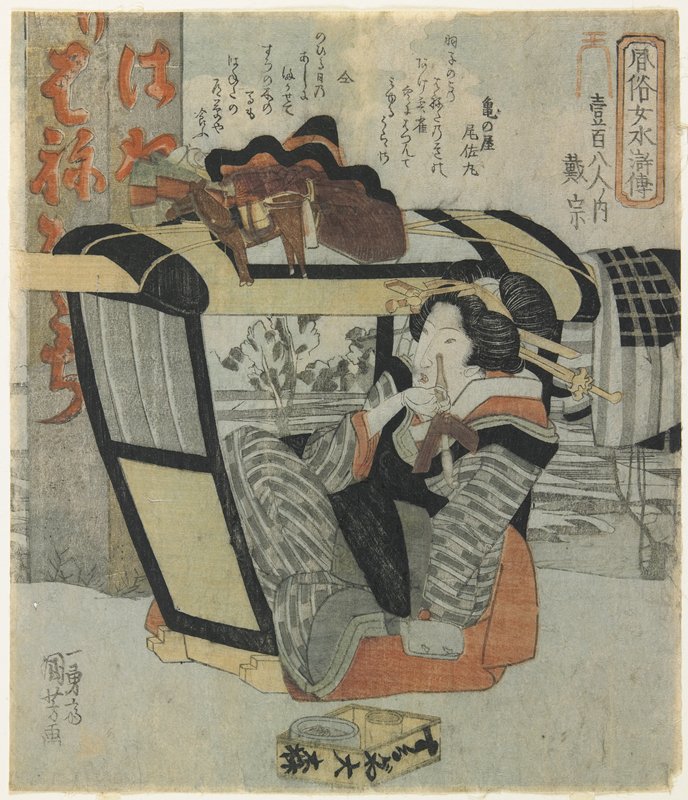
Woman as the Hero Taisō in Palanquin Holding a Pipe
c. 1830
Woodblock print (surimono), ink and color on paper

Yan Qing (Roshi Ensei), from the series "One Hundred and Eight Heroes of the Popular Water Margin (Tsuzoku Suikoden goketsu hyakuhachinin no hitori)"

Poem by Abe no Nakamaro, from an untitled series of One Hundred Poems by One Hundred Poets

Hu Sanniang (Ko Sanjo Ichijosei), from the series "One Hundred and Eight Heroes of the Popular Water Margin (Tsuzoku Suikoden goketsu hyakuhachinin no hitori)"
Frequently Asked Questions
The Paper Snake was created by Utagawa Kuniyoshi (歌川国芳).