![The Star Descends on Echi on the Thirteenth Night of the Ninth Month (Kugatsu jusan yoru Echi shoko), from the series "Concise Illustrated Biography of the Great Priest [Nichiren] (Koso go ichidai ryakuzu)" by Utagawa Kuniyoshi — Japanese Color woodblock print; oban, c. 1830/35](https://www.artic.edu/iiif/2/b8952a32-3c4e-c7f7-129e-772f2eb64254/full/843,/0/default.jpg)
The Star Descends on Echi on the Thirteenth Night of the Ninth Month (Kugatsu jusan yoru Echi shoko), from the series "Concise Illustrated Biography of the Great Priest [Nichiren] (Koso go ichidai ryakuzu)"
- Date:
- c. 1830/35
- Medium:
- Color woodblock print; oban
- Source:
- Art Institute of Chicago
Description
The Star Descends on Echi on the Thirteenth Night of the Ninth Month dramatises one of the great miracle scenes from the life of the priest Nichiren and forms part of Utagawa Kuniyoshi's series Concise Illustrated Biography of the Great Priest, published around 1825 and held in the Art Institute of Chicago. According to the Nichiren tradition, as the priest was preparing for execution at Tatsunokuchi he was saved by a brilliant star or luminous body that descended from the night sky and so dazzled his executioners that the sentence could not be carried out; in some accounts the event extends to Echi, where Nichiren was taken following the aborted execution. Kuniyoshi composes the sheet as a charged nocturnal scene with a streaking celestial body, awe-struck onlookers, and the still figure of the priest at the centre. The dramatic chiaroscuro of moonlit landscape, the controlled use of black areas, and the sweep of robes and lances anticipate the night-sky compositions that Kuniyoshi would refine in his later musha-e. Although the series is not strictly a warrior project, it borrows generously from the visual repertoire that he had been developing in early Edo ukiyo-e warrior prints, particularly his Suikoden designs of the late 1820s. The print thus stands at a productive crossroads in Kuniyoshi's career, where religious narrative, history, and musha-e energies converge. It also documents the cultural significance of the Nichiren tradition in late-Edo Japan, where the priest's miracles supplied a continuing reservoir of dramatic subject matter for publishers and audiences alike.
More Prints by Utagawa Kuniyoshi
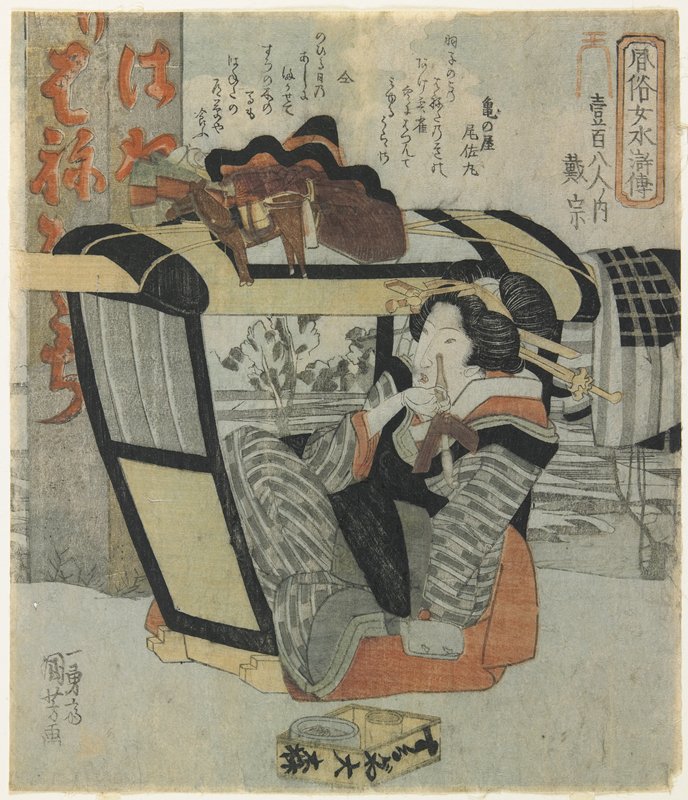
Woman as the Hero Taisō in Palanquin Holding a Pipe
c. 1830
Woodblock print (surimono), ink and color on paper

Yan Qing (Roshi Ensei), from the series "One Hundred and Eight Heroes of the Popular Water Margin (Tsuzoku Suikoden goketsu hyakuhachinin no hitori)"

Poem by Abe no Nakamaro, from an untitled series of One Hundred Poems by One Hundred Poets

Hu Sanniang (Ko Sanjo Ichijosei), from the series "One Hundred and Eight Heroes of the Popular Water Margin (Tsuzoku Suikoden goketsu hyakuhachinin no hitori)"
Frequently Asked Questions
The Star Descends on Echi on the Thirteenth Night of the Ninth Month (Kugatsu jusan yoru Echi shoko), from the series "Concise Illustrated Biography of the Great Priest [Nichiren] (Koso go ichidai ryakuzu)" was created by Utagawa Kuniyoshi (歌川国芳) in c. 1830/35.
Yes — The Star Descends on Echi on the Thirteenth Night of the Ninth Month (Kugatsu jusan yoru Echi shoko), from the series "Concise Illustrated Biography of the Great Priest [Nichiren] (Koso go ichidai ryakuzu)" is part of the Concise Illustrated Biography of the Great Priest [Nichiren] (Koso go ichidai ryakuzu) series by Utagawa Kuniyoshi.