Triptych: Three Kabuki Actors
- Date:
- Late Edo period, circa 1847-1852
- Medium:
- Right panel from an ukiyo-e woodblock-printed "ōban" triptych; ink and color on paper
- Source:
- Harvard Art Museums
Description
Dated to 1847, this Utagawa Kuniyoshi triptych presents three kabuki actors across three vertically oriented ōban sheets designed to be read as a single composition. The work belongs to the yakusha-e (actor print) strand of Edo ukiyo-e that Kuniyoshi practiced throughout his career alongside his celebrated warrior prints; while the Utagawa school was dominated in actor portraiture by Kunisada, Kuniyoshi brought a more sculptural, theatrically charged sensibility to the genre. Each panel isolates a figure in costume and stage attitude, with the linked baselines and complementary poses across the three sheets producing the kind of stretched, mural-like composition Kuniyoshi favored for his triptychs of the 1840s. The print also has to be understood in its censorship context: in 1842 the Tenpō reforms had banned the depiction of named actors and licensed-quarter beauties, and although enforcement eased after 1847, designers like Kuniyoshi still routinely staged actor likenesses with obliquely encoded mon, role names, and theatrical attributes rather than direct cartouches. The triptych's careful color register, strong outline carving, and the controlled use of saturated reds and indigos are typical of high-quality Edo block printing at midcentury. The Harvard Art Museums hold this impression as part of their substantial Kuniyoshi corpus, where it sits alongside his historical, warrior, and genre prints. Source: Harvard Art Museums (object 71743).
More Prints by Utagawa Kuniyoshi
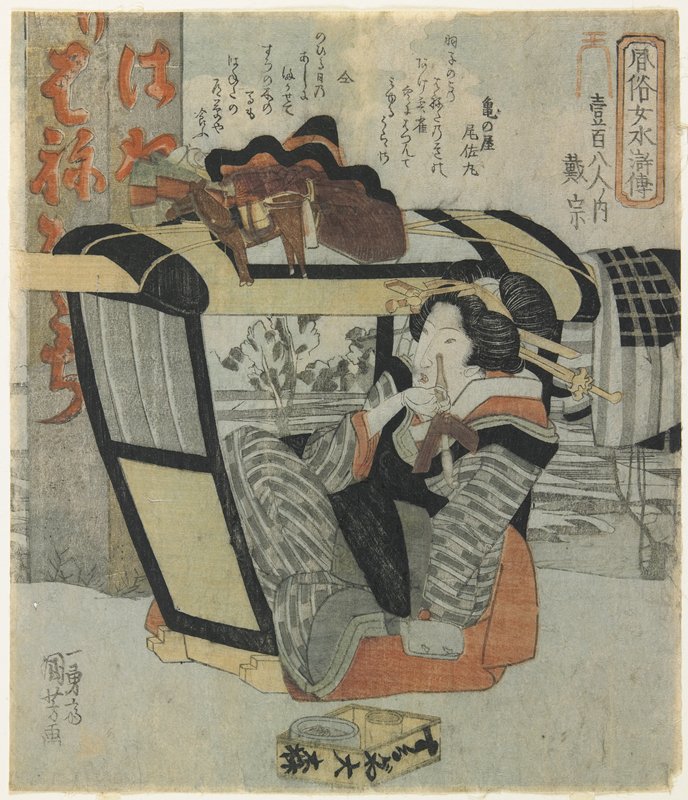
Woman as the Hero Taisō in Palanquin Holding a Pipe
c. 1830
Woodblock print (surimono), ink and color on paper

Yan Qing (Roshi Ensei), from the series "One Hundred and Eight Heroes of the Popular Water Margin (Tsuzoku Suikoden goketsu hyakuhachinin no hitori)"

Poem by Abe no Nakamaro, from an untitled series of One Hundred Poems by One Hundred Poets

Hu Sanniang (Ko Sanjo Ichijosei), from the series "One Hundred and Eight Heroes of the Popular Water Margin (Tsuzoku Suikoden goketsu hyakuhachinin no hitori)"
Frequently Asked Questions
Triptych: Three Kabuki Actors was created by Utagawa Kuniyoshi (歌川国芳) in Late Edo period, circa 1847-1852.