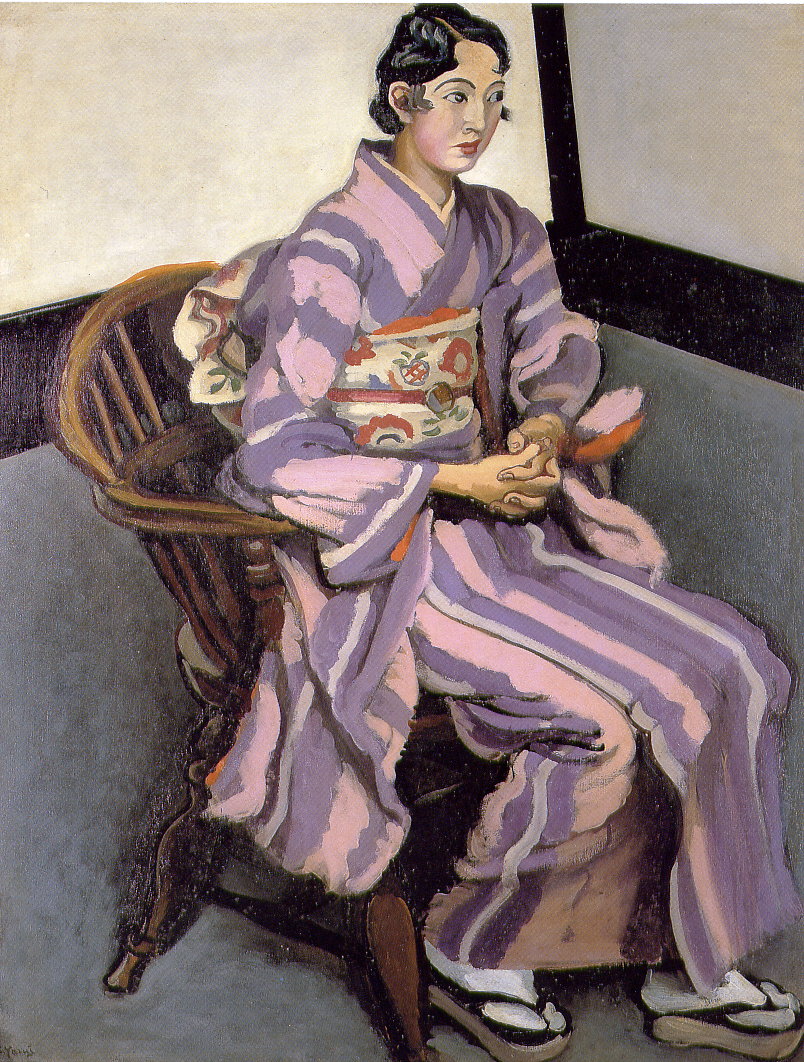
Portrait of a Woman
婦人像
by Yasui Sōtarō
- Date:
- 1930
- Medium:
- Oil on canvas
Description
Held in the National Museum of Modern Art, Kyoto, Portrait of a Woman (Fujin-zō, 1930) is the watershed canvas of Yasui Sōtarō's career and the painting for which he was awarded the Imperial Art Academy Prize, confirming his standing as the leading portrait painter of late-Taishō and early-Shōwa yōga. The vertical oil, 115 by 87 cm, shows a Japanese sitter seated in a high-backed chair, the body half-turned to the viewer's right and the gaze brought frontally to the picture plane in the quiet, ceremonial pose that became the signature of the Yasui-shiki shōzō. The handling is the mature Cézannism that Yasui had been developing through the 1920s — the contour drawing firm and dark, the modelling reduced to constructive planes of dulled green, brown and the chalky flesh tones of the face and hands, the local colour kept severely low and the chair, the kimono and the sitter's head arranged in a tightly resolved triangular composition. The painting was the first of the great commissioned portraits — the 1934 Tamamushi Sensei and Chin-Jung followed it directly — and is the canonical document of the Yasui-type portrait that dominated Japanese realist oil painting for the rest of the pre-war decade.
More Prints by Yasui Sōtarō


Frequently Asked Questions
Portrait of a Woman (婦人像) was created by Yasui Sōtarō (安井曾太郎) in 1930.