
Yasui Sōtarō
安井曾太郎
1888–1955
Japan
Biography
Yasui Sōtarō (安井曾太郎, 1888–1955) was one of the two great figures of mature Shōwa-era yōga (Western-style painting), the other being his lifelong friend Umehara Ryūzaburō. Together the pair represented the highest reach of pre-war and early post-war oil painting in Japan, and their parallel careers — both born in 1888, both trained in the Asai Chū circle in Kyoto, both sent to Paris in the late Meiji, both crowned in 1952 with the Order of Culture (文化勲章), Japan's highest civilian honour for artistic and cultural achievement — became the canonical narrative through which Shōwa yōga was taught and collected. Where Umehara embraced the saturated colour and decorative joy of post-Renoir painting, Yasui chose the harder road of Cézanne — structural drawing, severe colour, and the patient construction of the figure in space — and from the late 1920s onward he produced the central body of Japanese realist portraiture against which later yōga portrait painting was measured.
Yasui was born on 17 May 1888 in the Nakagyō district of Kyoto, the fifth son of a prosperous wholesale cotton dealer of the Yasui family. He showed an early facility for drawing but was directed by his father into the Kyoto City Commercial School in preparation for the family business. In 1903, at fifteen, he abandoned commerce against his family's wishes, and the following year entered the Shōgoin Yōga Kenkyūjo, the private painting institute founded in Kyoto by Asai Chū, the leading Meiji oil painter, recently returned from a long period of study in France. Asai's institute, which was reorganised in 1906 as the Kansai Bijutsu-in (Kansai Fine Art Academy), was the formative ground of a remarkable generation: alongside Yasui studied Umehara Ryūzaburō and Tsuda Seifū. Asai died unexpectedly late in 1907, but in his years under Asai's teaching Yasui had absorbed both the academic gospel of careful drawing from the figure and the Meiji idea that a young Japanese yōga painter should — if at all possible — finish his training in France.
In April 1907 Yasui, still eighteen, sailed for Marseille with Tsuda Seifū. He settled in Paris and enrolled at the Académie Julian, the open private academy that was for a generation the principal training ground of foreign students in the city, where he studied under the history painter Jean-Paul Laurens. He spent his free hours in the Louvre and at the regular exhibitions of the Salon d'Automne and the Salon des Indépendants. The decisive encounter of these years was with Paul Cézanne: soon after Yasui's arrival, the great Cézanne memorial exhibition at the 1907 Salon d'Automne set the course of his art, and he steeped himself in the master's work, learning to build the figure from constructive planes of colour. Where his friend Umehara, who reached Paris in 1908, at once fell under the spell of Renoir, Yasui set himself the harder discipline of Cézanne. The contrast between the two — Yasui the Cézannist, Umehara the Renoir devotee — would frame the rest of their parallel careers.
The outbreak of the First World War in August 1914, together with his own failing health, forced Yasui to leave Paris after seven years. He returned to Japan late in 1914 with the canvases and works on paper he had produced in France. At the second Nikakai (Second Section Society) exhibition in the autumn of 1915 — the Nikakai being the breakaway anti-Bunten exhibiting body founded the previous year by Ishii Hakutei, Yamashita Shintarō, Arishima Ikuma and others — he showed forty-four of his Paris paintings. The showing was a critical sensation: for the first time a Japanese painter had returned from Paris with a fully formed Cézannist manner. Yasui was at once elected a member of the Nikakai, a position he would hold until 1936.
The period from 1915 to the mid-1920s was one of personal difficulty. Yasui, whose health had always been fragile, spent several years in poor health and semi-convalescence after his return, producing relatively few finished paintings; the work he did show remained close to the Paris manner of his student years and was felt by critics to lack the urgency of the 1915 debut. By the mid-1920s, however, he had recovered, settled in Tokyo, married, and begun to develop the assured Shōwa style that became his signature: a Cézannist construction of the figure made monumental, the modelling drawn with a hard contour, the local colour kept low and slightly chalky, and the sitter brought right to the picture plane in a quiet, almost ceremonial frontality. The mature works of this new manner, such as Black-Haired Woman (Kurokami no onna, 1924) and the Portrait of a Woman (Fujin-zō, 1930), confirmed Yasui as the leading portrait painter of his generation.
The 1930s were Yasui's central decade. Roses (1932, Artizon Museum) was the painting through which Cézanne's late still-life manner entered the standard Japanese yōga repertoire. Above all the Portrait of Chin-Jung (Kinyō, 1934, National Museum of Modern Art, Tokyo) established what Japanese critics still call the Yasui-shiki shōzō (the Yasui-type portrait), in which the sitter is brought up to the plane in an almost iconic frontality, the body subtly recomposed from sketches drawn from many angles to suggest the latent possibility of movement. The painting depicts Odagiri Mineko, a Tokyo-born and multilingual young woman, the daughter of a Japanese consul-general in Shanghai, who was known by the Chinese name Chin-Jung (金蓉). In 1935 Yasui was elected a member of the Imperial Art Academy. The following year he, Arishima Ikuma and their colleagues led the breakaway from the Nikakai that became the Issuikai (一水会, founded 1936), an exhibiting body intended to give a more disciplined, technically rigorous home to Cézannist and post-Cézannist painting, and Yasui directed its exhibitions for the rest of his life. The wartime Portrait of Yokoyama Taikan (1943), in which the venerable nihonga master is shown frontally and at half-length against a plain ground, stands as the great example of one yōga master taking the measure of the leading nihonga painter of the age.
In 1944 Yasui was appointed professor of oil painting at the Tokyo School of Fine Arts (now Tokyo University of the Arts), becoming a formative teacher of the next generation of Japanese realist painters. The post-war years were the period of his greatest public visibility, and in his later years he also provided cover art for the leading literary monthly Bungei Shunjū, carrying his vision of yōga to a wide popular readership. In 1950 the Granddaughter (Magomusume, Ohara Museum of Art), a tender study of a small child seated in a child's chair against a Cézannist patchwork of green and rose, became one of the best-loved images in modern Japanese painting. On 3 November 1952 he received the Order of Culture in the same honours list as his friend Umehara Ryūzaburō, the novelist Nagai Kafū and the physicist Tomonaga Shin'ichirō. Yasui died in Tokyo on 14 December 1955 at the age of sixty-seven, of heart failure while convalescing from pneumonia. He is buried at Shōkaku-ji in the Taitō district of Tokyo. The major holdings of his work are at the National Museum of Modern Art, Tokyo (MOMAT), the National Museum of Modern Art, Kyoto, the Artizon Museum, the Ishibashi Museum of Art at Kurume, the Ohara Museum of Art, the Museum of Modern Art Kamakura and the Tokyo University of the Arts University Art Museum.
Key Facts
- Active Period
- 1888–1955
- Nationality
- 🇯🇵Japan
- Works Indexed
- 13
Frequently Asked Questions
Yasui Sōtarō (安井曾太郎, 1888–1955) was one of the two great figures of mature Shōwa-era yōga (Western-style painting), the other being his lifelong friend Umehara Ryūzaburō. Together the pair represented the highest reach of pre-war and early post-war oil painting in Japan, and their parallel careers — both born in 1888, both trained in the Asai Chū circle in Kyoto, both sent to Paris in the late Meiji, both crowned in 1952 with the Order of Culture (文化勲章), Japan's highest civilian honour for artistic and cultural achievement — became the canonical narrative through which Shōwa yōga was taught and collected. Where Umehara embraced the saturated colour and decorative joy of post-Renoir painting, Yasui chose the harder road of Cézanne — structural drawing, severe colour, and the patient construction of the figure in space — and from the late 1920s onward he produced the central body of Japanese realist portraiture against which later yōga portrait painting was measured.
Yasui Sōtarō was active from 1888 to 1955.
Original prints by Yasui Sōtarō can be found in collections including National Museum of Modern Art, Kyoto, The Museum of Art, Ehime, Private collection (Japanese), Ohara Museum of Art, Kurashiki.
Woodblock Prints by Yasui Sōtarō (13)

Nude with Black Hair
黒髪の裸婦
1913
Oil on canvas

Bathing Nudes
水浴裸婦
1914
Oil on canvas

Nude in the Trees
樹下裸婦
1919
Oil on canvas

Seated Woman
座婦
1929
Oil on canvas
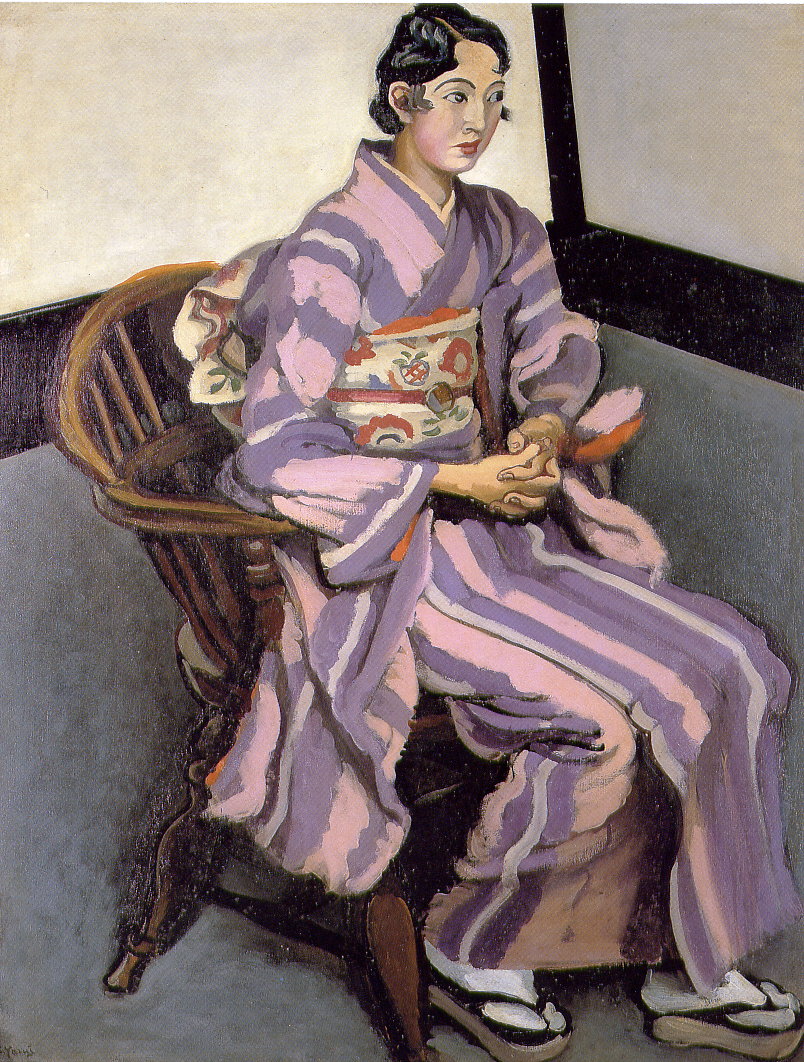
Portrait of a Woman
婦人像
1930
Oil on canvas
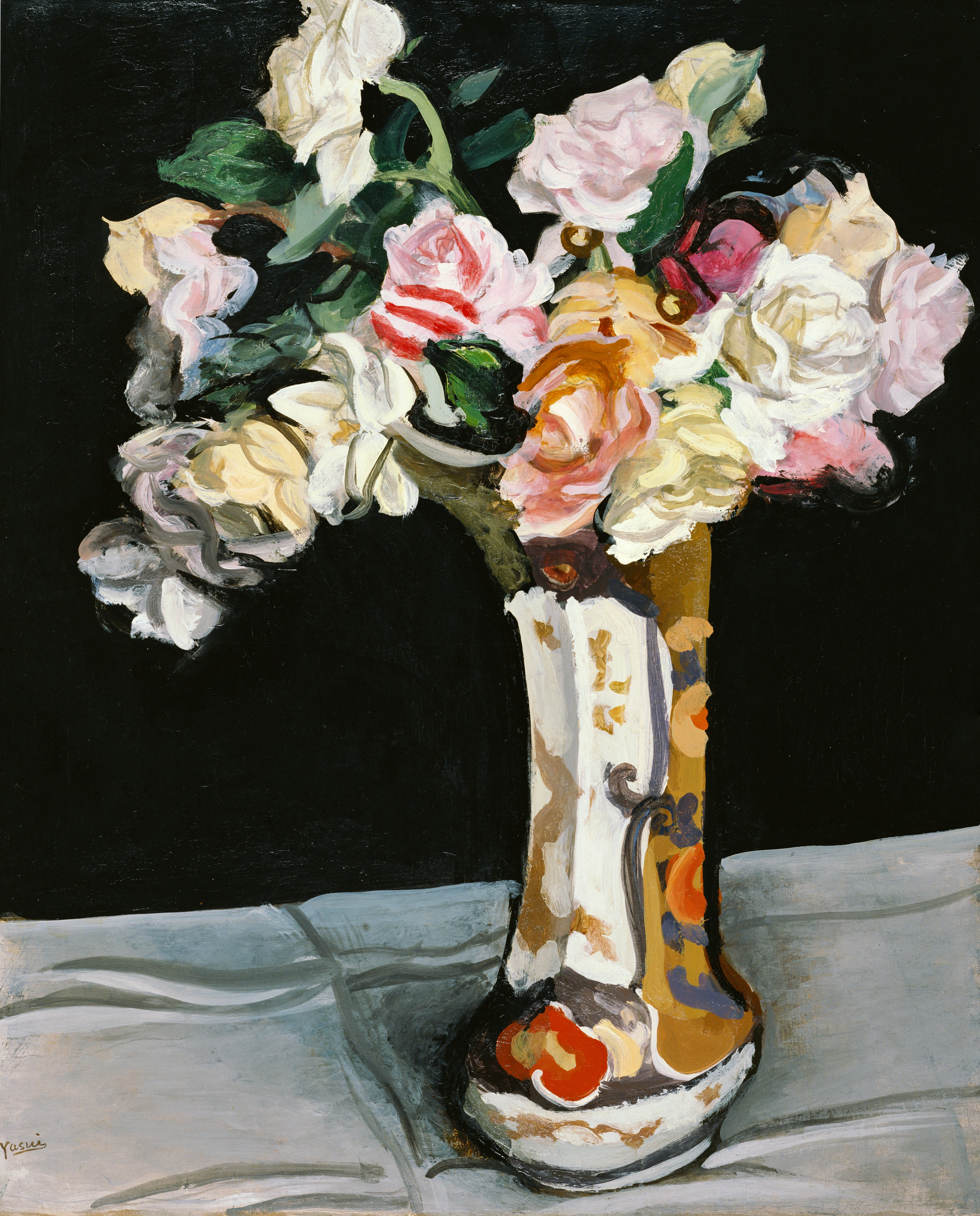
Roses
薔薇
1932
Oil on canvas

Portrait of Tamamushi Sensei
玉虫先生像
1934
Oil on canvas

Portrait of Chin-Jung
金蓉
1934
Oil on canvas

Landscape, Urabandai
裏磐梯風景
1935
Oil on canvas

Portrait of Mrs. F.
F夫人像
1939
Oil on canvas

Mount Yakedake
焼岳
1941
Oil on canvas

Portrait of Yokoyama Taikan
横山大観像
1943
Oil on canvas

Granddaughter
孫娘
1950
Oil on canvas