Daimonji (大文字)
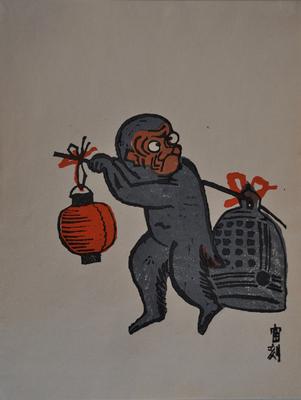
1 print by 1 artist
About Daimonji
Daimonji refers to the practice of writing the character dai (大), meaning great, in enormous form on the slope of Mount Nyoigatake (also called Mount Daimonji) on the eastern edge of Kyoto and igniting the laid-out beds of brush at nightfall on the sixteenth day of August. The character is the largest and most famous of the five mountainside characters that together form the Gozan no Okuribi, the lighting of fires on five mountains, a Bon Festival observance dating in its present form to at least the late Muromachi or Edo period and possibly older. The other four characters and shapes, lit in sequence after the great dai on Nyoigatake, include a second dai on Mount Hidaridaimonji (Left Daimonji) to the northwest above the Kamigamo district, the characters myo (妙) and ho (法), meaning the law of the Buddha, on adjacent slopes north of the city above the Matsugasaki district, the form of a boat (船) on Mount Funayama north of Kinkakuji, and the form of a torii gate (鳥居) on Mount Mandara above the western suburbs near Saga. The ceremony marks the close of the Obon period in mid-August in which the spirits of ancestors are believed to return to their families, with the fires understood as okuribi, or send-off fires, that guide the souls of the dead back to the other world after their brief annual visit. The historical origin of the practice is uncertain, with traditional attributions variously to Kobo Daishi Kukai in the early Heian period, to the Heian poet Onono Takamura, or to the Muromachi shogun Ashikaga Yoshimasa in connection with the Obon observances of the late fifteenth century; modern scholarly consensus is that the present form likely consolidated in the Edo period. For Japanese printmaking the Daimonji functions both as a specific calendrical motif and as a recognizable feature of the Kyoto skyline. The form of the great character appears in late Edo and Meiji prints of Kyoto and recurs in twentieth-century shin-hanga and sosaku-hanga sheets. Kawase Hasui treated the Daimonji slope in views of the Kamogawa River with the burning character visible on the mountain above, and Tokuriki Tomikichiro and other Kyoto-based artists incorporated the motif into their Kyoto-centered creative-print series, including treatments of the night sky with the burning character against the dark cone of the mountain. Asano Takeji and Tsuchiya Koitsu also produced compositions in which Mount Daimonji figures as part of the eastern Kyoto skyline. The visual character of Daimonji in prints is built on the dark cone of Nyoigatake against the night sky, the lines of fire arranged in the form of the great character with its three principal strokes laid out as broad beds of pine brush and pine logs ignited by the local hozenkai association, and frequently the foreground river, bridge, and rooftops of the city below, often with figures of viewers gathered to watch. Contemporary observers gather along the Kamogawa River, on rooftops in the Higashiyama district, on the platforms of major buildings in central Kyoto, and at hilltop sites west of the city to view the lighting on August 16, with the ceremony remaining one of the most heavily attended seasonal observances in Kyoto and one of the principal events of the Kyoto summer calendar alongside the Gion Matsuri.
Prints Depicting Daimonji (1)

Artists Who Depicted Daimonji (1)
Frequently Asked Questions
Daimonji refers to the practice of writing the character dai (大), meaning great, in enormous form on the slope of Mount Nyoigatake (also called Mount Daimonji) on the eastern edge of Kyoto and igniting the laid-out beds of brush at nightfall on the sixteenth day of August. The character is the largest and most famous of the five mountainside characters that together form the Gozan no Okuribi, the lighting of fires on five mountains, a Bon Festival observance dating in its present form to at least the late Muromachi or Edo period and possibly older. The other four characters and shapes, lit in sequence after the great dai on Nyoigatake, include a second dai on Mount Hidaridaimonji (Left Daimonji) to the northwest above the Kamigamo district, the characters myo (妙) and ho (法), meaning the law of the Buddha, on adjacent slopes north of the city above the Matsugasaki district, the form of a boat (船) on Mount Funayama north of Kinkakuji, and the form of a torii gate (鳥居) on Mount Mandara above the western suburbs near Saga. The ceremony marks the close of the Obon period in mid-August in which the spirits of ancestors are believed to return to their families, with the fires understood as okuribi, or send-off fires, that guide the souls of the dead back to the other world after their brief annual visit. The historical origin of the practice is uncertain, with traditional attributions variously to Kobo Daishi Kukai in the early Heian period, to the Heian poet Onono Takamura, or to the Muromachi shogun Ashikaga Yoshimasa in connection with the Obon observances of the late fifteenth century; modern scholarly consensus is that the present form likely consolidated in the Edo period. For Japanese printmaking the Daimonji functions both as a specific calendrical motif and as a recognizable feature of the Kyoto skyline. The form of the great character appears in late Edo and Meiji prints of Kyoto and recurs in twentieth-century shin-hanga and sosaku-hanga sheets. Kawase Hasui treated the Daimonji slope in views of the Kamogawa River with the burning character visible on the mountain above, and Tokuriki Tomikichiro and other Kyoto-based artists incorporated the motif into their Kyoto-centered creative-print series, including treatments of the night sky with the burning character against the dark cone of the mountain. Asano Takeji and Tsuchiya Koitsu also produced compositions in which Mount Daimonji figures as part of the eastern Kyoto skyline. The visual character of Daimonji in prints is built on the dark cone of Nyoigatake against the night sky, the lines of fire arranged in the form of the great character with its three principal strokes laid out as broad beds of pine brush and pine logs ignited by the local hozenkai association, and frequently the foreground river, bridge, and rooftops of the city below, often with figures of viewers gathered to watch. Contemporary observers gather along the Kamogawa River, on rooftops in the Higashiyama district, on the platforms of major buildings in central Kyoto, and at hilltop sites west of the city to view the lighting on August 16, with the ceremony remaining one of the most heavily attended seasonal observances in Kyoto and one of the principal events of the Kyoto summer calendar alongside the Gion Matsuri.
Hanga catalogues 1 print depicting Daimonji (大文字), by 1 artist.
Tomikichiro Tokuriki is among the 1 artist who depicted Daimonji in our collection.
Want to rate prints from Daimonji?
Sign up to start rating