Mount Yoshino (吉野山)
1 print by 1 artist
About Mount Yoshino
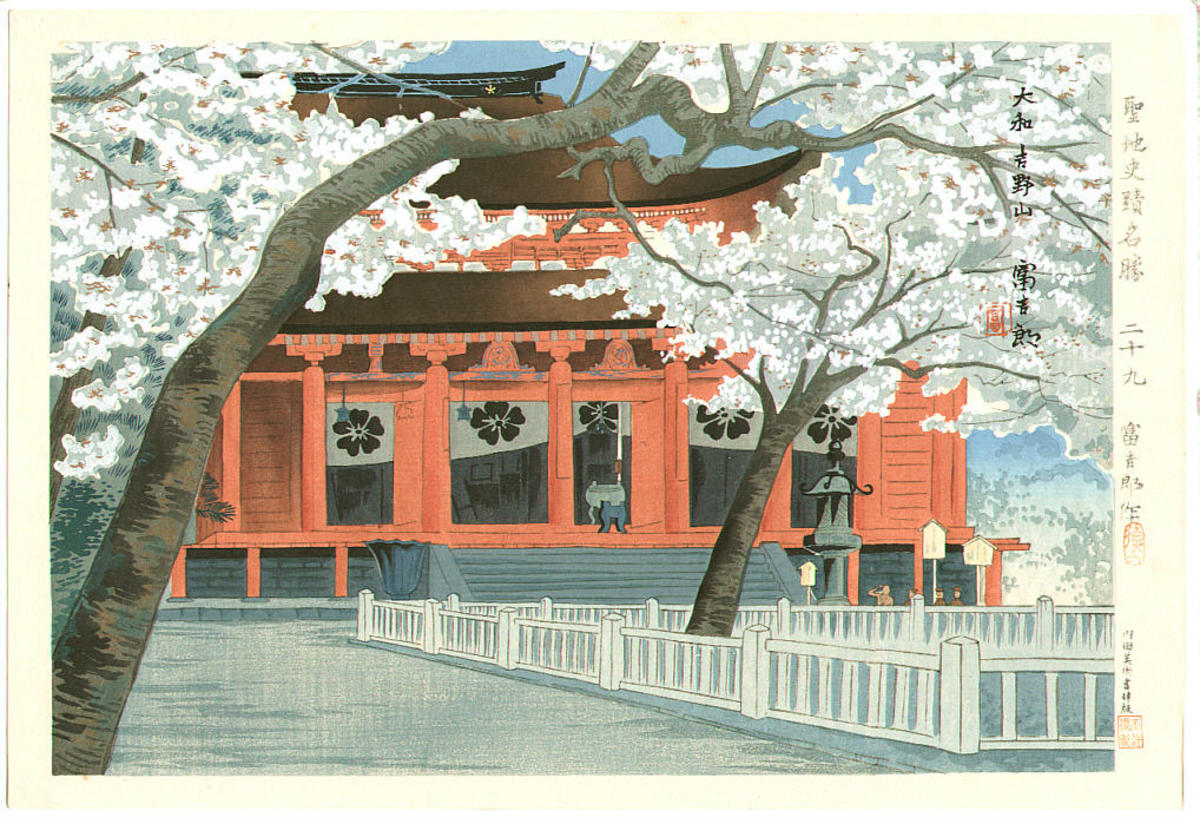
Mount Yoshino, in Japanese Yoshinoyama, refers collectively to a wooded mountain range and the surrounding district in central Nara Prefecture, southwest of the city of Nara in the Kii Peninsula region of Honshu. The area is celebrated principally as the most famous cherry blossom viewing site in Japan, with approximately thirty thousand cherry trees of multiple varieties planted across the four main viewing zones of Shimo Senbon, Naka Senbon, Kami Senbon, and Oku Senbon (Lower, Middle, Upper, and Innermost Thousand Trees), ascending the mountain in successive bands that bloom over a period of approximately one month in late March through April, with the lower bands blooming first and the upper bands following in sequence as the season progresses. The tradition of planting cherries on Yoshino reaches back to at least the Heian period, with extensive planting attributed to En no Gyoja, the seventh-century founder of the Shugendo mountain Buddhist tradition, and to the medieval Shugen practitioners who associated the cherry with the bodhisattva Zao Gongen of the Kinpusen-ji temple at the foot of the mountain. The blossoming of Yoshino has been celebrated in Japanese poetry since at least the eighth-century Manyoshu and the tenth-century Kokin Wakashu, and the mountain is associated with the medieval Shugendo tradition of mountain Buddhist practice, with the Kinpusen-ji temple at the foot of the mountain serving as the headquarters of one of the principal Shugendo schools alongside its sister institution Sanbutsuji at Mount Mitake. Yoshino was the temporary court of Emperor Go-Daigo during the Nanboku-cho period of the fourteenth century, when his Southern Court (Nancho) operated from the mountain in opposition to the Ashikaga-supported Northern Court at Kyoto from 1336 to 1392, and the surviving Yoshimizu Shrine on the mountain preserves several buildings associated with this period. The Yoshino-Kumano region was designated a UNESCO World Heritage Site in 2004 as the Sacred Sites and Pilgrimage Routes in the Kii Mountain Range. For Japanese printmaking Mount Yoshino is most often treated as a meisho specifically associated with cherry blossom, and as a recurrent literary and seasonal subject. The mountain appears in Edo-period meisho-e and in printed guidebook illustration, and in late ukiyo-e and Meiji prints of seasonal phenomena, with Hiroshige treating Yoshino in his Famous Views of the Sixty-Odd Provinces and individual sheets and Hokusai including the mountain in his printed-book sets. The shin-hanga revival included Yoshino in the work of Yoshida Hiroshi, Kawase Hasui, and Tsuchiya Koitsu, who treated the cherry blossom slopes under varied conditions, and Yoshida in particular produced multiple Yoshino compositions for his cherry blossom sets including the celebrated Yoshino in cherry blossom in which the layered pink masses of blossom occupy the receding mountain slopes. Tokuriki Tomikichiro and other Kyoto-based sosaku-hanga artists treated the mountain in their Kansai-region series, and the postwar Nara and Kansai sosaku-hanga circle produced further compositions. The visual character of Mount Yoshino in prints is built on the layered pink masses of cherry blossom on the receding slopes of the mountain, the temple roofs and pagodas of Kinpusen-ji and the secondary temples emerging from the foliage, the diffused atmospheric conditions of the early spring weather, the small figures of pilgrims and viewers on the mountain paths, and frequently the distant view of further mountain ranges beyond. The seasonally most striking views occur at the moment when one band of trees has reached peak blossom while the band above remains in bud, producing the characteristic graded pink composition. Contemporary visitors reach Yoshino via the Kintetsu Yoshino Line from Osaka and Nara to Yoshino Station, then by ropeway to the lower viewing zone, with the principal blossom viewing season concentrated in late March through April depending on year and altitude band.
Prints Depicting Mount Yoshino (1)
Artists Who Depicted Mount Yoshino (1)
Frequently Asked Questions
Mount Yoshino, in Japanese Yoshinoyama, refers collectively to a wooded mountain range and the surrounding district in central Nara Prefecture, southwest of the city of Nara in the Kii Peninsula region of Honshu. The area is celebrated principally as the most famous cherry blossom viewing site in Japan, with approximately thirty thousand cherry trees of multiple varieties planted across the four main viewing zones of Shimo Senbon, Naka Senbon, Kami Senbon, and Oku Senbon (Lower, Middle, Upper, and Innermost Thousand Trees), ascending the mountain in successive bands that bloom over a period of approximately one month in late March through April, with the lower bands blooming first and the upper bands following in sequence as the season progresses. The tradition of planting cherries on Yoshino reaches back to at least the Heian period, with extensive planting attributed to En no Gyoja, the seventh-century founder of the Shugendo mountain Buddhist tradition, and to the medieval Shugen practitioners who associated the cherry with the bodhisattva Zao Gongen of the Kinpusen-ji temple at the foot of the mountain. The blossoming of Yoshino has been celebrated in Japanese poetry since at least the eighth-century Manyoshu and the tenth-century Kokin Wakashu, and the mountain is associated with the medieval Shugendo tradition of mountain Buddhist practice, with the Kinpusen-ji temple at the foot of the mountain serving as the headquarters of one of the principal Shugendo schools alongside its sister institution Sanbutsuji at Mount Mitake. Yoshino was the temporary court of Emperor Go-Daigo during the Nanboku-cho period of the fourteenth century, when his Southern Court (Nancho) operated from the mountain in opposition to the Ashikaga-supported Northern Court at Kyoto from 1336 to 1392, and the surviving Yoshimizu Shrine on the mountain preserves several buildings associated with this period. The Yoshino-Kumano region was designated a UNESCO World Heritage Site in 2004 as the Sacred Sites and Pilgrimage Routes in the Kii Mountain Range. For Japanese printmaking Mount Yoshino is most often treated as a meisho specifically associated with cherry blossom, and as a recurrent literary and seasonal subject. The mountain appears in Edo-period meisho-e and in printed guidebook illustration, and in late ukiyo-e and Meiji prints of seasonal phenomena, with Hiroshige treating Yoshino in his Famous Views of the Sixty-Odd Provinces and individual sheets and Hokusai including the mountain in his printed-book sets. The shin-hanga revival included Yoshino in the work of Yoshida Hiroshi, Kawase Hasui, and Tsuchiya Koitsu, who treated the cherry blossom slopes under varied conditions, and Yoshida in particular produced multiple Yoshino compositions for his cherry blossom sets including the celebrated Yoshino in cherry blossom in which the layered pink masses of blossom occupy the receding mountain slopes. Tokuriki Tomikichiro and other Kyoto-based sosaku-hanga artists treated the mountain in their Kansai-region series, and the postwar Nara and Kansai sosaku-hanga circle produced further compositions. The visual character of Mount Yoshino in prints is built on the layered pink masses of cherry blossom on the receding slopes of the mountain, the temple roofs and pagodas of Kinpusen-ji and the secondary temples emerging from the foliage, the diffused atmospheric conditions of the early spring weather, the small figures of pilgrims and viewers on the mountain paths, and frequently the distant view of further mountain ranges beyond. The seasonally most striking views occur at the moment when one band of trees has reached peak blossom while the band above remains in bud, producing the characteristic graded pink composition. Contemporary visitors reach Yoshino via the Kintetsu Yoshino Line from Osaka and Nara to Yoshino Station, then by ropeway to the lower viewing zone, with the principal blossom viewing season concentrated in late March through April depending on year and altitude band.
Hanga catalogues 1 print depicting Mount Yoshino (吉野山), by 1 artist.
Tomikichiro Tokuriki is among the 1 artist who depicted Mount Yoshino in our collection.
Want to rate prints from Mount Yoshino?
Sign up to start rating