Twelve Views of Tokyo
About This Series
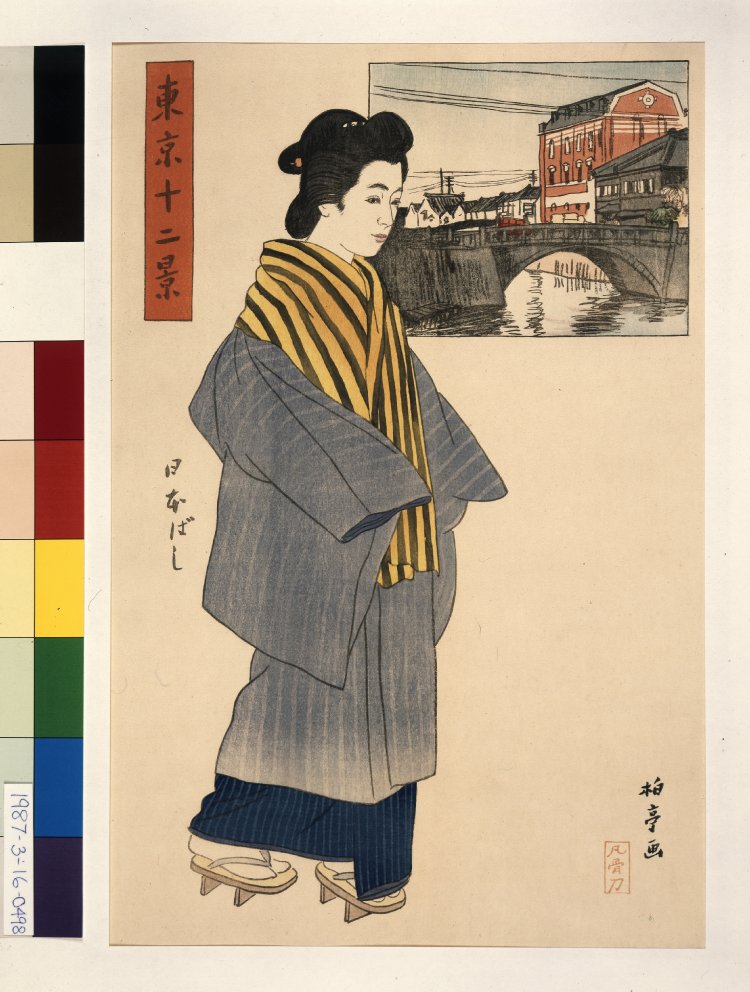
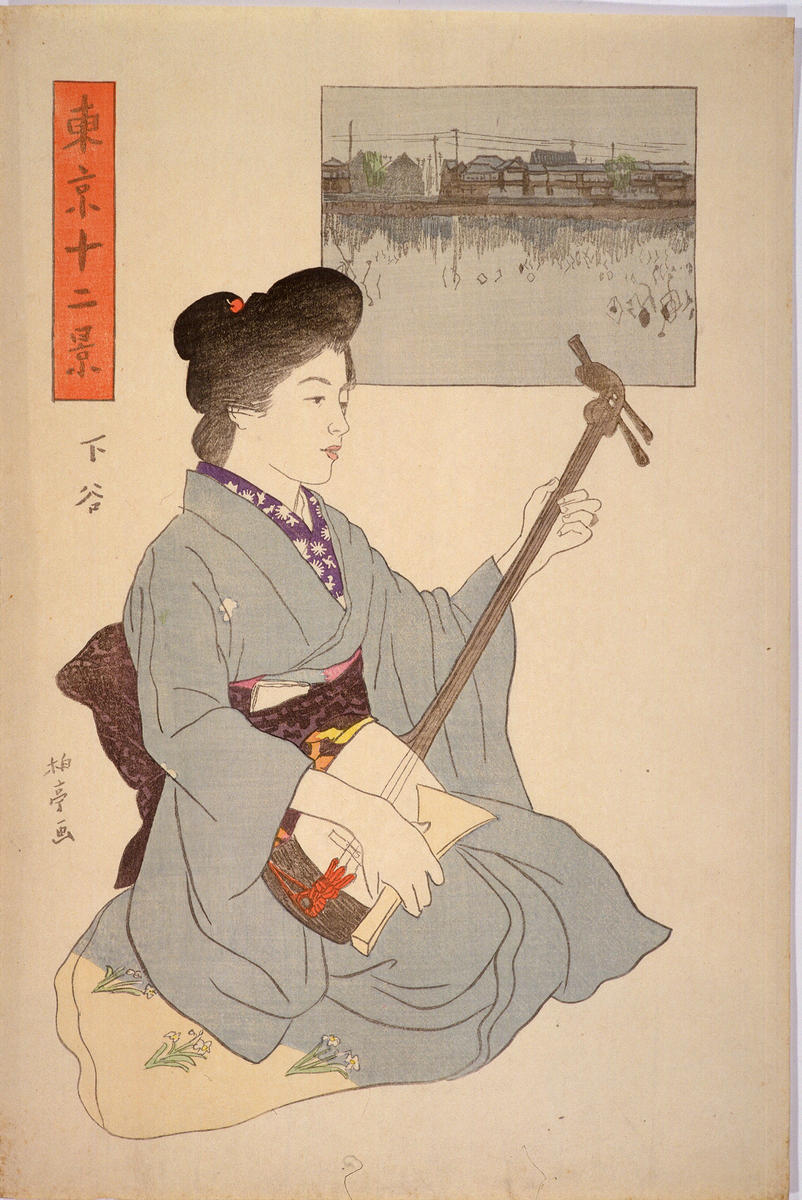
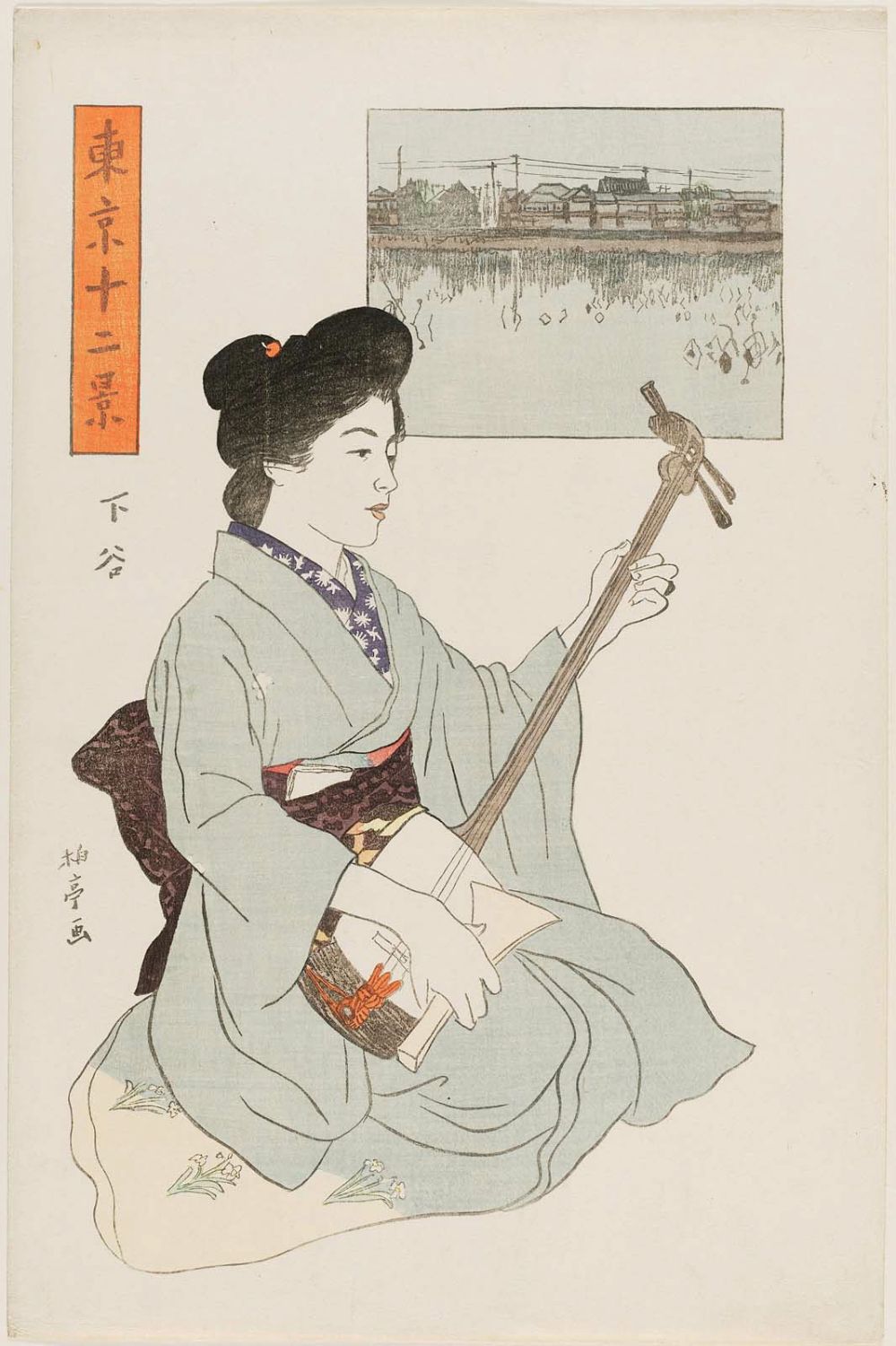
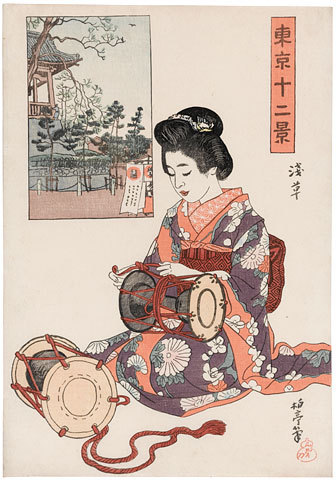
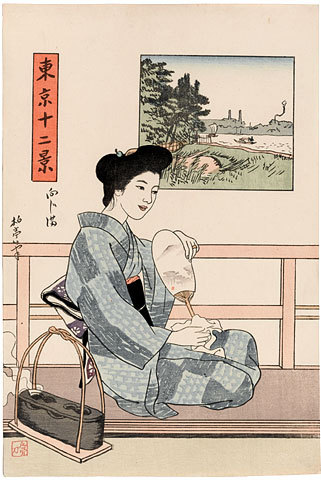
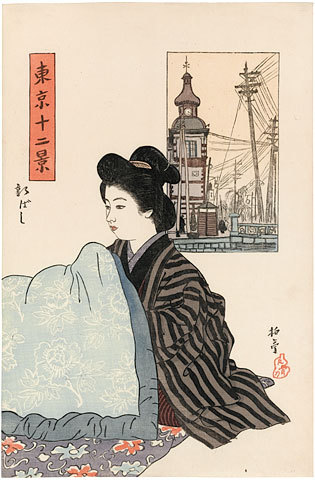
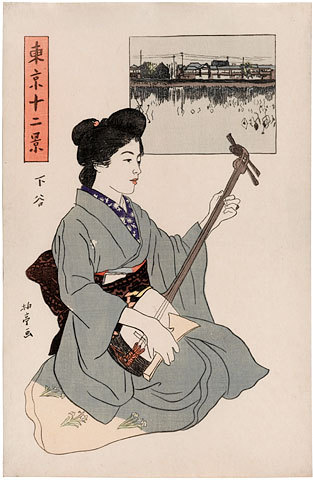
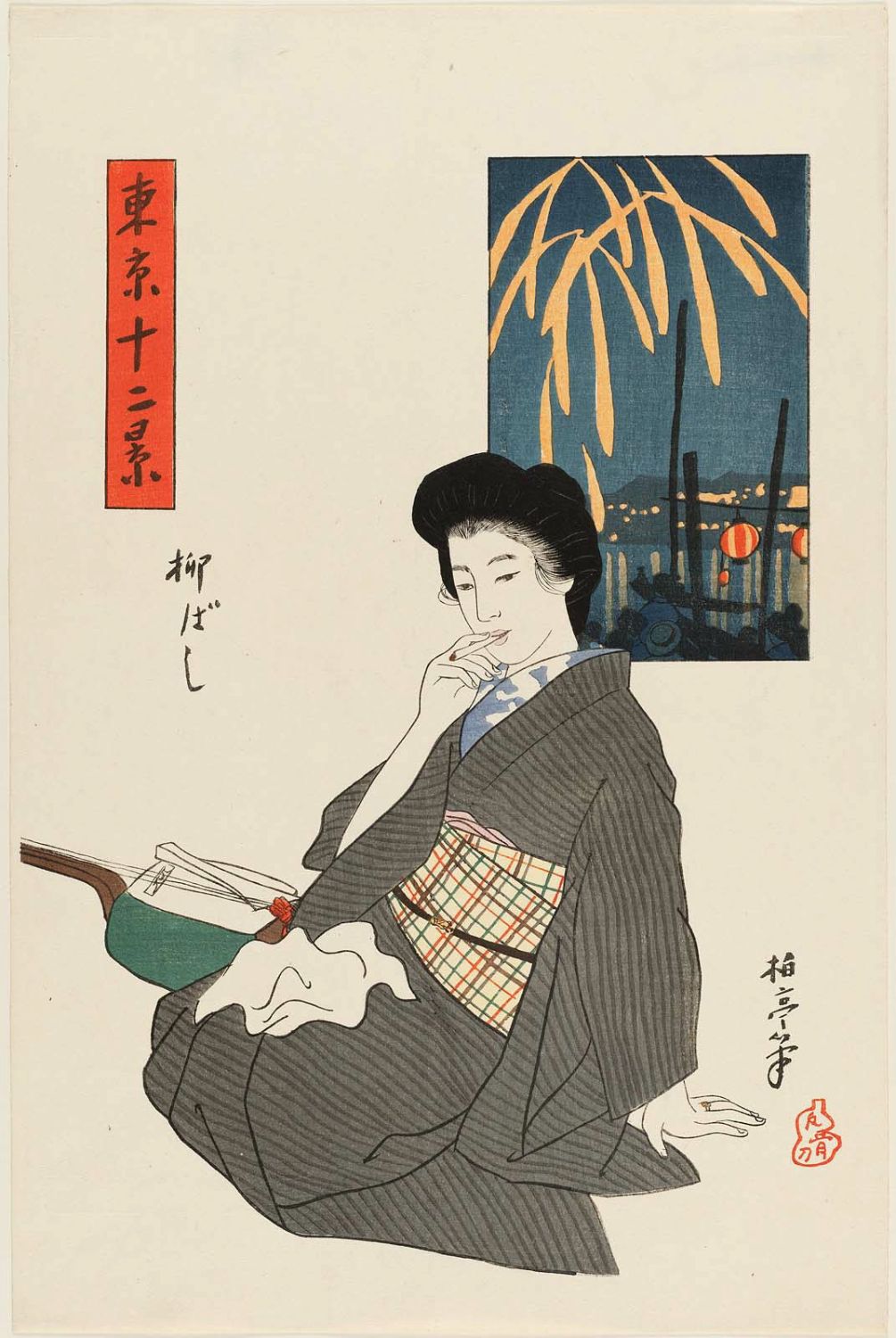
Twelve Views of Tokyo (Tokyo junikei) is the major Tokyo cycle through which Ishii Hakutei addressed the early-twentieth-century capital across the years around 1910 and 1916, designing a sequence of metropolitan figural and atmospheric prints whose particular subject was the working women of Tokyo's various entertainment districts and licensed quarters viewed against the backgrounds of their characteristic urban environments. The cycle pairs each district with a single female figure drawn from its particular trade or community, including the geisha, the cafe waitress, the licensed quarter courtesan, and similar urban women who occupied the night life of Meiji and early Taisho Tokyo, and places her against a landscape or townscape that fixes the district through its characteristic architectural, riverine, or open-air setting. The format collapses bijin-ga and fukei-e into a single hybrid genre, treating the city through its working women as much as through its sites, and the resulting cycle stands as one of the most distinctive contributions to early-twentieth-century Tokyo iconography. Hakutei, who had trained in yoga oil painting through his father's Nihonga workshop and the broader Tokyo art establishment, brought to the project the European-inflected pictorial vocabulary that he had championed through his cofounding of the Heitan Society in 1907 and his subsequent leadership of various yoga and sosaku-hanga organizations, and the Twelve Views accordingly treats its subjects with the modeled volumes, observed contemporary clothing, and atmospheric ground that distinguish his approach from the inherited ukiyo-e bijin-ga tradition. The production method that carried the cycle into print used commercial publishers and the standard division of labor between artist, carver, and printer characteristic of the period rather than the self-cut, self-printed sosaku-hanga practice that Hakutei's peers were beginning to develop in parallel, and the prints accordingly belong to a transitional moment in early-twentieth-century print culture before the doctrinal lines between collaborative shin-hanga and artist-cut sosaku-hanga had hardened. Within Hakutei's career the Twelve Views stands as his most ambitious print project and as one of the works through which he established his reputation as a leading transitional figure between yoga painting and the emerging sosaku-hanga movement, and modern scholarship treats the cycle as a documentary witness to the working women of Meiji and Taisho Tokyo and as a pivotal early example of the European-inflected bijin-ga that would influence subsequent artists including Yamamura Toyonari and Kobayakawa Kiyoshi. Representative impressions are held by major Western collections of twentieth-century Japanese print, including the Art Institute of Chicago, the Museum of Fine Arts in Boston, and the British Museum, where complete or near-complete sets allow direct comparison across the twelve prescribed views.
Prints in This Series (10)
Complete series — all 2 prints catalogued.

Frequently Asked Questions
Twelve Views of Tokyo (Tokyo junikei) is the major Tokyo cycle through which Ishii Hakutei addressed the early-twentieth-century capital across the years around 1910 and 1916, designing a sequence of metropolitan figural and atmospheric prints whose particular subject was the working women of Tokyo's various entertainment districts and licensed quarters viewed against the backgrounds of their characteristic urban environments. The cycle pairs each district with a single female figure drawn from its particular trade or community, including the geisha, the cafe waitress, the licensed quarter courtesan, and similar urban women who occupied the night life of Meiji and early Taisho Tokyo, and places her against a landscape or townscape that fixes the district through its characteristic architectural, riverine, or open-air setting. The format collapses bijin-ga and fukei-e into a single hybrid genre, treating the city through its working women as much as through its sites, and the resulting cycle stands as one of the most distinctive contributions to early-twentieth-century Tokyo iconography. Hakutei, who had trained in yoga oil painting through his father's Nihonga workshop and the broader Tokyo art establishment, brought to the project the European-inflected pictorial vocabulary that he had championed through his cofounding of the Heitan Society in 1907 and his subsequent leadership of various yoga and sosaku-hanga organizations, and the Twelve Views accordingly treats its subjects with the modeled volumes, observed contemporary clothing, and atmospheric ground that distinguish his approach from the inherited ukiyo-e bijin-ga tradition. The production method that carried the cycle into print used commercial publishers and the standard division of labor between artist, carver, and printer characteristic of the period rather than the self-cut, self-printed sosaku-hanga practice that Hakutei's peers were beginning to develop in parallel, and the prints accordingly belong to a transitional moment in early-twentieth-century print culture before the doctrinal lines between collaborative shin-hanga and artist-cut sosaku-hanga had hardened. Within Hakutei's career the Twelve Views stands as his most ambitious print project and as one of the works through which he established his reputation as a leading transitional figure between yoga painting and the emerging sosaku-hanga movement, and modern scholarship treats the cycle as a documentary witness to the working women of Meiji and Taisho Tokyo and as a pivotal early example of the European-inflected bijin-ga that would influence subsequent artists including Yamamura Toyonari and Kobayakawa Kiyoshi. Representative impressions are held by major Western collections of twentieth-century Japanese print, including the Art Institute of Chicago, the Museum of Fine Arts in Boston, and the British Museum, where complete or near-complete sets allow direct comparison across the twelve prescribed views.
The Twelve Views of Tokyo series contains 2 prints, created by Ishii Hakutei.
The Twelve Views of Tokyo series was created by Ishii Hakutei (石井柏亭).
We currently have 10 of 2 known prints from the Twelve Views of Tokyo series indexed in our collection. Browse them all on this page.
Want to rate prints from Twelve Views of Tokyo?
Sign up to start rating