Dutch-style Pictures: Eight Views of Edo
About This Series
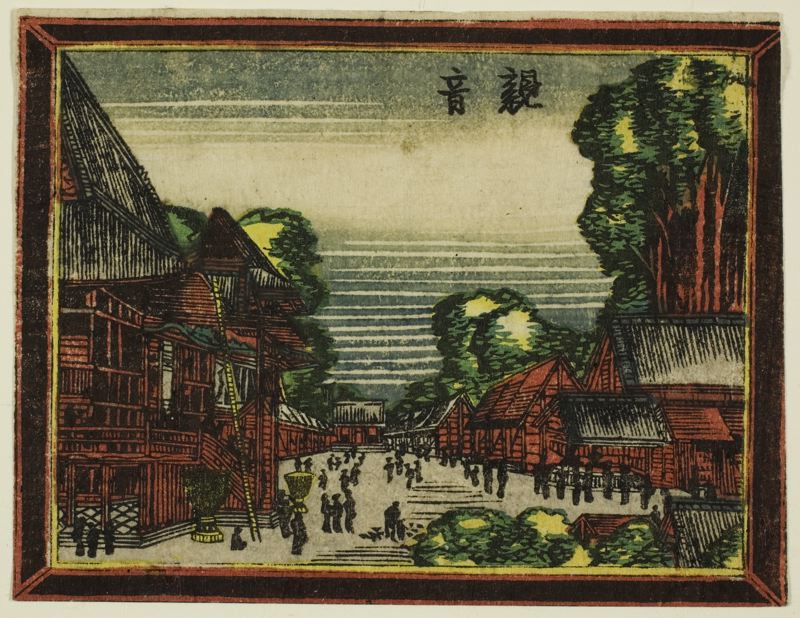
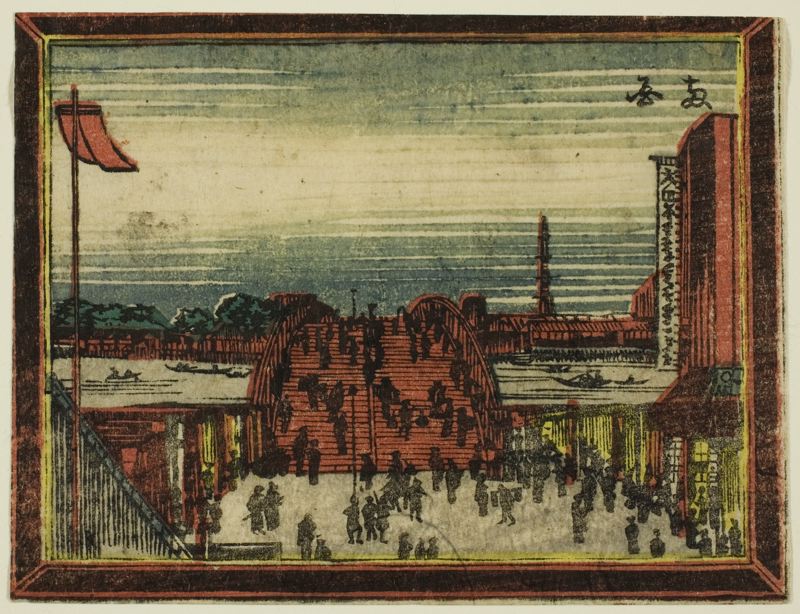
Dutch-style Pictures: Eight Views of Edo (Oranda gafu Edo hakkei) belongs to the small body of experimental prints in which Katsushika Hokusai applied the linear perspective and the engraver-like hatching he had absorbed from imported European etchings and from the rangaku, or Dutch studies, that circulated through Nagasaki and into late-Edo literati culture. The cycle, generally assigned to the first decade of the nineteenth century when the artist was working under the Sori and early Hokusai signatures, transposed the inherited Chinese eight-view convention to a roster of Edo sites including bridges, riverbanks, and shrine grounds, and reimagined them through a Western pictorial idiom of converging orthogonals, modeled shading, and an unusually deep recession into distance. The reference to oranda, the standard Edo-period term for the Netherlands and by extension for Western things generally, signaled to the print's contemporary audience that the set's pictorial novelty was its principal selling point rather than its topographical content, and the small cycle accordingly belongs as much to the history of Edo's engagement with European visual culture as to the meisho-e tradition proper. As an early-career experiment, the series anticipates by more than two decades the great landscape projects of Hokusai's Iitsu period, in which he would translate the lessons of Western perspective into the more thoroughly synthesized fukei-e vocabulary of the Thirty-six Views of Mount Fuji and related cycles. The Dutch-style Edo prints belong to the same impulse that produced his rare etching-style sets, his uki-e perspective views, and other formal experiments through which he tested how far the inherited ukiyo-e medium could be stretched toward Western pictorial conventions without abandoning the native idiom altogether. Modern scholarship treats the small cycle as an important documentary witness to the rangaku influence on late-Edo print culture and to the formative experimental period of Hokusai's career, and surviving impressions are scarce and prized by collectors of his pre-1810 work and by historians of Japan's pictorial engagement with Europe before the Meiji opening.
Prints in This Series (2)
Complete series — all 2 prints catalogued.
Frequently Asked Questions
Dutch-style Pictures: Eight Views of Edo (Oranda gafu Edo hakkei) belongs to the small body of experimental prints in which Katsushika Hokusai applied the linear perspective and the engraver-like hatching he had absorbed from imported European etchings and from the rangaku, or Dutch studies, that circulated through Nagasaki and into late-Edo literati culture. The cycle, generally assigned to the first decade of the nineteenth century when the artist was working under the Sori and early Hokusai signatures, transposed the inherited Chinese eight-view convention to a roster of Edo sites including bridges, riverbanks, and shrine grounds, and reimagined them through a Western pictorial idiom of converging orthogonals, modeled shading, and an unusually deep recession into distance. The reference to oranda, the standard Edo-period term for the Netherlands and by extension for Western things generally, signaled to the print's contemporary audience that the set's pictorial novelty was its principal selling point rather than its topographical content, and the small cycle accordingly belongs as much to the history of Edo's engagement with European visual culture as to the meisho-e tradition proper. As an early-career experiment, the series anticipates by more than two decades the great landscape projects of Hokusai's Iitsu period, in which he would translate the lessons of Western perspective into the more thoroughly synthesized fukei-e vocabulary of the Thirty-six Views of Mount Fuji and related cycles. The Dutch-style Edo prints belong to the same impulse that produced his rare etching-style sets, his uki-e perspective views, and other formal experiments through which he tested how far the inherited ukiyo-e medium could be stretched toward Western pictorial conventions without abandoning the native idiom altogether. Modern scholarship treats the small cycle as an important documentary witness to the rangaku influence on late-Edo print culture and to the formative experimental period of Hokusai's career, and surviving impressions are scarce and prized by collectors of his pre-1810 work and by historians of Japan's pictorial engagement with Europe before the Meiji opening.
The Dutch-style Pictures: Eight Views of Edo series contains 2 prints, created by Katsushika Hokusai.
The Dutch-style Pictures: Eight Views of Edo series was created by Katsushika Hokusai (葛飾北斎).
We currently have 2 of 2 known prints from the Dutch-style Pictures: Eight Views of Edo series indexed in our collection. Browse them all on this page.
Want to rate prints from Dutch-style Pictures: Eight Views of Edo?
Sign up to start rating