Renowned Beauties Likened to the Six Immortal Poets
About This Series
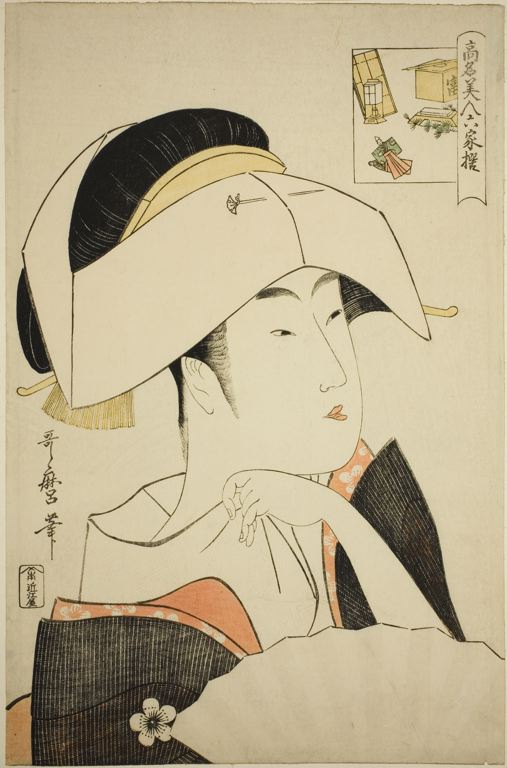
Kitagawa Utamaro's "Renowned Beauties Likened to the Six Immortal Poets" (Komei bijin rokkasen) is one of the artist's most accomplished bijin-ga cycles, applying the rokkasen literary parody to a roster of leading teahouse and Yoshiwara beauties of the mid-1790s. The series was published by Omiya Gonkuro around 1795-1796 and organizes its six sheets under the names of the canonical Six Poetic Immortals codified by Ki no Tsurayuki in the preface to the Kokin wakashu: Ariwara no Narihira, Ono no Komachi, Sojo Henjo, Bunya no Yasuhide, Kisen Hoshi, and Otomo no Kuronushi. Each classical poet is substituted by a celebrated contemporary beauty, typically including Naniwaya Okita, Takashima Ohisa, and Tomimoto Toyohina among the leading public female celebrities of the period, and the literary reference is carried by costume motif, accessory, and inscribed poem rather than by explicit classical iconography. The sheets are oban tate-e and depict each figure at half-length in the okubi-e mode that the artist had developed across the early and mid-1790s, with the beauty placed against a plain or yellow ground that concentrates attention on the modulation of facial expression. The series operates simultaneously as a literary parody, a fashion record, and a comparative roster of the leading celebrities of mid-1790s Edo. Impressions are held in the Museum of Fine Arts Boston, the British Museum, the Tokyo National Museum, the Honolulu Museum of Art, and the Chiba City Museum of Art, where the series is regularly cited as one of the supreme statements of the rokkasen mitate format in Utamaro's hands.
Prints in This Series (4)
Complete series — all 1 prints catalogued.


Frequently Asked Questions
Kitagawa Utamaro's "Renowned Beauties Likened to the Six Immortal Poets" (Komei bijin rokkasen) is one of the artist's most accomplished bijin-ga cycles, applying the rokkasen literary parody to a roster of leading teahouse and Yoshiwara beauties of the mid-1790s. The series was published by Omiya Gonkuro around 1795-1796 and organizes its six sheets under the names of the canonical Six Poetic Immortals codified by Ki no Tsurayuki in the preface to the Kokin wakashu: Ariwara no Narihira, Ono no Komachi, Sojo Henjo, Bunya no Yasuhide, Kisen Hoshi, and Otomo no Kuronushi. Each classical poet is substituted by a celebrated contemporary beauty, typically including Naniwaya Okita, Takashima Ohisa, and Tomimoto Toyohina among the leading public female celebrities of the period, and the literary reference is carried by costume motif, accessory, and inscribed poem rather than by explicit classical iconography. The sheets are oban tate-e and depict each figure at half-length in the okubi-e mode that the artist had developed across the early and mid-1790s, with the beauty placed against a plain or yellow ground that concentrates attention on the modulation of facial expression. The series operates simultaneously as a literary parody, a fashion record, and a comparative roster of the leading celebrities of mid-1790s Edo. Impressions are held in the Museum of Fine Arts Boston, the British Museum, the Tokyo National Museum, the Honolulu Museum of Art, and the Chiba City Museum of Art, where the series is regularly cited as one of the supreme statements of the rokkasen mitate format in Utamaro's hands.
The Renowned Beauties Likened to the Six Immortal Poets series contains 1 prints, created by Kitagawa Utamaro.
The Renowned Beauties Likened to the Six Immortal Poets series was created by Kitagawa Utamaro (喜多川歌麿).
We currently have 4 of 1 known prints from the Renowned Beauties Likened to the Six Immortal Poets series indexed in our collection. Browse them all on this page.
Want to rate prints from Renowned Beauties Likened to the Six Immortal Poets?
Sign up to start rating