
The Asahiya Widow, from the series “Renowned Beauties Likened to the Six Immortal Poets" ("Komei bijin rokkasen")
- Date:
- c. 1795/96
- Medium:
- Color woodblock print
- Source:
- Art Institute of Chicago
Description
The Asahiya Widow, from the series Renowned Beauties Likened to the Six Immortal Poets (Komei bijin rokkasen), dated 1790 and held in the Art Institute of Chicago, is part of one of Kitagawa Utamaro's most overtly literary bijin-ga projects. The Rokkasen, or Six Immortal Poets, were a canonical grouping of ninth-century waka poets, including figures like Ariwara no Narihira and Ono no Komachi, whose biographies and legendary qualities had been recycled across centuries of Japanese visual culture. By aligning a celebrated contemporary beauty, the widow of the Asahiya teahouse, with one of these immortals, Utamaro engages in a sophisticated mitate that treats Edo bijin-ga as a continuation of classical poetic culture rather than as mere ephemera. The print likely uses a luminous mica or pale yellow background typical of the series, with the widow rendered in bust-length or half-length format to direct attention to her face and the elegant arrangement of her hair. Her expression is composed and inward, hinting at the experience and reserve associated with a teahouse proprietor. The textile patterns and accessories function both decoratively and as social signals, marking her as a figure of substantial standing within the urban culture of late-eighteenth-century Edo. As part of the Art Institute of Chicago's distinguished ukiyo-e collection, this image showcases the literary ambition behind Kitagawa Utamaro's most innovative bijin-ga and the artist's ability to fuse celebrity portraiture with deep historical allusion.
More Prints by Kitagawa Utamaro
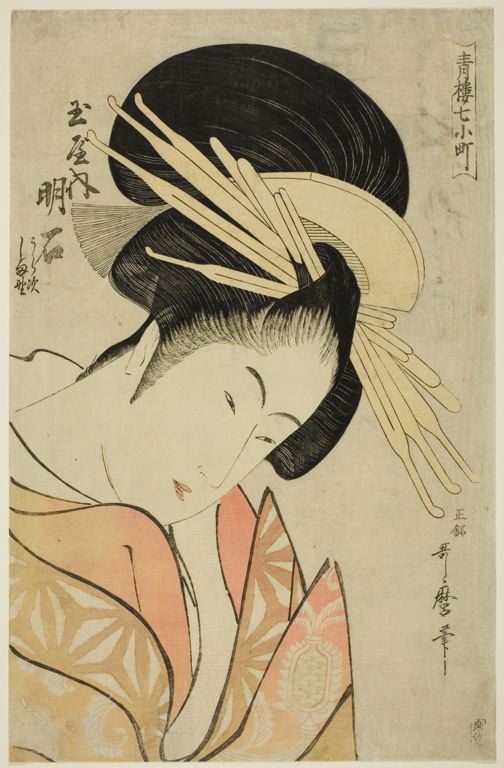
Akashi of the Tamaya, from the series Seven Komachis of Yoshiwara (Seiro nana Komachi) (Tamaya uchi Akashi, Uraji, Shimano)
Woodblock print
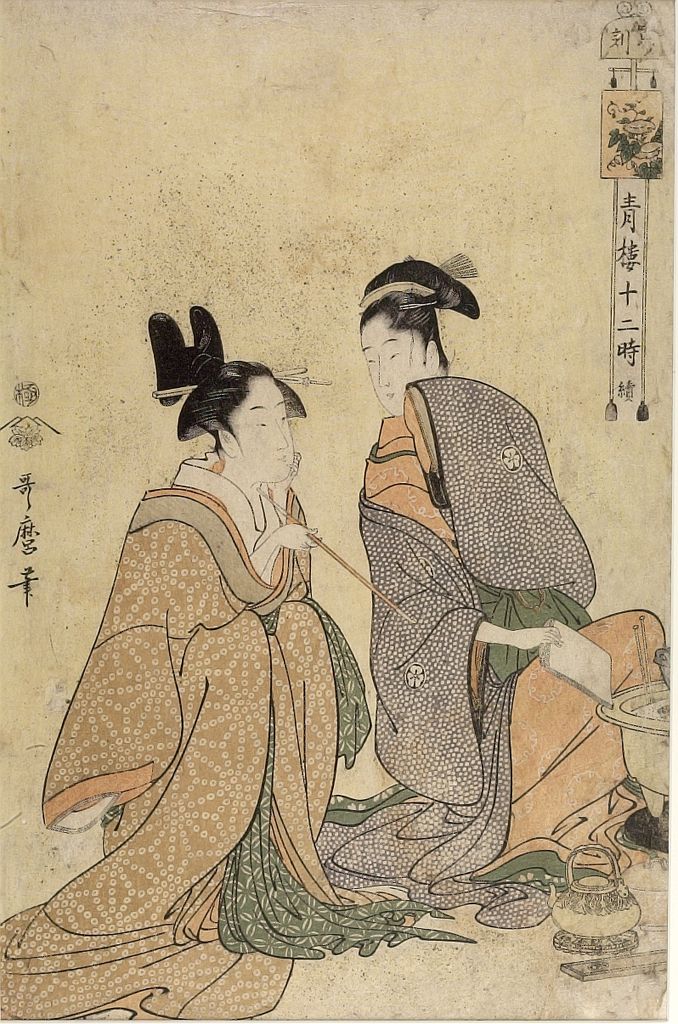
Hour of the Tiger (Tora no koku = 4 AM) from the series Twelve Hours in Yoshiwara (Seirô jûni toki tsuzuki), Late Edo period, circa 1794
Woodblock print
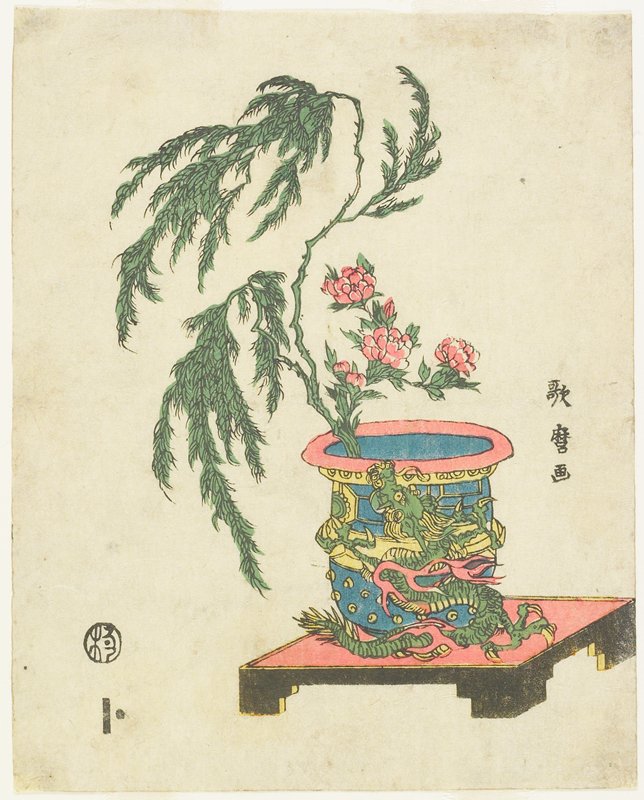
Ikebana arrangement of Peony and Willow in Dragon Pot
1781–1806
Woodblock print (nishiki-e), ink and color on paper
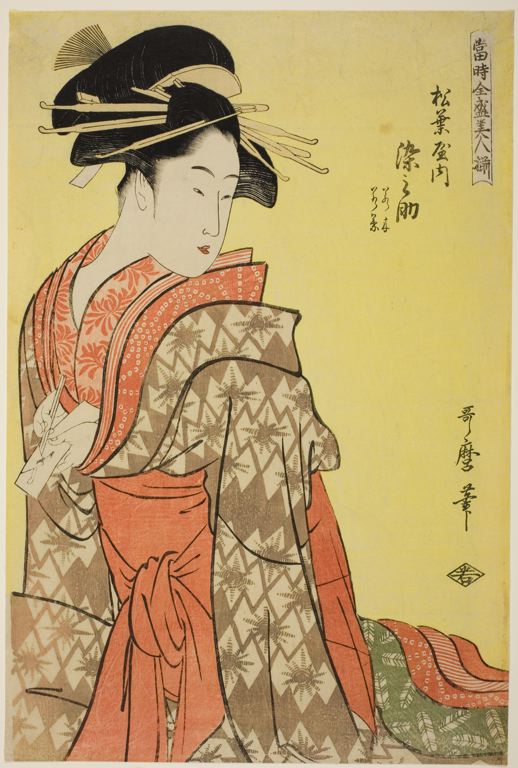
The Greatest Beauties of Our Time (Toji zensei bijin zoroe): Somenosuke of the Matsubaya with Attendants Wakagi and Wakaba
Woodblock print
Frequently Asked Questions
The Asahiya Widow, from the series “Renowned Beauties Likened to the Six Immortal Poets" ("Komei bijin rokkasen") was created by Kitagawa Utamaro (喜多川歌麿) in c. 1795/96.
Yes — The Asahiya Widow, from the series “Renowned Beauties Likened to the Six Immortal Poets" ("Komei bijin rokkasen") is part of the Renowned Beauties Likened to the Six Immortal Poets series by Kitagawa Utamaro.