Treasury of Loyal Retainers
About This Series
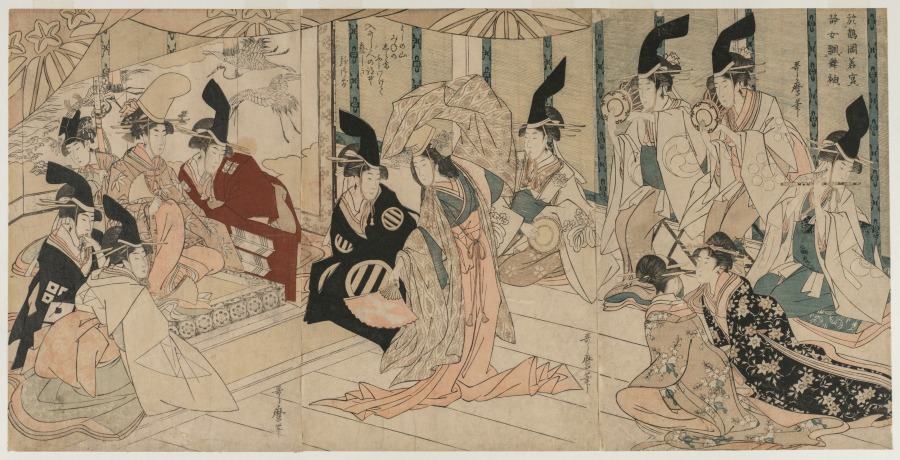
Kitagawa Utamaro's "Treasury of Loyal Retainers" (Chushingura) prints belong to the long-standing ukiyo-e engagement with the eleven acts of the celebrated Kanadehon Chushingura, the puppet and kabuki dramatization of the 1701-1703 vendetta of the forty-seven Ako ronin. The story had been a staple of Edo theatrical and print culture since its premiere in 1748, and successive generations of ukiyo-e designers, including Toyokuni, Kunisada, and Hiroshige, produced series of prints organized around its eleven acts. Utamaro's treatments, dated variously to the mid-1790s and the early years of the nineteenth century, characteristically apply his bijin-ga sensibility to the narrative, presenting the women of the Chushingura cast as elegant Edo beauties in compositions that emphasize the female characters of the story, such as Okaru and Kao-yo, alongside the principal male combatants. The sheets are oban tate-e and each is identified by a cartouche giving the act of the play, and the compositions sometimes treat the eleven-act sequence as a complete series, while in other instances Utamaro produced individual sheets within mixed projects. The Chushingura presented Utamaro with the opportunity to extend his bijin-ga aesthetic into narrative ukiyo-e, an unusual register for an artist whose primary commitment was to the contemporary courtesan portrait, and the resulting prints occupy a distinctive position within his oeuvre. Impressions are catalogued among the Utamaro holdings of the Museum of Fine Arts Boston, the British Museum, the Tokyo National Museum, and the Art Institute of Chicago, and the prints are noted in the standard literature for the way they apply his bijin-ga manner to a narrative subject.
Prints in This Series (3)
Complete series — all 1 prints catalogued.
Frequently Asked Questions
Kitagawa Utamaro's "Treasury of Loyal Retainers" (Chushingura) prints belong to the long-standing ukiyo-e engagement with the eleven acts of the celebrated Kanadehon Chushingura, the puppet and kabuki dramatization of the 1701-1703 vendetta of the forty-seven Ako ronin. The story had been a staple of Edo theatrical and print culture since its premiere in 1748, and successive generations of ukiyo-e designers, including Toyokuni, Kunisada, and Hiroshige, produced series of prints organized around its eleven acts. Utamaro's treatments, dated variously to the mid-1790s and the early years of the nineteenth century, characteristically apply his bijin-ga sensibility to the narrative, presenting the women of the Chushingura cast as elegant Edo beauties in compositions that emphasize the female characters of the story, such as Okaru and Kao-yo, alongside the principal male combatants. The sheets are oban tate-e and each is identified by a cartouche giving the act of the play, and the compositions sometimes treat the eleven-act sequence as a complete series, while in other instances Utamaro produced individual sheets within mixed projects. The Chushingura presented Utamaro with the opportunity to extend his bijin-ga aesthetic into narrative ukiyo-e, an unusual register for an artist whose primary commitment was to the contemporary courtesan portrait, and the resulting prints occupy a distinctive position within his oeuvre. Impressions are catalogued among the Utamaro holdings of the Museum of Fine Arts Boston, the British Museum, the Tokyo National Museum, and the Art Institute of Chicago, and the prints are noted in the standard literature for the way they apply his bijin-ga manner to a narrative subject.
The Treasury of Loyal Retainers series contains 1 prints, created by Kitagawa Utamaro.
The Treasury of Loyal Retainers series was created by Kitagawa Utamaro (喜多川歌麿).
We currently have 3 of 1 known prints from the Treasury of Loyal Retainers series indexed in our collection. Browse them all on this page.
Want to rate prints from Treasury of Loyal Retainers?
Sign up to start rating