Two Views of Modern Fashions
About This Series
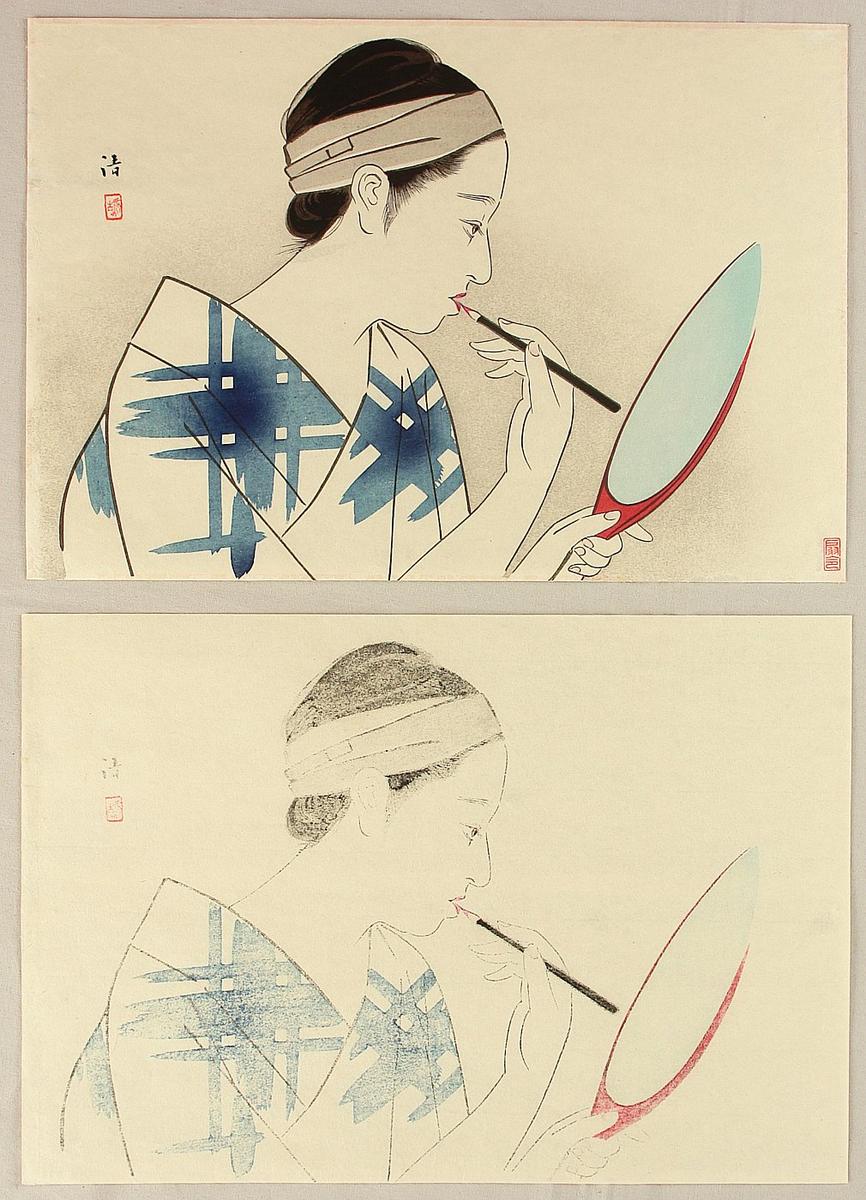
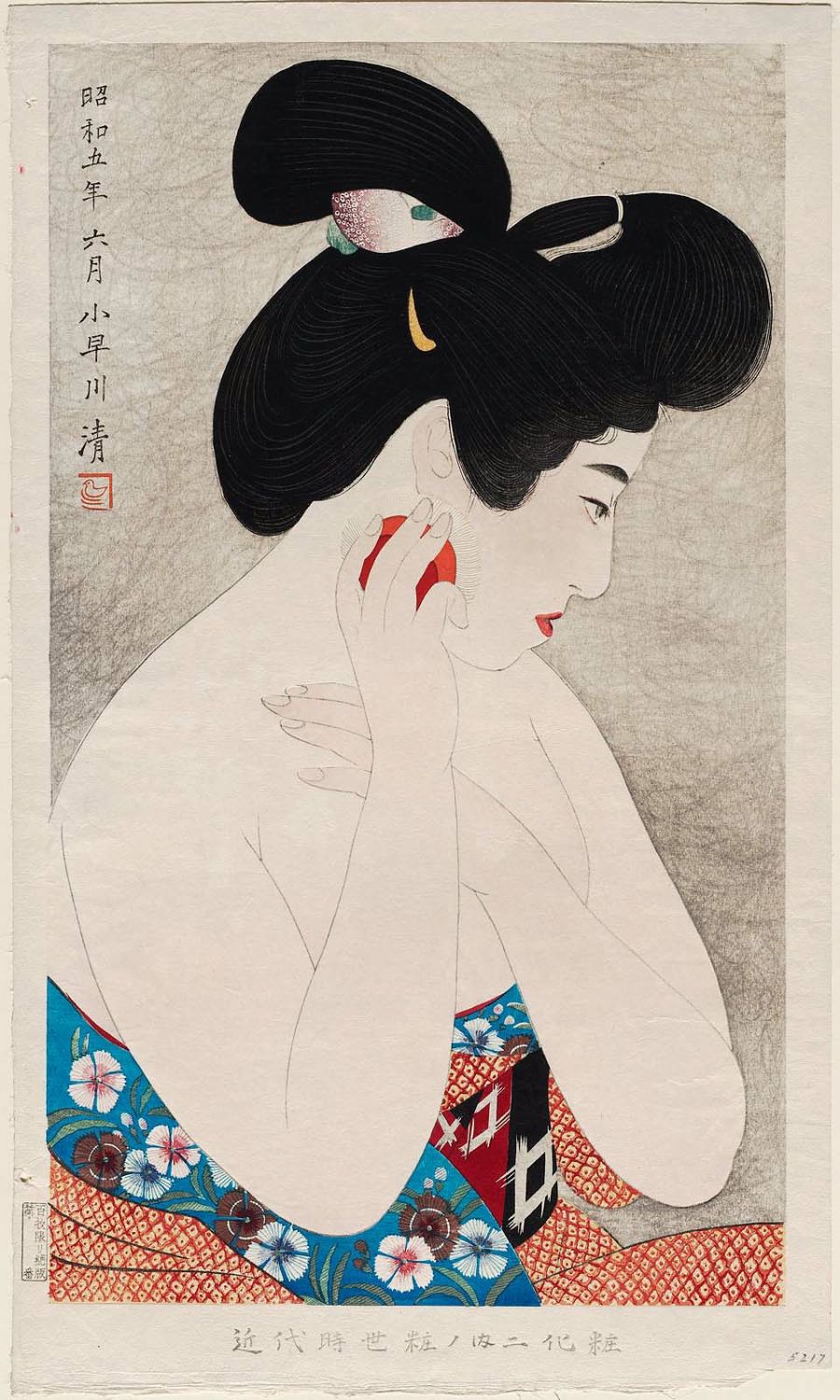
Two Views of Modern Fashions is the English designation under which a small bijin-ga cycle of Kobayakawa Kiyoshi circulates in Western cataloguing, a body of work belonging to the late 1920s and early 1930s in which the artist treated the contemporary Japanese woman through the distinctive modan and moga aesthetic that distinguished his bijin-ga output from the more traditionally inflected work of Ito Shinsui and the other Watanabe Shozaburo figural artists. Kobayakawa Kiyoshi, born in 1899 in Fukuoka and trained in Nihonga under the Kaburaki Kiyokata school before his entry into the shin-hanga program around the late 1920s, developed across his short career a particular focus on the modern girl, the Japanese woman of the late Taisho and early Showa decades who had absorbed Western dress, hairstyles, and patterns of urban entertainment, and whose visual register through the bobbed hair, the Western evening gown, and the cosmetic-saturated face supplied a sharply contemporary subject for shin-hanga treatment. The cycle accordingly belongs to the body of shin-hanga moga prints through which Kobayakawa and his closest peer Yamakawa Shuho addressed a Japanese urban modernity that Shinsui's more traditionally costumed bijin-ga did not directly engage, and the small Modern Fashions group sits alongside Kobayakawa's better-known Modern Styles of Makeup (Kindai jiseisho or Kindai jiseisho) cycle as the principal vehicles through which his moga bijin-ga was distributed to interwar collectors. The collaborative shin-hanga production method, in which Watanabe's separately trained block carvers and printers carried through the artist's drawing under the publisher's coordinating direction, allowed the cycle to achieve the saturated cosmetic effects, sharp linear contour, and atmospheric ground that the moga subject demanded, with the Watanabe workshop's mature command of layered overprinting and bokashi gradation supplying the technical means for the prints' distinctive visual register. Kobayakawa's career was cut short by his death in 1948 at the age of forty-nine, and his bijin-ga output across the 1920s and 1930s is correspondingly compact, occupying a particular niche within the broader shin-hanga bijin-ga tradition as the most committed treatment of the moga subject by any of the Watanabe figural artists. Modern scholarship treats the Modern Fashions cycle and its companion Modern Styles of Makeup as the principal documentation of the shin-hanga engagement with moga modernity, and surviving impressions are valued by collectors of the genre. Representative impressions are held by the Art Institute of Chicago, the Museum of Fine Arts in Boston, and other major collections of twentieth-century Japanese print.
Prints in This Series (2)
Complete series — all 1 prints catalogued.
Frequently Asked Questions
Two Views of Modern Fashions is the English designation under which a small bijin-ga cycle of Kobayakawa Kiyoshi circulates in Western cataloguing, a body of work belonging to the late 1920s and early 1930s in which the artist treated the contemporary Japanese woman through the distinctive modan and moga aesthetic that distinguished his bijin-ga output from the more traditionally inflected work of Ito Shinsui and the other Watanabe Shozaburo figural artists. Kobayakawa Kiyoshi, born in 1899 in Fukuoka and trained in Nihonga under the Kaburaki Kiyokata school before his entry into the shin-hanga program around the late 1920s, developed across his short career a particular focus on the modern girl, the Japanese woman of the late Taisho and early Showa decades who had absorbed Western dress, hairstyles, and patterns of urban entertainment, and whose visual register through the bobbed hair, the Western evening gown, and the cosmetic-saturated face supplied a sharply contemporary subject for shin-hanga treatment. The cycle accordingly belongs to the body of shin-hanga moga prints through which Kobayakawa and his closest peer Yamakawa Shuho addressed a Japanese urban modernity that Shinsui's more traditionally costumed bijin-ga did not directly engage, and the small Modern Fashions group sits alongside Kobayakawa's better-known Modern Styles of Makeup (Kindai jiseisho or Kindai jiseisho) cycle as the principal vehicles through which his moga bijin-ga was distributed to interwar collectors. The collaborative shin-hanga production method, in which Watanabe's separately trained block carvers and printers carried through the artist's drawing under the publisher's coordinating direction, allowed the cycle to achieve the saturated cosmetic effects, sharp linear contour, and atmospheric ground that the moga subject demanded, with the Watanabe workshop's mature command of layered overprinting and bokashi gradation supplying the technical means for the prints' distinctive visual register. Kobayakawa's career was cut short by his death in 1948 at the age of forty-nine, and his bijin-ga output across the 1920s and 1930s is correspondingly compact, occupying a particular niche within the broader shin-hanga bijin-ga tradition as the most committed treatment of the moga subject by any of the Watanabe figural artists. Modern scholarship treats the Modern Fashions cycle and its companion Modern Styles of Makeup as the principal documentation of the shin-hanga engagement with moga modernity, and surviving impressions are valued by collectors of the genre. Representative impressions are held by the Art Institute of Chicago, the Museum of Fine Arts in Boston, and other major collections of twentieth-century Japanese print.
The Two Views of Modern Fashions series contains 1 prints, created by Kobayakawa Kiyoshi.
The Two Views of Modern Fashions series was created by Kobayakawa Kiyoshi (小早川清).
We currently have 2 of 1 known prints from the Two Views of Modern Fashions series indexed in our collection. Browse them all on this page.
Want to rate prints from Two Views of Modern Fashions?
Sign up to start rating