Kyoraku Meisho
About This Series
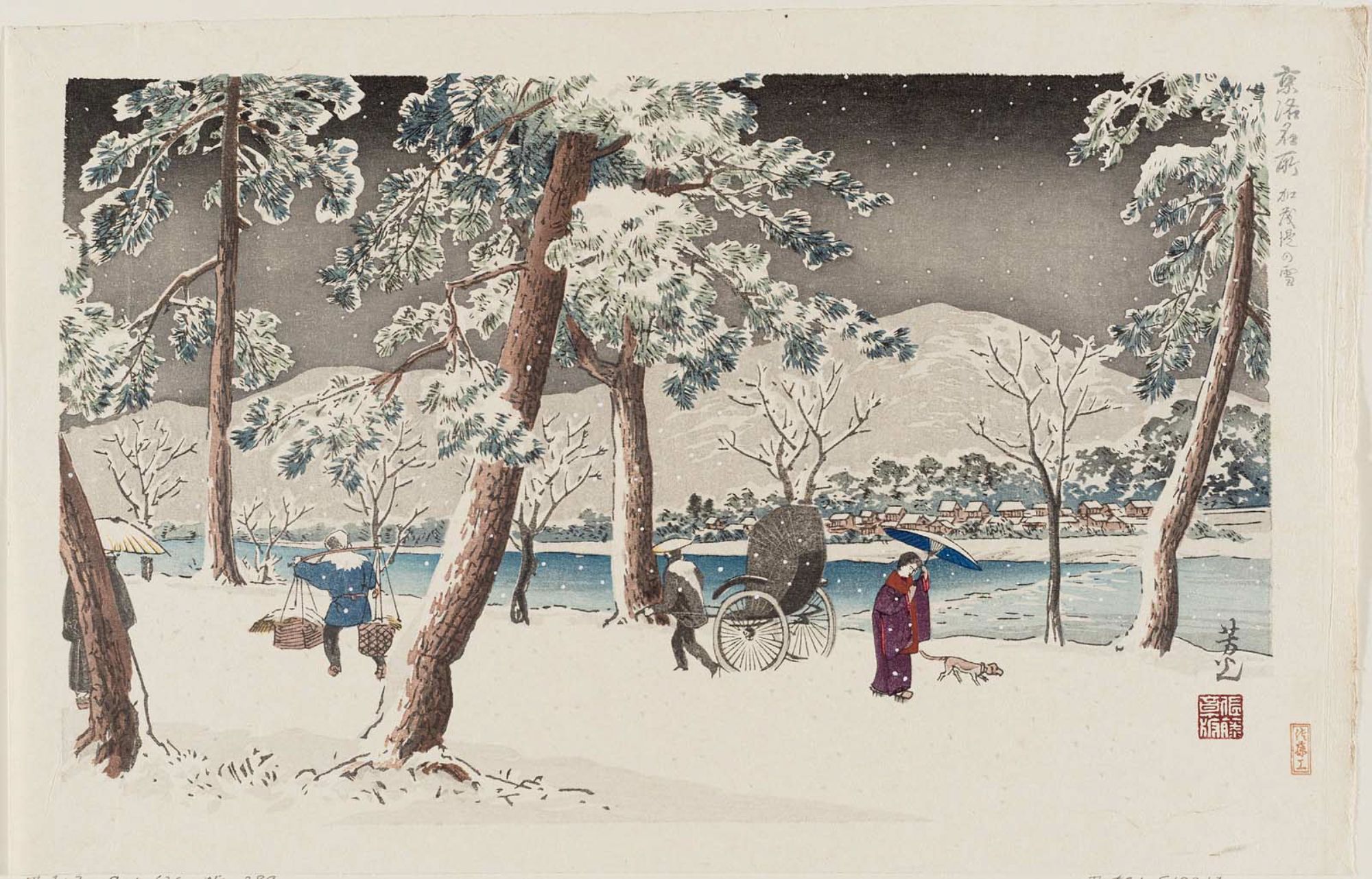
Kyoraku Meisho, here translated Famous Places of the Capital, is a print series in which Nomura Yoshimitsu treated the topography of Kyoto, the historical capital whose temples, gardens, riverbanks, and old quarters had supplied a continuous subject for Japanese pictorial art from the medieval rakuchu rakugai screens through the nineteenth-century meisho-ki guidebooks to the modern hanga of the twentieth century. The title's term kyoraku, literally pleasures of the capital, draws on the Edo-period vocabulary of guidebook literature and meisho-zue topographical compendia, and the meisho or famous-place format had been a structural backbone of Japanese landscape printmaking from Hiroshige through the shin-hanga Kyoto views of Tsuchiya Koitsu and Tokuriki Tomikichiro. Nomura, a twentieth-century sosaku-hanga artist working in the self-carved, self-printed tradition that Onchi Koshiro and the Ichimoku-kai had established as the movement's distinguishing practice, brought to the Kyoto subject the flattened design and broadly massed color that characterize sosaku-hanga in contradistinction to the atmospheric realism of contemporary shin-hanga, treating Kiyomizu temple, the Kamo riverbank, the Yasaka pagoda, the Higashiyama district, and other classical Kyoto motifs as autonomous compositional fields rather than topographical illustrations. The series belongs to the broader twentieth-century reanimation of the meisho-e tradition under modernist auspices, parallel to the various hyakkei projects organized by Onchi and his circle, and impressions are documented in Japanese institutional holdings of postwar sosaku-hanga and in the American collections of twentieth-century Japanese print that built holdings of the movement through the postwar decades, including the Honolulu Museum of Art, the Museum of Modern Art New York, and the Art Institute of Chicago.
Prints in This Series (1)
Complete series — all 1 prints catalogued.
Frequently Asked Questions
Kyoraku Meisho, here translated Famous Places of the Capital, is a print series in which Nomura Yoshimitsu treated the topography of Kyoto, the historical capital whose temples, gardens, riverbanks, and old quarters had supplied a continuous subject for Japanese pictorial art from the medieval rakuchu rakugai screens through the nineteenth-century meisho-ki guidebooks to the modern hanga of the twentieth century. The title's term kyoraku, literally pleasures of the capital, draws on the Edo-period vocabulary of guidebook literature and meisho-zue topographical compendia, and the meisho or famous-place format had been a structural backbone of Japanese landscape printmaking from Hiroshige through the shin-hanga Kyoto views of Tsuchiya Koitsu and Tokuriki Tomikichiro. Nomura, a twentieth-century sosaku-hanga artist working in the self-carved, self-printed tradition that Onchi Koshiro and the Ichimoku-kai had established as the movement's distinguishing practice, brought to the Kyoto subject the flattened design and broadly massed color that characterize sosaku-hanga in contradistinction to the atmospheric realism of contemporary shin-hanga, treating Kiyomizu temple, the Kamo riverbank, the Yasaka pagoda, the Higashiyama district, and other classical Kyoto motifs as autonomous compositional fields rather than topographical illustrations. The series belongs to the broader twentieth-century reanimation of the meisho-e tradition under modernist auspices, parallel to the various hyakkei projects organized by Onchi and his circle, and impressions are documented in Japanese institutional holdings of postwar sosaku-hanga and in the American collections of twentieth-century Japanese print that built holdings of the movement through the postwar decades, including the Honolulu Museum of Art, the Museum of Modern Art New York, and the Art Institute of Chicago.
The Kyoraku Meisho series contains 1 prints, created by Nomura Yoshimitsu.
The Kyoraku Meisho series was created by Nomura Yoshimitsu (野村義光).
We currently have 1 of 1 known prints from the Kyoraku Meisho series indexed in our collection. Browse them all on this page.
Want to rate prints from Kyoraku Meisho?
Sign up to start rating