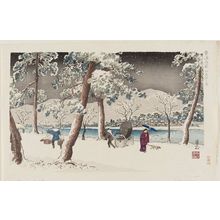
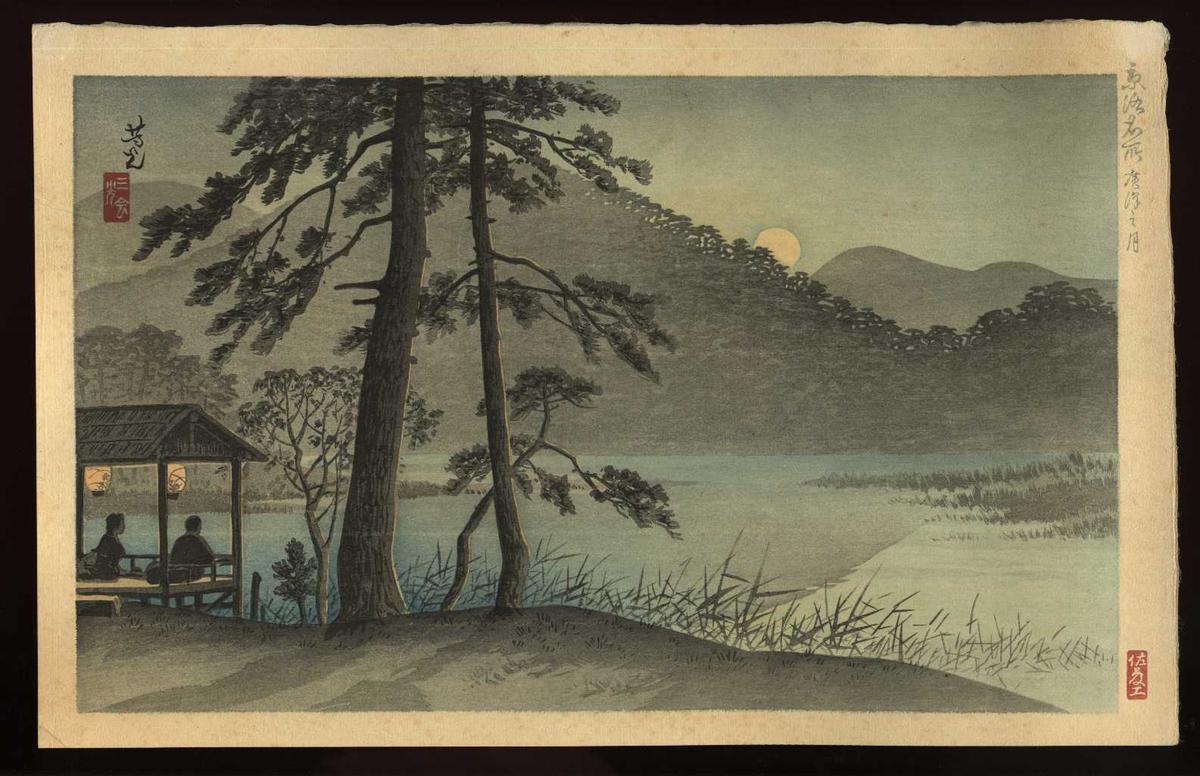
Snow on the banks of the Kamo River (Kamo tsutsumi no yuki) from the series Kyoraku Meisho (Famous places about Kyoto).
- Series:
- Kyoraku Meisho
- Medium:
- Woodblock print
- Source:
- Museum of Fine Arts Boston
- Image courtesy of
- Museum of Fine Arts Boston
Description
This print belongs to a named series, Kyoraku Meisho (Famous Places About Kyoto), documenting the city's notable sites in a format that echoes earlier meisho-e traditions. The Kamo River runs through central Kyoto, its banks lined with willows, stone embankments, and, in the distance, the Higashiyama mountain range. A snow scene along these banks — the title's Kamo tsutsumi no yuki — would present the river in winter stillness: snow accumulated on the embankments and bridge parapets, the water dark against the white ground, the mountains behind reduced to pale silhouettes in the cold air. Shin-hanga snow scenes typically employed the bare washi paper surface to represent accumulated snow, with bokashi transitions in blue-white tones for shadow and sky. The inclusion of a Kyoto landmark view within a named series suggests this print was marketed as part of a collectible set, a common publishing strategy in the Taisho and early Showa periods.
More Prints by Nomura Yoshimitsu
More Landscapes Prints

Lake Kugushi in Wakasa Province (Wakasa Kugushiko), from the series Souvenirs of Travel I (Tabi miyage dai isshu)"
Wakasa Kugushiko
1920
Color woodblock print; oban
Autumn Maple Leaves at Takao, from the album Eight Views of Kyoto (Kyôto hakkei)
Woodblock print

The Beach at Kaiganji in Sanuki Province (Sanuki Kaiganji no hama), from the series "Collection of Views of Japan II, Kansai Edition (Nihon fukei shu II Kansai hen)"
1934
Color woodblock print; oban

Tea Kettle, section of a sheet from the series "Mirror of Stone Rubbings of Views of the Provinces" (Kohon meihitsu ishizuri kagami)
n.d.
Woodblock print; ishizuri-e, section of harimaze sheet
Featured in Collections
Curated cross-cuts that include this print.
Frequently Asked Questions
Snow on the banks of the Kamo River (Kamo tsutsumi no yuki) from the series Kyoraku Meisho (Famous places about Kyoto). was created by Nomura Yoshimitsu (野村義光).
Yes — Snow on the banks of the Kamo River (Kamo tsutsumi no yuki) from the series Kyoraku Meisho (Famous places about Kyoto). is part of the Kyoraku Meisho series by Nomura Yoshimitsu.
Snow on the banks of the Kamo River (Kamo tsutsumi no yuki) from the series Kyoraku Meisho (Famous places about Kyoto). depicts landscapes, snow scenes, and rivers & lakes, set at Kyoto.