Steady Gaze
About This Series
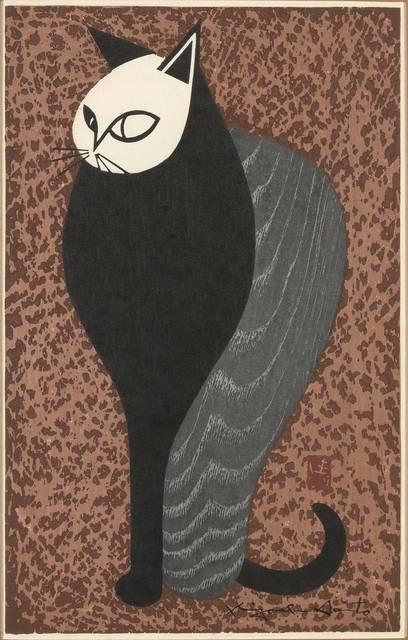
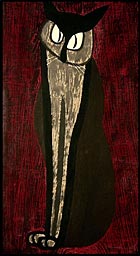
Steady Gaze is the English designation under which a Saito Kiyoshi figural cycle circulates in Western cataloguing, a body of portrait or figure prints through which the foundational sosaku-hanga artist addressed the human subject within his characteristic modernist woodblock vocabulary. Saito Kiyoshi, born in 1907 in Fukushima and largely self-taught as a printmaker before his emergence within the sosaku-hanga movement in the late 1930s, established his international reputation through his joint first prize at the 1951 Sao Paulo Biennale and built across the postwar decades a mature woodblock practice distinguished by bold compositional simplification, exposed wood-grain texture, and a controlled palette calibrated to the natural materials of the medium. The figural and portrait work that the Steady Gaze designation gathers belongs to the body of human-subject prints through which Saito addressed faces, half-length figures, and the introspective register of the modern individual within his characteristic stylized vocabulary, distinct from the more anecdotal genre and theatrical figural traditions of the inherited ukiyo-e bijin-ga and yakusha-e. The sosaku-hanga production method, in which the artist personally cut his own blocks and supervised or executed his own printing in opposition to the collaborative division of labor of the inherited workshop tradition, gave Saito's figural prints an authorial directness in which the cutting marks of the gouge and the exposed grain of the wood block supplied part of the expressive vocabulary of the design, and the figures accordingly read as much through the material trace of their production as through their iconographic content. Within Saito's career the figural work belongs alongside his celebrated Aizu winter landscape cycles, his Buddhist temple and Kyoto subjects, and his various other series through which he established the mature vocabulary that defined postwar sosaku-hanga internationally, and the Steady Gaze cycle stands as one of the strands through which he addressed the human subject within that vocabulary. Modern scholarship treats Saito as one of the defining figures of the postwar sosaku-hanga movement and as the principal artist through whom the movement gained sustained international recognition in the 1950s and beyond, and his figural prints supply evidence of how the sosaku-hanga method could be brought to bear on the portrait and figure subjects that the parallel shin-hanga of the interwar Watanabe program had treated through its collaborative bijin-ga and yakusha-e cycles. Representative impressions are held by the Art Institute of Chicago, the Museum of Fine Arts in Boston, the Honolulu Museum of Art, and other major Western collections of twentieth-century Japanese print, where Saito's work is comprehensively represented across the principal genres and series of his career.
Prints in This Series (5)
Complete series — all 2 prints catalogued.



Frequently Asked Questions
Steady Gaze is the English designation under which a Saito Kiyoshi figural cycle circulates in Western cataloguing, a body of portrait or figure prints through which the foundational sosaku-hanga artist addressed the human subject within his characteristic modernist woodblock vocabulary. Saito Kiyoshi, born in 1907 in Fukushima and largely self-taught as a printmaker before his emergence within the sosaku-hanga movement in the late 1930s, established his international reputation through his joint first prize at the 1951 Sao Paulo Biennale and built across the postwar decades a mature woodblock practice distinguished by bold compositional simplification, exposed wood-grain texture, and a controlled palette calibrated to the natural materials of the medium. The figural and portrait work that the Steady Gaze designation gathers belongs to the body of human-subject prints through which Saito addressed faces, half-length figures, and the introspective register of the modern individual within his characteristic stylized vocabulary, distinct from the more anecdotal genre and theatrical figural traditions of the inherited ukiyo-e bijin-ga and yakusha-e. The sosaku-hanga production method, in which the artist personally cut his own blocks and supervised or executed his own printing in opposition to the collaborative division of labor of the inherited workshop tradition, gave Saito's figural prints an authorial directness in which the cutting marks of the gouge and the exposed grain of the wood block supplied part of the expressive vocabulary of the design, and the figures accordingly read as much through the material trace of their production as through their iconographic content. Within Saito's career the figural work belongs alongside his celebrated Aizu winter landscape cycles, his Buddhist temple and Kyoto subjects, and his various other series through which he established the mature vocabulary that defined postwar sosaku-hanga internationally, and the Steady Gaze cycle stands as one of the strands through which he addressed the human subject within that vocabulary. Modern scholarship treats Saito as one of the defining figures of the postwar sosaku-hanga movement and as the principal artist through whom the movement gained sustained international recognition in the 1950s and beyond, and his figural prints supply evidence of how the sosaku-hanga method could be brought to bear on the portrait and figure subjects that the parallel shin-hanga of the interwar Watanabe program had treated through its collaborative bijin-ga and yakusha-e cycles. Representative impressions are held by the Art Institute of Chicago, the Museum of Fine Arts in Boston, the Honolulu Museum of Art, and other major Western collections of twentieth-century Japanese print, where Saito's work is comprehensively represented across the principal genres and series of his career.
The Steady Gaze series contains 2 prints, created by Saito Kiyoshi.
The Steady Gaze series was created by Saito Kiyoshi (斎藤清).
We currently have 5 of 2 known prints from the Steady Gaze series indexed in our collection. Browse them all on this page.
Want to rate prints from Steady Gaze?
Sign up to start rating