One Hundred Views of New Japan
About This Series
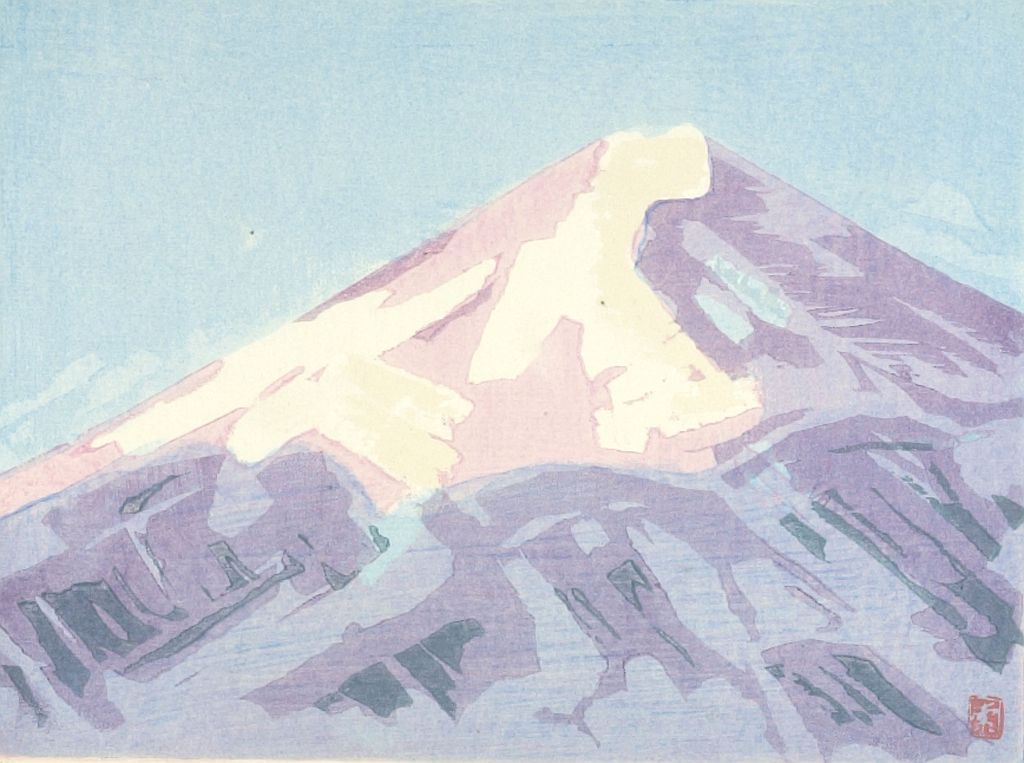
One Hundred Views of New Japan, in Japanese Shin Nihon hyakkei, refers to the collaborative hyakkei-format print project in which a group of sosaku-hanga artists extended beyond the Tokyo focus of the earlier Shin Tokyo hyakkei to embrace the wider national landscape, treating provincial cities, coastal towns, mountain scenery, and the agricultural countryside in the same self-carved, self-printed modernist idiom. Fukazawa Sakuichi (1896-1947), a Tokyo sosaku-hanga modernist active in the Ichimoku-kai milieu that Onchi Koshiro had organized in the late 1930s, contributed views in his characteristic vocabulary of flattened plane, broadly massed unmodulated color, and reduced contour, distinguishing his sheets from the atmospheric realism of contemporary shin-hanga landscape practice. As with the earlier Shin Tokyo hyakkei in which he had also participated, each sheet was self-carved and self-printed by its artist, the editions were small, and the whole was distributed to subscribers in the artisanal manner that the sosaku-hanga movement had established for itself in contradistinction to the carver-printer commercial publishing of Watanabe Shozaburo. Fukazawa died in 1947, his career cut short before the postwar international visibility that Oliver Statler's 1956 Modern Japanese Prints would bring to his Ichimoku-kai colleagues, and impressions of his work survive principally in Japanese museum holdings and among the early American sosaku-hanga collections, including the National Museum of Modern Art Tokyo, the Museum of Modern Art New York, the Art Institute of Chicago, and the Honolulu Museum of Art.
Prints in This Series (1)
Complete series — all 1 prints catalogued.
Frequently Asked Questions
One Hundred Views of New Japan, in Japanese Shin Nihon hyakkei, refers to the collaborative hyakkei-format print project in which a group of sosaku-hanga artists extended beyond the Tokyo focus of the earlier Shin Tokyo hyakkei to embrace the wider national landscape, treating provincial cities, coastal towns, mountain scenery, and the agricultural countryside in the same self-carved, self-printed modernist idiom. Fukazawa Sakuichi (1896-1947), a Tokyo sosaku-hanga modernist active in the Ichimoku-kai milieu that Onchi Koshiro had organized in the late 1930s, contributed views in his characteristic vocabulary of flattened plane, broadly massed unmodulated color, and reduced contour, distinguishing his sheets from the atmospheric realism of contemporary shin-hanga landscape practice. As with the earlier Shin Tokyo hyakkei in which he had also participated, each sheet was self-carved and self-printed by its artist, the editions were small, and the whole was distributed to subscribers in the artisanal manner that the sosaku-hanga movement had established for itself in contradistinction to the carver-printer commercial publishing of Watanabe Shozaburo. Fukazawa died in 1947, his career cut short before the postwar international visibility that Oliver Statler's 1956 Modern Japanese Prints would bring to his Ichimoku-kai colleagues, and impressions of his work survive principally in Japanese museum holdings and among the early American sosaku-hanga collections, including the National Museum of Modern Art Tokyo, the Museum of Modern Art New York, the Art Institute of Chicago, and the Honolulu Museum of Art.
The One Hundred Views of New Japan series contains 1 prints, created by Sakuichi Fukazawa.
The One Hundred Views of New Japan series was created by Sakuichi Fukazawa (深沢索一).
We currently have 1 of 1 known prints from the One Hundred Views of New Japan series indexed in our collection. Browse them all on this page.
Want to rate prints from One Hundred Views of New Japan?
Sign up to start rating