Calendar in the Mood of the Tea Ceremony
About This Series
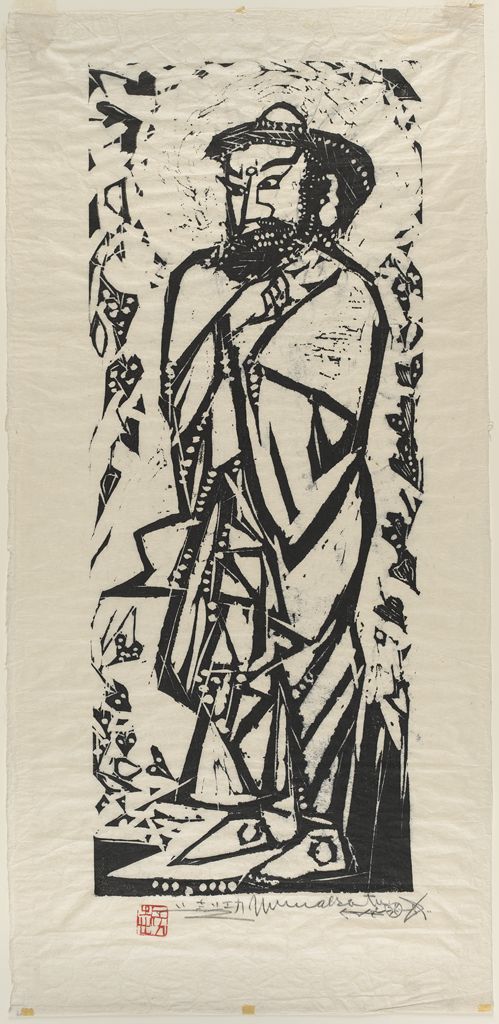
Calendar in the Mood of the Tea Ceremony is one of the calendar print suites that Shiko Munakata produced for the literary and tea-circle patrons who sustained his work throughout the postwar decades. The format of an annual calendar in ita-e, with a sheet for each month, allowed Munakata to deploy the full range of his seasonal vocabulary, plum and camellia for the cold months, cherry and wisteria for spring, iris and hydrangea for the rainy season, and chrysanthemum, maple, and snow for autumn and winter, each treated in the manner of a tea-room hanging scroll whose subject is suited to the moment of the year in which it would be displayed. The title's reference to the tea ceremony, chanoyu, signals the suite's deliberate alignment with the wabi aesthetic of the tea room, in which seasonal awareness, calligraphic restraint, and the visible mark of the maker's hand are central values, all qualities native to Munakata's woodblock practice. Each calendar plate is carved directly into yamazakura cherry without preparatory drawing and printed in sumi on washi, with several impressions completed by uragashin verso-coloring in which mineral pigments brushed onto the back of the translucent paper diffuse forward as pale tints. The calendar belongs to the broad family of commissioned print projects through which Munakata extended his practice beyond the monumental Buddhist cycles for which he became internationally celebrated after the 1955 Sao Paulo and 1956 Venice prizes, and impressions of his calendar plates are documented in the Munakata Shiko Memorial Hall in Aomori and in postwar Japanese print collections at the National Museum of Modern Art Tokyo and major American museums.
Prints in This Series (1)
Complete series — all 1 prints catalogued.
Frequently Asked Questions
Calendar in the Mood of the Tea Ceremony is one of the calendar print suites that Shiko Munakata produced for the literary and tea-circle patrons who sustained his work throughout the postwar decades. The format of an annual calendar in ita-e, with a sheet for each month, allowed Munakata to deploy the full range of his seasonal vocabulary, plum and camellia for the cold months, cherry and wisteria for spring, iris and hydrangea for the rainy season, and chrysanthemum, maple, and snow for autumn and winter, each treated in the manner of a tea-room hanging scroll whose subject is suited to the moment of the year in which it would be displayed. The title's reference to the tea ceremony, chanoyu, signals the suite's deliberate alignment with the wabi aesthetic of the tea room, in which seasonal awareness, calligraphic restraint, and the visible mark of the maker's hand are central values, all qualities native to Munakata's woodblock practice. Each calendar plate is carved directly into yamazakura cherry without preparatory drawing and printed in sumi on washi, with several impressions completed by uragashin verso-coloring in which mineral pigments brushed onto the back of the translucent paper diffuse forward as pale tints. The calendar belongs to the broad family of commissioned print projects through which Munakata extended his practice beyond the monumental Buddhist cycles for which he became internationally celebrated after the 1955 Sao Paulo and 1956 Venice prizes, and impressions of his calendar plates are documented in the Munakata Shiko Memorial Hall in Aomori and in postwar Japanese print collections at the National Museum of Modern Art Tokyo and major American museums.
The Calendar in the Mood of the Tea Ceremony series contains 1 prints, created by Shiko Munakata.
The Calendar in the Mood of the Tea Ceremony series was created by Shiko Munakata (棟方志功).
We currently have 1 of 1 known prints from the Calendar in the Mood of the Tea Ceremony series indexed in our collection. Browse them all on this page.
Want to rate prints from Calendar in the Mood of the Tea Ceremony?
Sign up to start rating