Travel Scenes Prints (502)
Travel scenes document journeys along Japan's historic roads, sea routes, and pilgrimage paths, forming one of the woodblock print tradition's most commercially successful and artistically significant genres. The meisho-e (famous places) format, which presented sequential views of notable sites along a route, generated some of ukiyo-e's greatest masterworks and established templates that artists followed for generations. Hiroshige's "Fifty-three Stations of the Tokaido" (1833-34), depicting the post stations along the great road connecting Edo and Kyoto, became the bestselling print series of the Edo period and defined the travel-scene genre. Its success spawned dozens of road series by Hiroshige himself and his contemporaries, documenting the Kisokaido, Nikko road, and other major routes. These prints served dual purposes — as art objects and as practical references for travelers, capturing the character of inns, teahouses, and scenic viewpoints along each route. The travel-scene tradition continued into the modern era as artists documented Japan's expanding railway network and new tourist destinations. Shin-hanga publishers like Watanabe Shozaburo commissioned series of famous views specifically targeting the tourist market, both domestic and international, creating prints that continue to define visual expectations of Japan's most celebrated landscapes.
Artists Known for Travel Scenes



Journey with the emperor
Etching

Siberian road
Mokuhanga (Japanese woodblock)

The road to Pompei
Mokuhanga (Japanese woodblock)

Dark road
Mokuhanga (Japanese woodblock)

Riverside road
Mokuhanga (Japanese woodblock)

Snowy road
Mokuhanga (Japanese woodblock)

Coastal Road
Mokuhanga (Japanese woodblock)

Road construction PARIS
Mokuhanga (Japanese woodblock)

The U.S.A. - A Nostalgic journey
Mokuhanga (Japanese woodblock)

Wayside restaurant
Mokuhanga (Japanese woodblock)

White road
Mokuhanga (Japanese woodblock)

road-opened-06923
Mokuhanga (Japanese woodblock)

Kanbara, from the series "Fifty-three Stations of the Tokaido (Tokaido gojusan tsugi)," also known as the Tokaido with Poem (Kyoka iri Tokaido)
c. 1837/42
Color woodblock print; chuban

Maisaka: The Ferry at Imagiri (Maisaka, Imagiri funawatashi), from the series "Fifty-three Stations of the Tokaido (Tokaido gojusan tsugi)," also known as the Tokaido with Poem (Kyoka iri Tokaido)
c. 1837/42
Color woodblock print; chuban

Yakedake in Kamikôchi
Woodblock print

Gozanoishi Shrine at Lake Tazawa, from the series "Souvenirs of Travel, Third Series" (Tabi miyage dai sanshu, Tazawako Gozanoishi)
1926
Color woodblock print

Nagare Pleasure Quarter, Kanazawa (Kanazawa Nagare no kuruwa), from the series Souvenirs of Travel, First Series (Tabi miyage dai isshū)
1920
Color woodblock print

Akasaka, from the series "Fifty-three Stations of the Tokaido (Tokaido gojusan tsugi)," also known as the Tokaido with Poem (Kyoka iri Tokaido)
c. 1837/42
Color woodblock print; chuban

Hamamatsu, from the series "Fifty-three Stations of the Tokaido (Tokaido gojusan tsugi)," also known as the Tokaido with Poem (Kyoka iri Tokaido)
c. 1837/42
Color woodblock print; chuban

Shirasuka: Shiomi Slope,no. 33 from the series Fifty-Three Stations of the Tokaido (Tōkaidō gojūsan tsugi)
1847-52
Color woodblock print; ōban
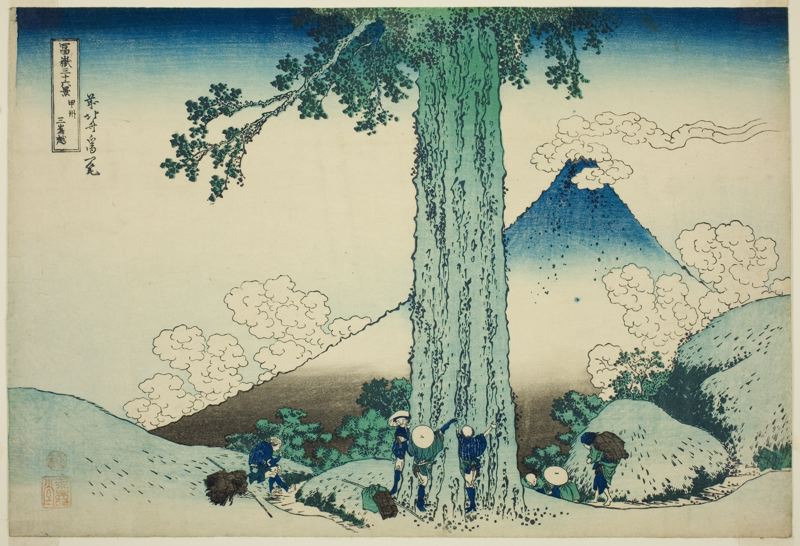
Mishima Pass in Kai Province (Koshu Mishimagoe), from the series Thirty-Six Views of Mount Fuji (Fugaku sanjurokkei)
ca. 1831
Woodblock print

Futakawa, from the series "Fifty-three Stations of the Tokaido (Tokaido gojusan tsugi)," also known as the Tokaido with Poem (Kyoka iri Tokaido)
c. 1837/42
Color woodblock print; chuban
Related Subjects
Frequently Asked Questions
Travel scenes document journeys along Japan's historic roads, sea routes, and pilgrimage paths, forming one of the woodblock print tradition's most commercially successful and artistically significant genres. The meisho-e (famous places) format, which presented sequential views of notable sites along a route, generated some of ukiyo-e's greatest masterworks and established templates that artists followed for generations.
Kawase Hasui, Jun'ichiro Sekino, and Utagawa Hiroshige are among the artists most associated with travel scenes in our collection. Browse the full list of artists who explored this subject above.
Hanga currently catalogues 502 prints tagged with travel scenes, spanning ukiyo-e, shin-hanga, and sōsaku-hanga traditions where applicable.