Taniguchi Kōkyō
谷口香嶠
1864–1915
Japan
Biography
Taniguchi Kōkyō (谷口香嶠, 1864-1915) was a Kyoto nihonga painter of the late Meiji and early Taishō periods, one of the most accomplished Maruyama-Shijō-trained kachō-e and figure painters of his generation, and a central figure in the Kyoto painting circles that produced Takeuchi Seihō, Kikuchi Hōbun, Yamamoto Shunkyo, and Tsuji Kakō. Born in 1864 with the childhood name Tsuji Tsuchinosuke (辻槌之助), he later took the family name Taniguchi by which he is known, and around 1883 he entered the Kyoto studio of Kōno Bairei (1844-1895), the dominant figure of late-nineteenth-century Kyoto painting, becoming one of the leading pupils later counted among the "Four Heavenly Kings" of the Bairei school. From Bairei he absorbed both the disciplined shasei (sketching from life) tradition descended from Maruyama Ōkyo and the late-Edo Shijō habit of placing closely observed birds, animals, and figures against generous, atmospheric negative space.
Kōkyō built his reputation primarily as a painter rather than a print designer, exhibiting at the major national painting competitions of the Meiji period — the domestic painting and industrial expositions (the Naikoku Kaiga Kyōshinkai) and, at the 1900 Paris Exposition Universelle, where his "Sudden Shower" (驟雨) was awarded a bronze medal — and later serving as a juror for the government Bunten exhibitions inaugurated in 1907. He earned particular recognition as a history-painting specialist, drawing on classical Japanese and Chinese literary and historical subjects, as well as for bird-and-flower compositions in the Shijō manner. He was active in the Kyoto art associations that defended the city's painting tradition through the long Meiji confrontation with Tokyo and with the emerging yōga (Western-style) movement, and he taught in Kyoto's principal art schools, becoming an instructor at the Kyoto Municipal School of Arts and Crafts (Kyōto-shiritsu Bijutsu Kōgei Gakkō) in 1894 and a professor at the Kyoto Municipal Painting Specialist School from 1909 — the institutions that supplied the next generation of Kyoto nihonga painters with their formal training.
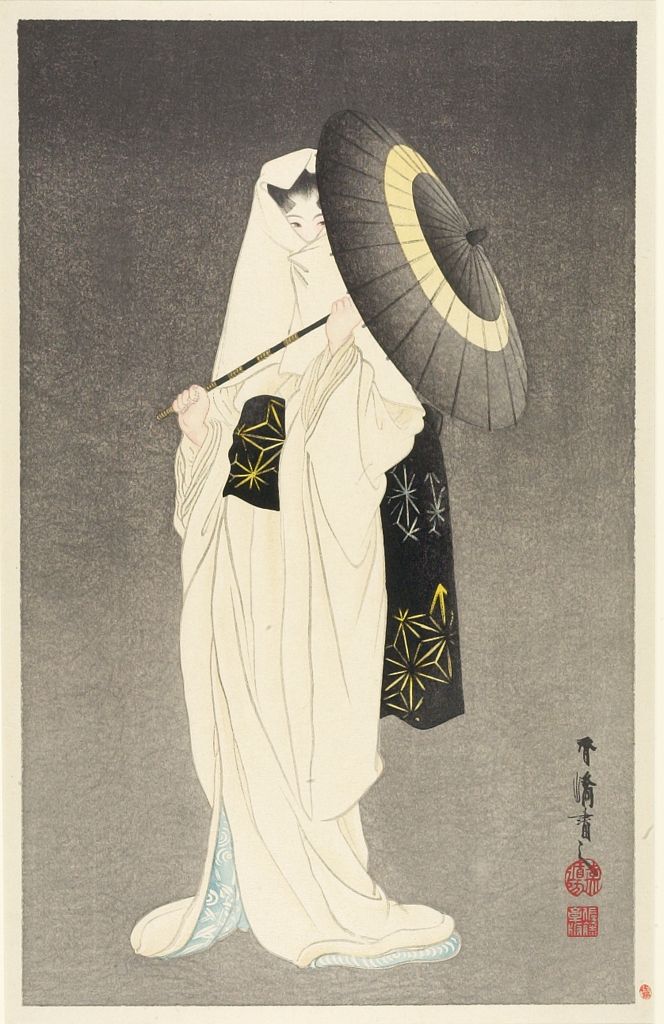
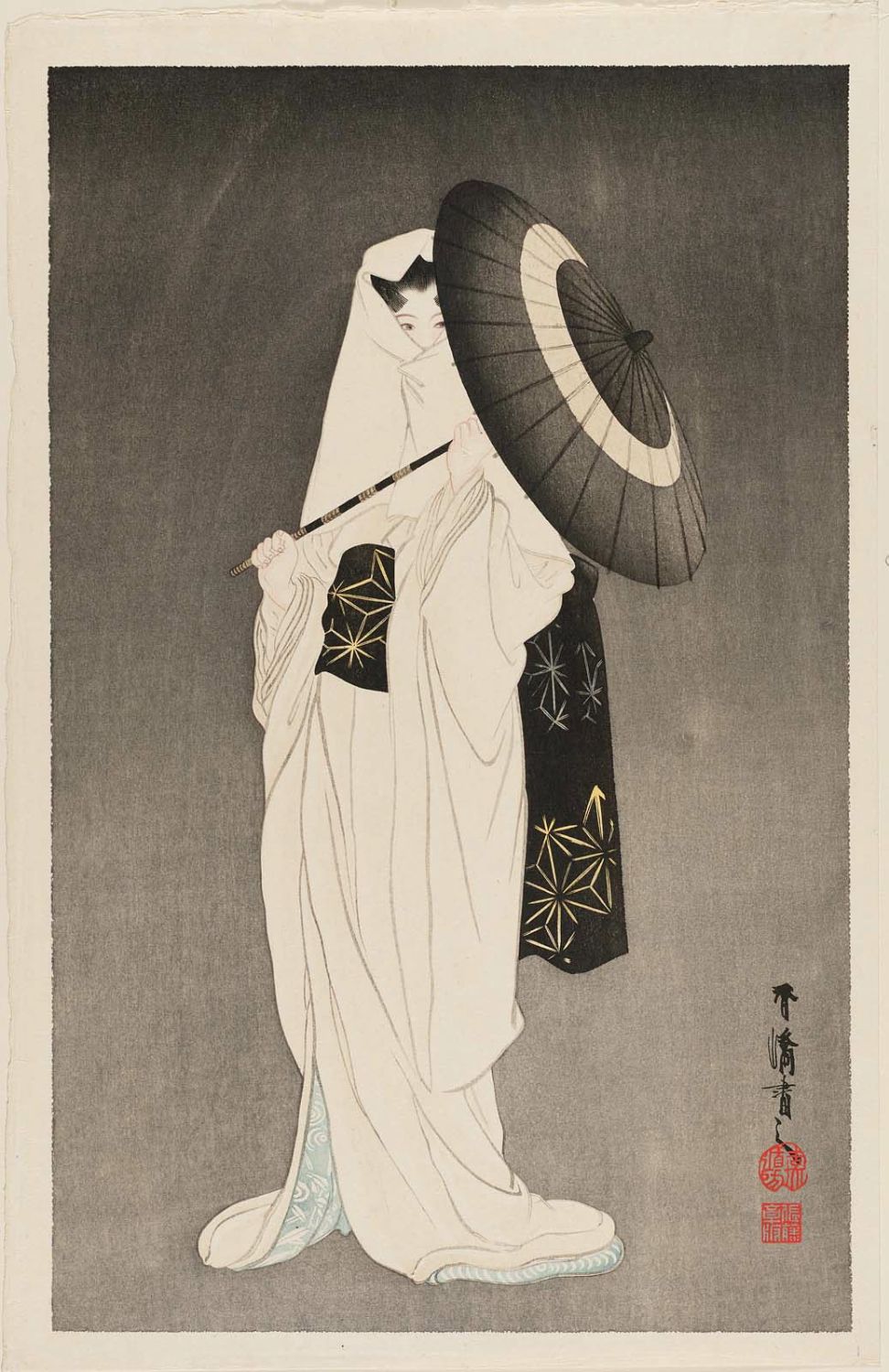
Kōkyō also contributed designs to the collaborative Kyoto woodblock picture books and painting albums of the late Meiji period, which gathered leading Bairei-school painters within single volumes. His best-known single print subject is Sagi musume (鷺娘, Heron Maiden), a figure drawn from the eighteenth-century kabuki dance of the same name in which a heron-spirit takes the form of a young woman, and which Kōkyō treated in several variant compositions. These Heron Maiden prints place the white-robed figure against an indeterminate ground with the gauffrage and subtle bokashi gradation that the high-end Kyoto block-printing trade had developed by the 1910s.
Alongside his print designs, Kōkyō produced a substantial body of hanging-scroll and screen paintings on silk and paper. Among the subjects documented in his surviving work are figure and narrative paintings on classical themes, bird-and-animal studies in the kachō tradition learned from Bairei, and history paintings such as his Yamauba (山姥, Mountain Witch). His teaching in Kyoto, alongside contemporaries such as Seihō and Hōbun, contributed to the environment in which the early twentieth-century revival of Japanese-style painting took shape.
Kōkyō died in 1915 at the age of fifty-one, before he could secure the institutional honors that his peer Takeuchi Seihō would later accumulate, but his work was collected in his lifetime and circulated through the early twentieth-century Japanese-print collecting market in Europe and the United States. His prints survive today in the Art Institute of Chicago and other institutional collections, and his paintings continue to appear in Kyoto-school exhibition catalogues, where he is recognized as one of the strongest representatives of the late-Meiji Kyoto Shijō line between Bairei's generation and the full-fledged twentieth-century Kyoto nihonga movement.
Key Facts
- Active Period
- 1864–1915
- Nationality
- 🇯🇵Japan
- Subjects
- Birds & FlowersChildren
- Works Indexed
- 3
Frequently Asked Questions
Taniguchi Kōkyō (谷口香嶠, 1864-1915) was a Kyoto nihonga painter of the late Meiji and early Taishō periods, one of the most accomplished Maruyama-Shijō-trained kachō-e and figure painters of his generation, and a central figure in the Kyoto painting circles that produced Takeuchi Seihō, Kikuchi Hōbun, Yamamoto Shunkyo, and Tsuji Kakō. Born in 1864 with the childhood name Tsuji Tsuchinosuke (辻槌之助), he later took the family name Taniguchi by which he is known, and around 1883 he entered the Kyoto studio of Kōno Bairei (1844-1895), the dominant figure of late-nineteenth-century Kyoto painting, becoming one of the leading pupils later counted among the "Four Heavenly Kings" of the Bairei school. From Bairei he absorbed both the disciplined shasei (sketching from life) tradition descended from Maruyama Ōkyo and the late-Edo Shijō habit of placing closely observed birds, animals, and figures against generous, atmospheric negative space.
Taniguchi Kōkyō was active from 1864 to 1915.
Taniguchi Kōkyō's prints frequently feature birds & flowers, children.
Original prints by Taniguchi Kōkyō can be found in collections including Harvard Art Museums (via ukiyo-e.org), Art Institute of Chicago, Museum of Fine Arts, Boston (via ukiyo-e.org).